
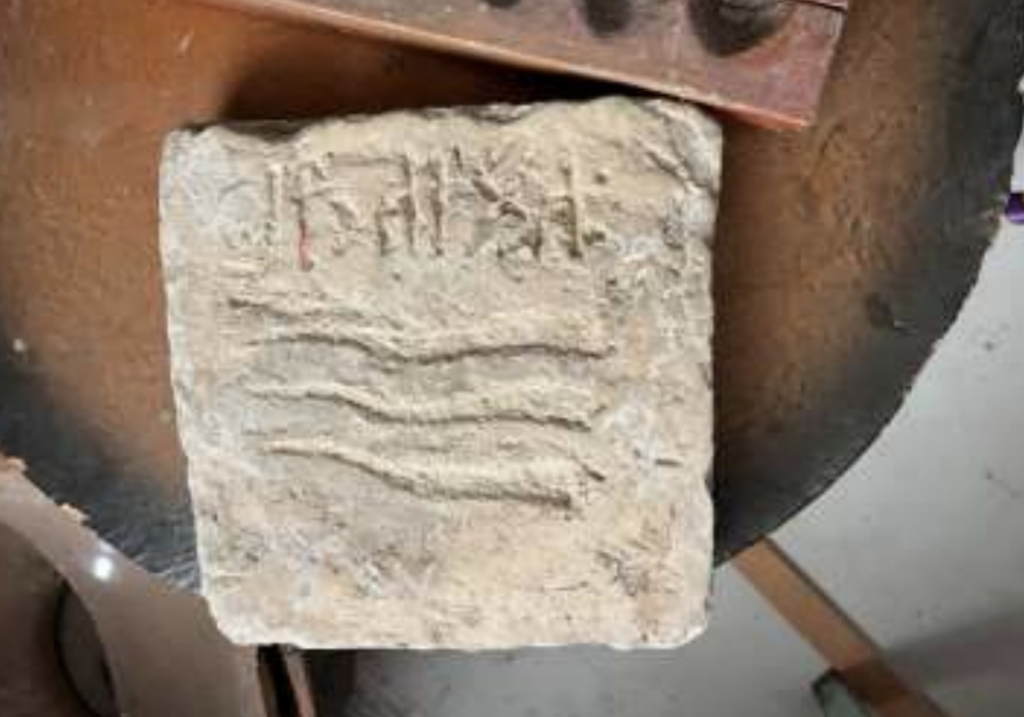
A remarkable archaeological discovery in southern Kazakhstan is reshaping what scholars know about the early history of the Oghuz Turks and the development of written Turkic languages. The Kültöbe Inscription, dated to the 9th–10th centuries, was unexpectedly found in a small village school museum near the city of Türkistan, offering rare and compelling evidence that the Oghuz Turks used a written script centuries earlier than previously believed.
A Chance Discovery with Major Historical Impact
The inscription was discovered in the village of Orañğay, near the ruins of an ancient Oghuz settlement known as Kültöbe. While visiting a modest museum inside a local middle school, Assoc. Prof. Dr. Hayrettin İhsan Erkoç of Çanakkale Onsekiz Mart University came across a limestone stone bearing a short line of text written in the Old Turkic (runiform) script. Until then, the artifact—unearthed during an illegal excavation in the 1990s—had never been the subject of a formal academic study.
After careful documentation and collaborative analysis with Turkic epigraphy experts, the inscription was formally introduced to the academic world in 2025. Despite its brevity, the Kültöbe Inscription has proven to be one of the most significant finds related to early Oghuz history in recent decades.
Dating the Inscription: Why the 9th–10th Centuries Matter
Archaeological and historical evidence strongly suggests that the inscription dates to the 9th or 10th century, a period when the Oghuz Turks were settling along the Syr Darya (Seyhun) River basin. Excavations in the region indicate that the Oghuz took control of these settlements during the 9th century and largely migrated westward by the early 11th century.
This timeframe is crucial. Until now, mainstream scholarship held that Oghuz Turkish only became a written language in the 13th century, following the spread of Arabic script during the Seljuk and post-Seljuk periods. The Kültöbe Inscription directly challenges this assumption by demonstrating that the Oghuz were already using the traditional Turkic script several centuries earlier.
What Does the Kültöbe Inscription Say?
The inscription consists of a single line, making interpretation difficult. Some characters appear in unusual variants, adding to the complexity of decipherment. However, one prominent reading proposal suggests the phrase “Kazar qan qul”, which may be translated as “servant of the Khazar Khagan.”
If this interpretation is confirmed, it could have far-reaching implications. It would support theories that the Oghuz Yabghu State had political or hierarchical ties to the Khazar Khaganate, one of the most powerful steppe empires of the early medieval period. While scholars caution that the reading remains open to debate, the possibility alone has reignited discussions about Oghuz–Khazar relations.
Beneath the text is a carved symbol believed to be either a tribal tamga (clan emblem) or a stylized representation of a river or watercourse, a motif commonly associated with Turkic nomadic culture. Similar symbols appear in other Turkic contexts from the 8th to 11th centuries, reinforcing the proposed dating.

The Kültöbe Inscription is carved on a small, carefully shaped limestone block of modest dimensions, roughly palm-sized, making it a portable object rather than a monumental stone. Credit: Erkoç & Kavaklı, 2025
Redefining Oghuz Literacy Before the Seljuks
Perhaps the most groundbreaking aspect of the Kültöbe Inscription is what it reveals about early Oghuz literacy. The find joins a growing body of inscriptions discovered around Türkistan that collectively demonstrate the use of Turkic writing in Oghuz territories long before the adoption of Arabic script.
This challenges long-standing linguistic narratives and suggests that the Oghuz possessed a more developed written culture during the pre-Islamic and early Islamic periods than previously assumed. In broader terms, it places the Oghuz more firmly within the literary traditions of the Turkic world, alongside groups such as the Göktürks and Uighurs.
A Window into Central Asia’s Hidden Past
Dr. Erkoç emphasizes that the Kültöbe Inscription is likely just one of many undiscovered artifacts still hidden across Kazakhstan’s vast landscapes. The fact that such a historically valuable object remained unnoticed for decades in a small village museum highlights the untapped potential of local collections and the urgent need for systematic archaeological research.
As further scientific analyses—such as material testing and controlled excavations at the Kültöbe site—are planned, scholars hope to refine the inscription’s dating and confirm its reading. Each step promises to deepen our understanding of Oghuz political structures, cultural identity, and linguistic history.
Why the Kültöbe Inscription Matters Today
Beyond academic circles, the discovery resonates strongly with those interested in Turkic heritage, Central Asian history, and the evolution of written languages. It underscores Kazakhstan’s role as a key crossroads of early Turkic civilization and reaffirms the importance of preserving and studying local historical artifacts.
In short, the Kültöbe Inscription is not merely a stone with ancient letters—it is a powerful testament to the intellectual and political sophistication of the early Oghuz Turks, rewriting a critical chapter of Turkic history.
Erkoç, H. İ., & Kavaklı, A. (2025). Kültöbe Yazıtı: Erken Oğuzlarda yazı kullanımına ilişkin yeni bir buluntu [The Kültöbe inscription: A new find regarding the usage of writing among the early Oghuz]. Yazıt Kültür Bilimleri Dergisi, 5(2), 236–266. https://doi.org/10.59902/yazit.1813749
Cover Image Credit: Yazıt Kültür Bilimleri Dergisi. Erkoç & Kavaklı, 2025
