
At first glance, it looked like little more than a compact lump of earth, corroded metal and mineralized textile. But inside a fifth-century grave at Oudenburg, Belgium, archaeologists found something far more revealing: a purse that may preserve the moment when Roman money stopped being enough.
The burial, known as Grave A-104, was discovered in the 1960s in one of the late Roman cemeteries linked to the coastal fort of Oudenburg. Now, a new reassessment of the assemblage suggests that the small objects once carried in the purse could help explain how people in northwestern Europe adapted after bronze coinage ceased arriving around A.D. 400.
The find is not a treasure in the usual sense. There are no glittering gold coins, no silver hoard, no ceremonial vessel placed for display. Instead, the purse held at least three, and possibly four, bronze coins, fragments of copper-alloy objects, flints, an iron fire striker and other small pieces of metal. To modern eyes, some of it might look like scrap. To someone living at the edge of the Roman world in the early fifth century, it may have been useful, portable value.
A Roman fort on a changing frontier
Oudenburg occupied a strategic sand ridge near the North Sea coast, in what is now West Flanders. In the Roman period, the area lay close to tidal channels, salt marshes and coastal routes, making it an important military position in the northwestern provinces.
The fort was first established in the late second century and later rebuilt in stone during the third century. Under Constantine, it was reactivated and renovated, becoming part of the broader defensive world associated with the Saxon Shore, the coastal military zone that guarded vulnerable routes along the Channel and North Sea.
By the late fourth and early fifth centuries, however, Rome’s control in the region had become unstable. Troops were withdrawn, usurpers rose and fell, and local military communities increasingly operated in semi-autonomous ways. Oudenburg did not simply vanish when imperial structures weakened. People remained, adapted and buried their dead with objects that speak of both Roman identity and a new post-Roman reality.
The man buried with a belt, brooch and purse
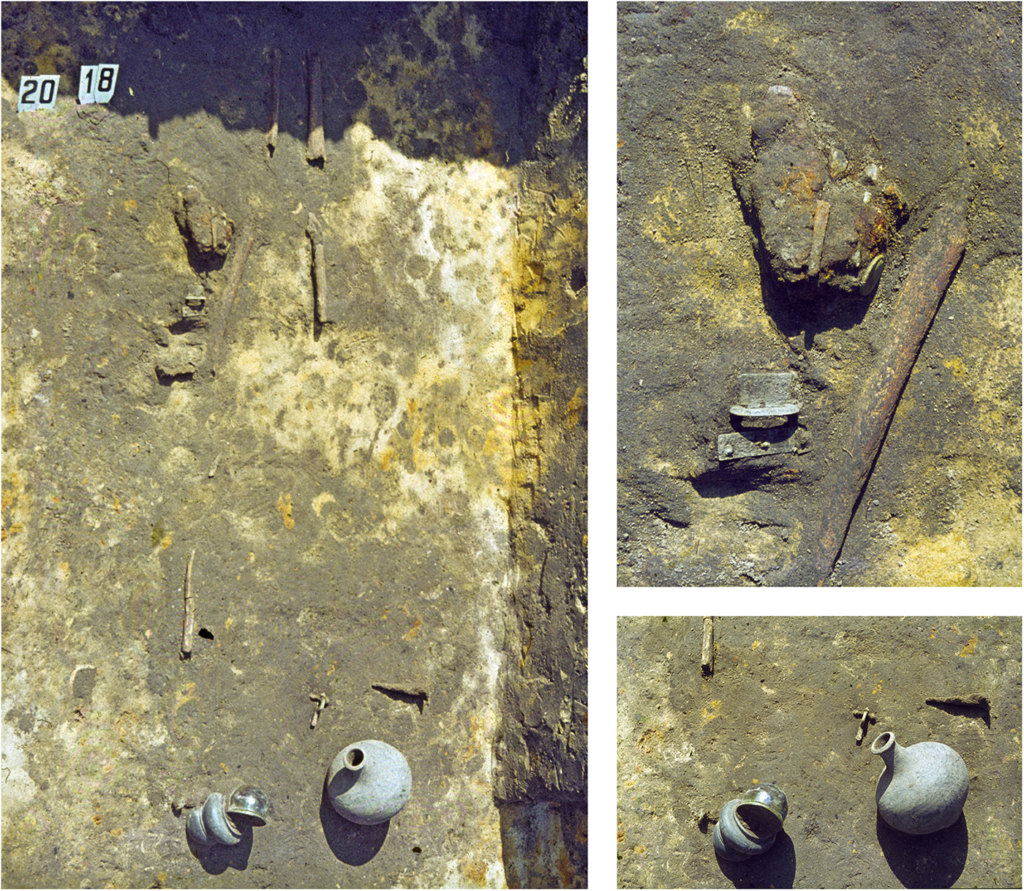
Grave A-104 belonged to an individual buried with items associated with male dress and late Roman military style. A crossbow brooch, an ornamented belt set, a knife, glass and ceramic vessels, and a purse accompanied the body. The belt and brooch are especially important because they place the burial in a world where military identity still mattered.
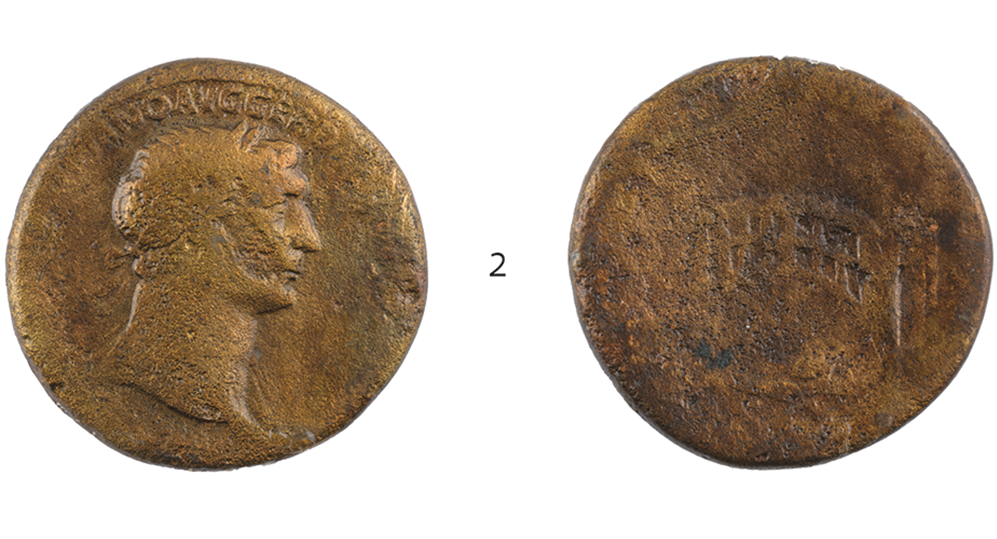
The grave is dated after A.D. 388, based on the latest coin in the purse, an AE4 bronze coin of Valentinian II minted at Arles between A.D. 388 and 402. Other grave goods suggest the burial most likely belongs between the late fourth century and around A.D. 430.
The purse itself appears to have been attached to the belt, rather than placed separately as a symbolic offering. That detail matters. It suggests the contents were not necessarily selected only for the funeral. They may represent things the man, or the people who prepared his body, already regarded as useful possessions.
Ancient coins in a late Roman purse
The coin group is one of the most intriguing elements of the discovery. Alongside the late fourth-century Valentinian coin were much older Roman coins: a Trajanic dupondius from around A.D. 98–117, a Trajanic sestertius from around A.D. 107–110, and a Hadrianic sestertius minted in A.D. 138.
That means coins more than 250 years old ended up in a purse used during the twilight of Roman administration in northern Gaul.
Older coins in late Roman graves are often dismissed as residual or intrusive. But the Oudenburg purse challenges that assumption. These were not random stray finds from disturbed soil. At least two of the early imperial coins were part of the purse assemblage, and the Hadrianic coin may also have belonged with it.
Why would someone carry old bronze coins centuries after they were minted? One possibility is memory and identity. Roman coins carried imperial portraits, and large bronze coins made those images highly visible. In a frontier society where Roman, local and Germanic cultural signals overlapped, such coins may have expressed loyalty, status or attachment to Roman authority.
But the new study gives another possibility even more weight: the coins may have mattered for their metal.
Hackbronze and the value of broken things
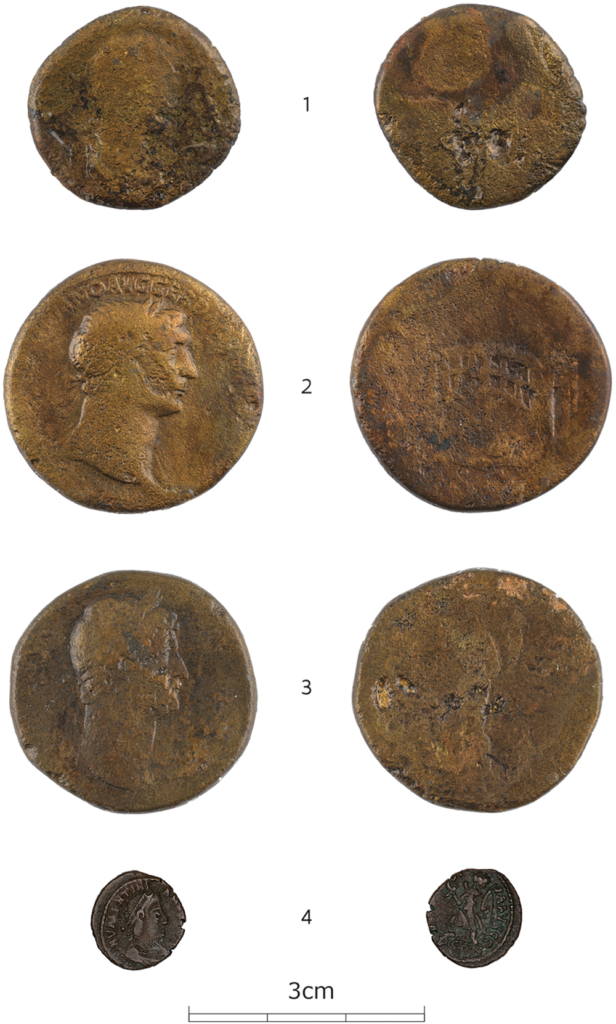
The purse also contained Hackbronze, a term used for intentionally fragmented base-metal objects. These were not decorative scraps waiting to be repaired. The fragments included parts of brooches, belt fittings and other copper-alloy objects that had lost their original function. Many were broken beyond practical restoration.
That makes their presence harder to explain as ordinary personal equipment. They may have been collected for their raw material, for remelting, or possibly for exchange by weight.
This is where the Oudenburg purse becomes especially important. Around A.D. 400, base metal coinage stopped reaching the northwestern Roman provinces in regular supply. Gold and silver remained part of the official monetary system, but they were too valuable for small everyday transactions. People still needed to buy, sell, compensate, exchange and negotiate daily value. If small bronze coins no longer circulated reliably, what replaced them?
The Oudenburg assemblage may offer one answer. Broken bronze, old coins and small metal fragments could have entered a flexible economy in which value depended less on official coin denominations and more on material weight.
The researchers weighed the coins and metal fragments and found a striking pattern. The coins alone came close to two Roman unciae, a known Roman weight unit. The total assemblage of coins and base-metal items came remarkably close to fourteen solidi in weight, or two unciae and two solidi. The authors are careful not to call this proof. One missing fragment and post-depositional changes mean caution is necessary. Still, the pattern is suggestive.
If intentional, it implies that the purse did not merely contain random debris. It may have held a carefully assembled weight of bronze value.
A pocket-sized economy after Rome
The Oudenburg purse sits at a historical crossroads. It belongs to a man buried with Roman military symbols, in a fort community shaped by imperial service, frontier life and cultural transformation. Yet the contents of his purse point toward the early medieval world, where coins, metal fragments and portable objects often appear together in burial contexts.
That transition is the real power of the discovery. The purse does not show a clean collapse, where Roman money disappeared overnight and barter instantly replaced it. Instead, it reveals adaptation. People reused old coins. They carried broken metal. They may have weighed value, remembered coinage, recycled objects and moved between monetary and material exchange depending on need.
In that sense, the Oudenburg purse is less a relic of poverty than a record of improvisation. It shows a society finding ways to keep exchange alive when the official supply of small money failed.
The man in Grave A-104 may never have thought of himself as living “after Rome.” He lived in a world where Roman objects still mattered, Roman military dress still carried meaning and Roman coins still bore the faces of emperors. But inside his purse, the old system had already changed.
A few battered coins and broken bronze fragments may now preserve one of archaeology’s hardest things to see: not the fall of an empire in a single dramatic event, but the quiet reinvention of everyday life.
Flückiger A, Van Thienen V, Vanhoutte S. A Fifth-century Purse Assemblage with Coins and Hackbronze from Oudenburg Reconsidered. Britannia. Published online 2026:1-19. doi:10.1017/S0068113X26100695
Cover Image Credit: Flückiger A, et al., 2026
