
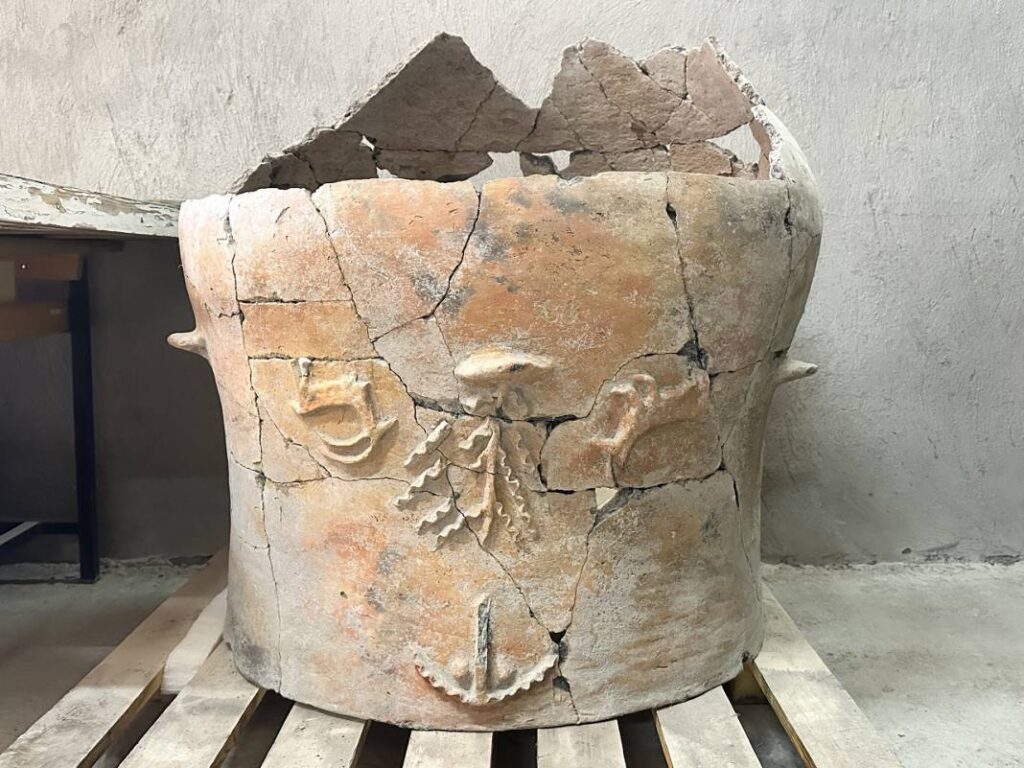
Archaeologists excavating Gökhöyük in central Türkiye have uncovered an extraordinary 5,000-year-old ceramic vessel decorated with a human face, two wild goats and what researchers interpret as a tree of life.
The monumental jar was found at the center of the prehistoric settlement near Seydişehir in Konya province. Although its final function remains uncertain, the vessel’s unusual imagery, enormous capacity and carefully arranged abandonment suggest that it may have played a role in ceremonies rather than ordinary household storage.
The discovery offers a rare glimpse into the symbolic world of communities living in Central Anatolia during the transition from the Early Bronze Age I to the Early Bronze Age II, around the beginning of the third millennium BCE.
A Human Face Above the Tree of Life
The upper section of the vessel was modeled to resemble a human face. Raised eyebrows, two eyes, and a prominent nose were formed around its wide opening.
Directly beneath the face is a stylized tree. On either side, wild goats appear to climb toward its branches, creating a carefully organized symbolic scene rather than a simple decorative pattern.
Excavation director Associate Professor Ramazan Gündüz of Selçuk University believes the composition may have represented fertility, abundance, and the continuation of life. In his interpretation, the human-like figure positioned above the tree and animals may have been imagined as a protective or creative power overseeing the natural cycle.
Such interpretations remain provisional. However, the deliberate arrangement of the figures indicates that the vessel carried meanings beyond its practical form.
A Vessel Capable of Holding Nearly a Ton
The jar measures approximately 1.2 meters in height, while its mouth is nearly one meter wide. Researchers estimate that it could have held between 800 and 1,000 kilograms of grain, liquid or another material.
Five handles placed around the body indicate that the vessel may occasionally have been moved, despite its exceptional size. Its elaborate relief decoration also distinguishes it from the more utilitarian storage jars commonly associated with prehistoric households.
Gündüz said the team considers ceremonial use more likely than routine food storage. The vessel may have contained provisions used during communal gatherings, seasonal rituals or offerings, although no definitive evidence has yet established the nature of those ceremonies.
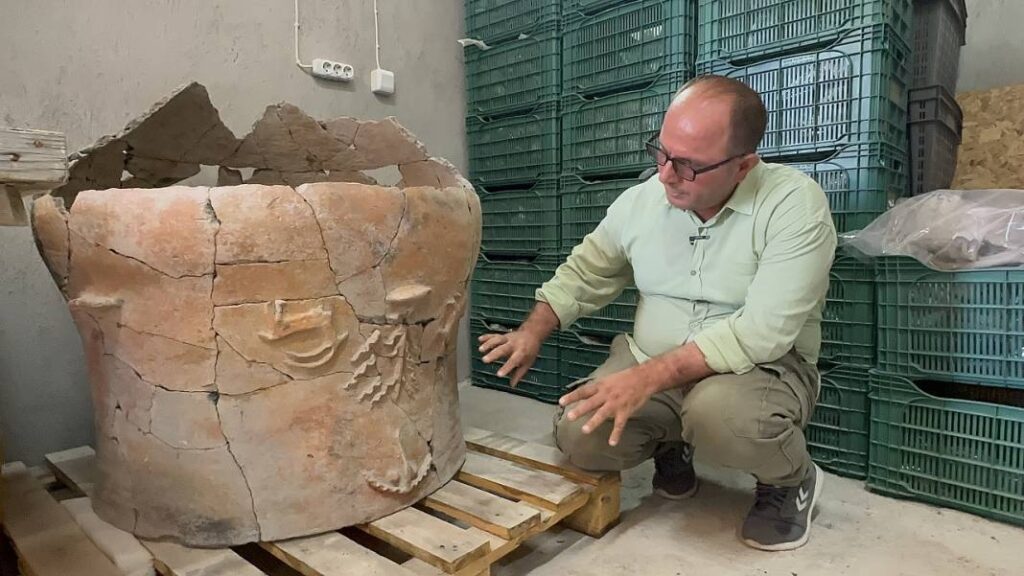
The Jar Was Deliberately Turned Upside Down
The team first encountered part of the vessel in 2024. A wider section of the excavation area, known as Trench F8, was opened in 2025, revealing more of the jar and its archaeological context.
One of the most intriguing details was its position. Large storage vessels are normally found with their openings facing upward, reflecting how they were used inside houses, storerooms or workshops. At Gökhöyük, however, the jar had been carefully turned upside down.
Archaeologists believe this was intentional rather than the result of a building collapse. The inverted position may indicate that the vessel was ritually decommissioned or that the surrounding structure was deliberately abandoned.
Whether that structure was an ordinary residential building or a space reserved for ceremonies cannot yet be determined. Excavations around the vessel are continuing, and the architectural plan has not been fully exposed.
Gökhöyük Preserves Thousands of Years of Settlement
Gökhöyük, also known as Kanal Höyük, lies about eight kilometers from the modern town of Seydişehir. The mound was first recorded by British archaeologist James Mellaart during surveys of the Konya region in the 1950s.
Its archaeological importance became clearer in 2002, when ancient remains were encountered during work on an irrigation canal. Construction was halted, and the Konya Museum Directorate conducted rescue excavations between 2002 and 2005.
Research resumed in 2020 under Gündüz’s direction. The project is supported by Türkiye’s Ministry of Culture and Tourism through its Heritage for the Future initiative, together with Konya Metropolitan Municipality and Seydişehir Municipality.
The settlement contains cultural layers belonging to the Neolithic, Chalcolithic, Bronze and Iron ages, making it one of the most valuable stratified prehistoric sites in the southern Konya Plain. Archaeologists have uncovered mudbrick buildings, hearths, grinding stones, storage vessels, botanical remains and evidence of destructive fires.
Because these layers survive one above another, Gökhöyük allows researchers to examine how farming, food production, domestic architecture and belief systems changed over thousands of years. Previous excavations have even revealed a human skeleton trapped beneath collapsed mudbrick walls in a Bronze Age destruction layer.
The newly documented jar adds another dimension to that record. Rather than showing only what Gökhöyük’s inhabitants ate or stored, its human face, climbing goats and tree-like motif may reveal how they understood fertility, protection and the renewal of life nearly five millennia ago.
