
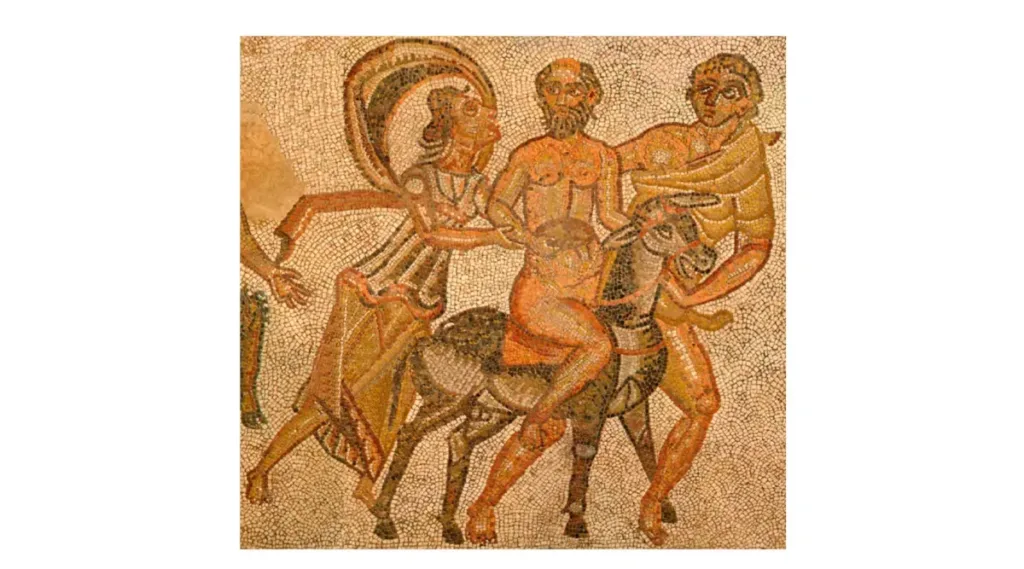
A room at the Roman villa of Fuente Álamo, long interpreted as a sanctuary of Mithras, has been reidentified as a private library—and may be the westernmost known library in the Roman Empire.
At first glance, Room 10 at the Roman villa of Fuente Álamo appears almost empty. Its books have vanished. Any wooden shelves that once lined its walls disappeared centuries ago. Yet the architecture still preserves traces of what may have been one of the most intellectually charged spaces in Roman Spain.
Researchers from the University of Granada now argue that the room was not a mithraeum, or sanctuary dedicated to the god Mithras, as previously proposed. Instead, its unusual arrangement of niches, adjoining chambers and a raised platform indicates that it functioned as a private library.
The identification would make the Fuente Álamo library the oldest documented example in the Iberian Peninsula, the westernmost known library in the Roman Empire and one of the best-preserved private libraries from the Roman world. The findings were published in the Journal of Mediterranean Archaeology.
An empty room filled with clues
Ancient libraries are notoriously difficult to recognize archaeologically. Books were normally written on organic materials such as papyrus or parchment, while shelves, cupboards and other furnishings were commonly made from wood.
Unless exceptional environmental conditions preserve these materials, both the books and the furniture disappear. Archaeologists are often left with little more than walls, floors and architectural features whose original purpose may be open to several interpretations.
To solve this problem at Fuente Álamo, Antonio López García, Javier Martínez-Jiménez and Eduardo Cerrato Casado examined the room using a method known as “shape grammar.”
Rather than focusing on a single feature, the method studies how architectural elements are arranged and how they work together. The researchers compared the plan of Room 10 with the recurring design language of other libraries from the Roman world.
The match was striking.
The room contains an apse, rectangular wall niches that may once have held shelving, smaller semicircular niches, a podium and adjoining rooms that could have been used for storage or intellectual work. Taken individually, none of these features proves that the room was a library. Together, however, they form an architectural pattern closely associated with Roman spaces devoted to reading, study and the display of written culture.
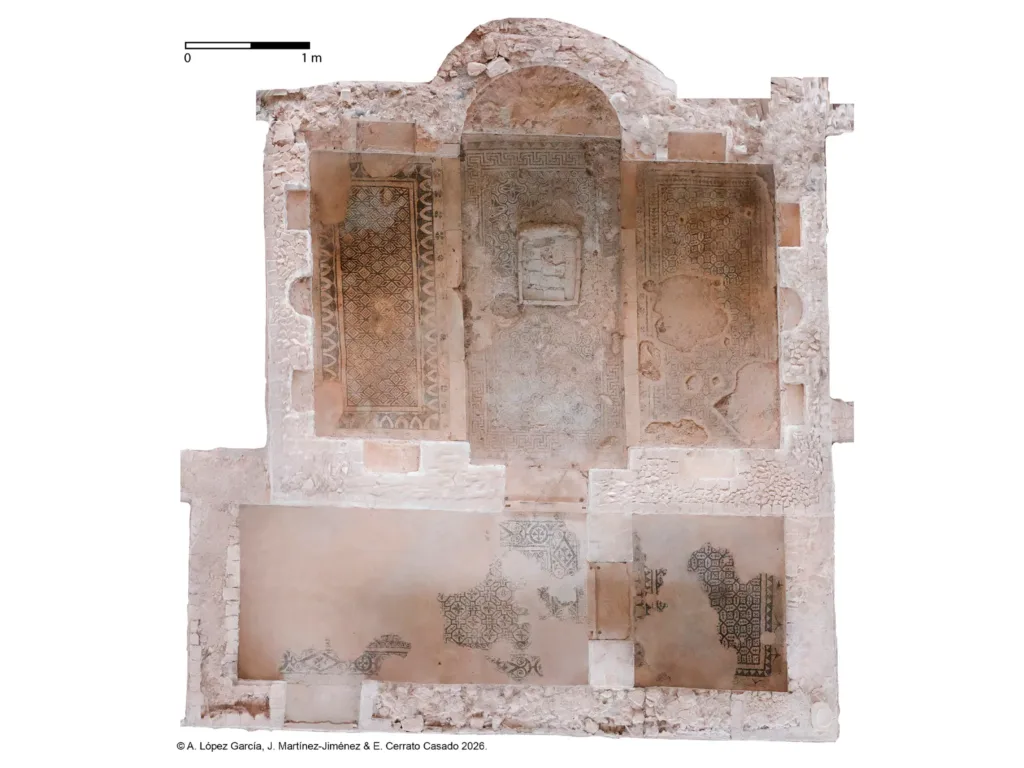
From a Mithras sanctuary to a house of books
Room 10 had previously been interpreted as a possible Mithras sanctuary. Sanctuaries dedicated to Mithras were usually enclosed spaces associated with a mystery cult that became popular across parts of the Roman Empire, particularly among soldiers, officials and merchants.
The new study argues that the room’s full architectural composition does not fit that interpretation as closely as it fits the known structure of a Roman library.
This reassessment changes more than the name assigned to a single room. It alters how archaeologists understand the people who lived at Fuente Álamo.
A private library required wealth, space and access to books, which were expensive to produce and copy. It was also a social statement. For members of the Roman elite, displaying literary knowledge could be as important as displaying mosaics, sculpture or fine tableware.
The library may therefore reflect a household that wanted to present itself not only as prosperous but also as educated and culturally connected.
A Roman villa in southern Spain
Fuente Álamo lies near Puente Genil in the province of Córdoba, within the territory of the Roman province of Baetica. The site is known for its extensive mosaic floors, which cover hundreds of square metres and include elaborate figurative and geometric compositions.
The settlement changed considerably during its long history. What began as a Roman-period complex was later transformed into an increasingly elaborate rural residence. During Late Antiquity, such villas were more than agricultural estates. They could serve as centres of production, administration and elite social life.
The newly identified library adds another dimension to that picture. It suggests that written culture extended well beyond major cities and public institutions, reaching wealthy rural residences on the western edge of the empire.
According to the University of Granada, Fuente Álamo may preserve the most complete architectural remains of a Roman private library apart from the famous Villa of the Papyri at Herculaneum. At Herculaneum, hundreds of carbonized scrolls survived the eruption of Mount Vesuvius, but the original physical structure that housed the collection is less clearly preserved.
Was the library owner buried nearby?
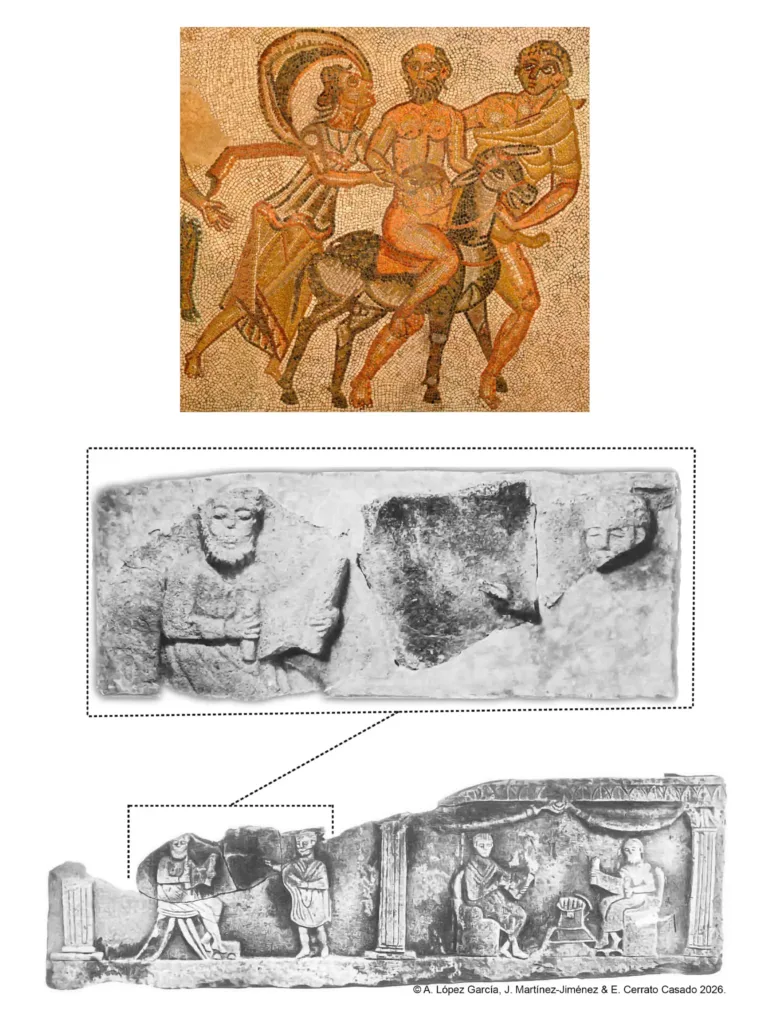
The study also proposes a possible connection between the Fuente Álamo library and a Roman sarcophagus discovered during the 19th century at the nearby site of Villares del Carril.
Known as the Declamatio Sarcophagus, the object is now held by the Museum of Málaga. Its relief decoration includes scenes associated with reading and education.
One figure is shown as a bearded man holding both a scroll and a codex—the bound-book format that gradually became more common during the later Roman period. Researchers noted similarities between this figure and a man represented in a mosaic from Fuente Álamo who has previously been interpreted as the owner of the villa.
The chronology and imagery of the sarcophagus also correspond with the later phase of Fuente Álamo.
The connection remains hypothetical. There is currently no definitive evidence that the sarcophagus belonged to the owner of the villa or its library. Still, the possibility offers a glimpse of how wealthy landowners in Late Antique Baetica may have used literacy, education and philosophical identity to shape how they were seen in both life and death.
Rethinking lost libraries
The importance of the study extends beyond Fuente Álamo. Many ancient rooms have been classified according to a single architectural feature or compared with only a small number of parallels.
By examining combinations of features, shape grammar may provide archaeologists with a more consistent way to identify libraries and other specialized spaces whose contents have disappeared.
The books of Fuente Álamo may never be recovered. Their subjects, authors and languages remain unknown. But the room designed to hold them has survived, preserving evidence that one of Roman Spain’s rural elites built a place specifically for reading, knowledge and the public performance of learning.
For centuries, its empty niches concealed that purpose in plain sight.
López García, A., Martínez Jiménez, J., & Cerrato Casado, E. (2026). New Approaches to Identifying Roman Libraries: Two Late Antique Examples from Stobi (North Macedonia) and Fuente Álamo (Spain). Journal of Mediterranean Archaeology, 39(1). DOI: 10.1558/jma.35930.
