
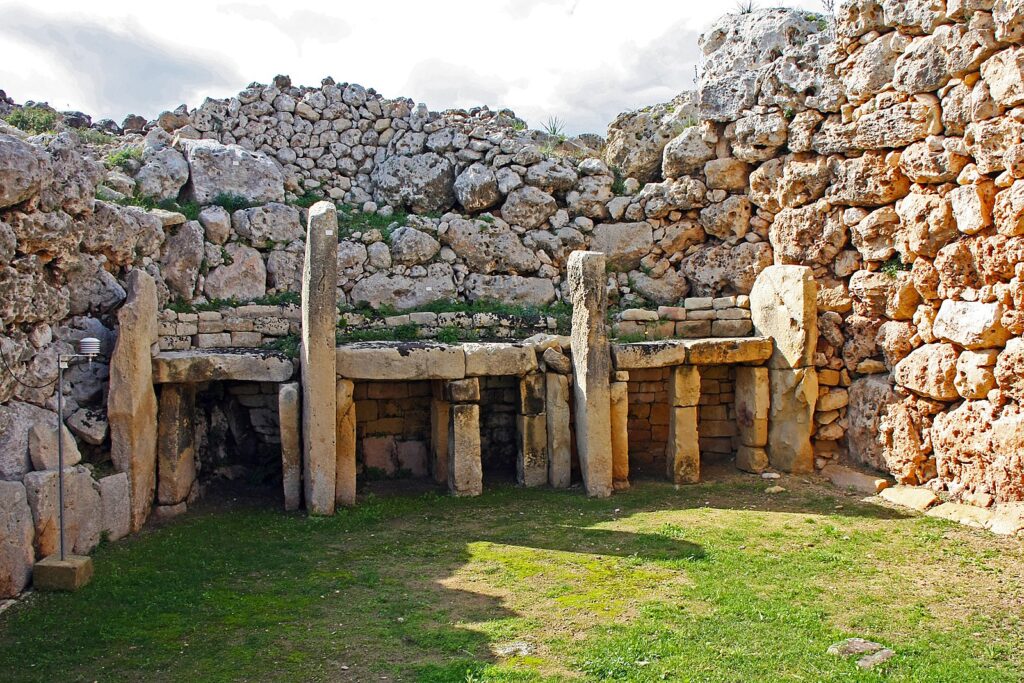
A new open-access study published in Archaeological and Anthropological Sciences has reignited the debate surrounding the purpose and cosmic alignment of Malta’s prehistoric temples.
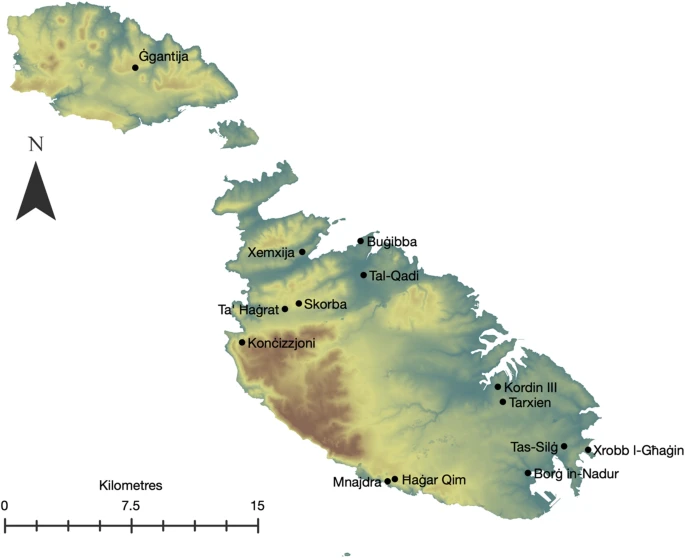
Constructed between 3800 and 2400 BCE, Malta’s prehistoric temples—including famed sites such as Ġgantija, Ħaġar Qim, Mnajdra, and Tarxien—are UNESCO World Heritage Sites celebrated for their advanced architectural design, megalithic engineering, and elaborate carvings. Built over a millennium before Stonehenge or the Great Pyramids, these temples reflect a highly organized society with strong spiritual and possibly astronomical traditions.
The temples were constructed using massive limestone blocks, some weighing several tons, and were often laid out in cloverleaf-like trilithon or apsidal plans. Many are aligned with solar events, such as solstices and equinoxes, suggesting that their builders had a deep understanding of celestial cycles. Yet, despite decades of study, the full extent of their astronomical precision—and whether such alignments were symbolic, functional, or both—has remained an open question.
These megalithic structures, among the oldest free-standing buildings in the world, have long puzzled archaeologists. Now, researchers have taken a data-driven, interdisciplinary approach to uncover whether the orientations of these temples were guided more by earthbound considerations or by the stars themselves.
Largest Dataset of Temple Orientations Ever Assembled
In a landmark effort, researchers Fabio Silva and Tore Lomsdalen compiled and analyzed orientation data from 32 individual temple structures spread across the Maltese archipelago. This represents the largest sample size of its kind, significantly expanding on previous studies that had relied on smaller and more fragmented datasets. By creating a robust statistical framework, the team was able to test multiple hypotheses simultaneously, offering the most comprehensive look yet at how the builders may have chosen where and how to orient these sacred spaces.
The data were processed using a unified probabilistic model that integrated both terrestrial and celestial variables—an approach rarely seen in archaeoastronomical studies. This model allowed the authors to evaluate competing explanations on equal footing, measuring the likelihood that temple orientations were influenced by factors such as land slope, prevailing wind directions, exposure to winter sunlight, or celestial alignments with the rising and setting of specific stars.
Earth-Based Explanations: Not the Whole Story
Initial findings showed that a substantial number of temples did align with practical earthly factors. For instance, some orientations appear to correlate with topographical gradients, possibly to prevent flooding or to optimize construction on sloped terrain. Others may have faced certain directions to shield the interiors from strong Mediterranean winds or to allow more winter sunlight into the structure—an especially important consideration in Neolithic societies with no artificial lighting.
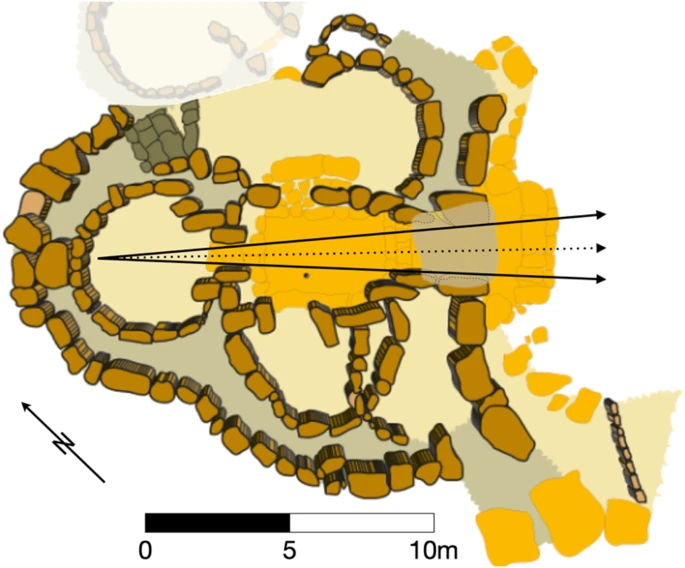
However, when all environmental and geographic factors were accounted for, two major orientation clusters—centered around azimuths of approximately 130° and 200°—remained statistically significant and unexplained by non-astronomical variables. These persistent patterns hinted at a different kind of logic guiding the temple builders—one that pointed toward the night sky.
Celestial Alignments with Southern Stars
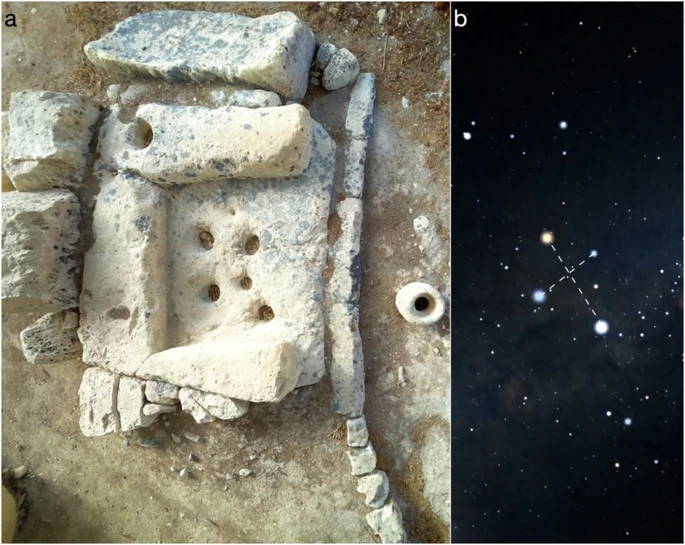
To explore the astronomical hypothesis, the researchers simulated the night sky as it would have appeared to temple builders between 3400 and 2400 BCE, factoring in the effects of axial precession. Remarkably, the unexplained orientation peaks matched the rising and setting azimuths of bright southern stars, including Hadar (Beta Centauri), Gacrux (Gamma Crucis), and Avior (Epsilon Carinae).
These stars, while no longer visible from Malta due to changes in Earth’s axial tilt, would have been prominent in the Neolithic southern sky. Importantly, these were not just any stars—they were bright enough to be used in open-sea navigation, forming key components of what later became the “southern star paths” in Mediterranean maritime tradition.
Temples as Training Grounds for Seafaring Societies?
The researchers propose a bold and novel interpretation: some of Malta’s earliest temples may have served a dual function as both sacred spaces and astronavigation training centers. According to this theory, the carefully aligned temple doorways and internal corridors may have acted as observational windows, directing the viewer’s gaze to the horizon point where specific stars would rise or set.
This aligns with broader anthropological theories that suggest early temple structures often played educational roles in addition to religious ones. In this case, young seafarers or apprentices might have been brought to these structures at night to learn how to identify, track, and follow stellar pathways, potentially as preparation for long-distance sea voyages. Some temples even appear to simulate a horizon through artificial elevation or sunken flooring, possibly creating the illusion of a seascape under the stars.
A Breakthrough in Archaeoastronomical Methodology
Beyond its compelling conclusions, the study represents a methodological breakthrough. By merging landscape archaeology with skyscape archaeology into a single statistical model, Silva and Lomsdalen have set a new standard for how such interdisciplinary studies should be conducted. This model reduces the risk of confirmation bias, a persistent problem in archaeoastronomy where researchers sometimes “see what they want to see” in sky alignments.
The authors’ approach ensures that claims of astronomical significance are rigorously tested against other plausible explanations. In doing so, it strengthens the case for the intentionality of the celestial alignments and opens up exciting new avenues for research—not just in Malta, but across other megalithic landscapes in the Mediterranean and beyond.
Reframing Malta’s Megaliths: Sacred Structures with Practical Purposes
This new perspective challenges the long-standing assumption that Malta’s prehistoric temples were solely ritualistic or symbolic in purpose. Instead, they may have embodied a sophisticated integration of cosmology, navigation, and pedagogy—tools not just for worship, but for survival in a maritime world.
As the paper’s title suggests, “non est ad astra mollis e terris via” – there is no easy way from Earth to the stars. Yet, for Malta’s temple builders, it seems that reaching toward the heavens was not just a metaphorical aspiration, but a literal one—etched in stone and oriented by starlight.
Silva, F. & Lomsdalen, T. (2025). “No easy way from the earth to the stars”: a new statistical approach to the orientation of the Maltese temples. Archaeological and Anthropological Sciences, 17:96. https://doi.org/10.1007/s12520-025-02208-4
Cover Image Credit: Ggantija Temples, Xaghra, Gozo. Wikipedia Commons
