
11 February 2026 The Future is the Product of the Past

6,000-Year-Old Temple with Blood Channel and Altar Unearthed in Eastern Türkiye

Archaeologists have discovered a 6,000-year-old temple site during ongoing excavations in the village of Tadım, located in Elazığ Province, eastern Türkiye. The site, dating back to the Late Chalcolithic and Early Bronze Age, reveals one of the earliest known examples of ritual architecture in the Upper Euphrates Basin.

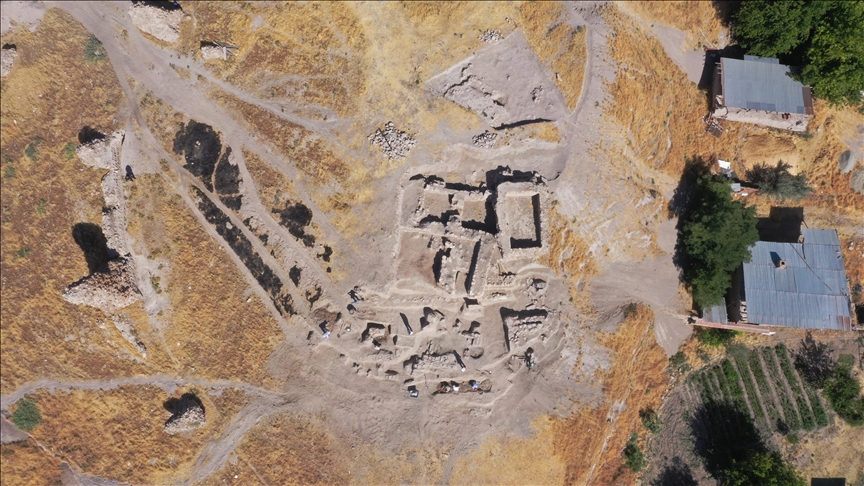
The excavation project, conducted under the coordination of the Ministry of Culture and Tourism and led by the Elazığ Museum Directorate, focuses on the Tadım Fortress and Mound (Tadım Höyüğü), a prominent archaeological mound standing approximately 35 meters tall and covering an area of 210 by 160 meters. This site is believed to have been a significant religious and settlement center for ancient communities.

Ritual Structures and Sacrificial Evidence

In the 80–81 numbered grid sections of the mound, researchers unearthed a temple complex featuring a ritual “blood channel” containing human and animal remains, along with an altar stone bearing knife marks. These findings suggest that sacrificial rituals—possibly involving both animals and humans—were performed as offerings to deities, reflecting the spiritual beliefs of the period.

The team also uncovered four podiums, likely used for placing votive offerings, a sacred hearth, and various ceremonial and domestic items. Among the artifacts were:
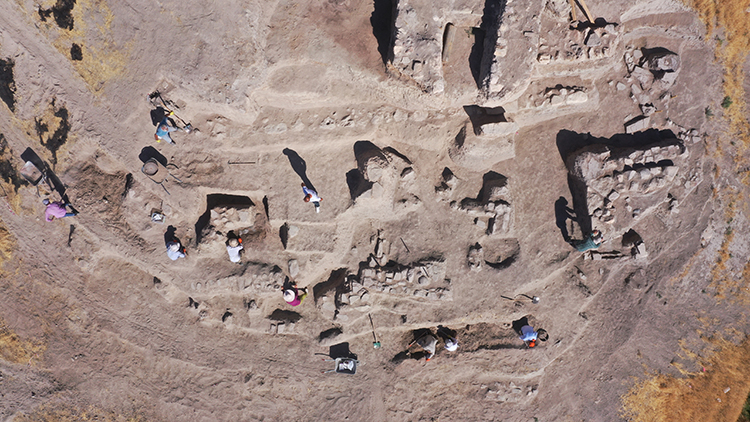
6,000-Year-Old Temple with Blood Channel and Altar Unearthed in Elazığ. Credit: İsmail Şen / Anadolu Agency (AA)

Nakhchivan-style pottery,


📣 Our WhatsApp channel is now LIVE! Stay up-to-date with the latest news and updates, just click here to follow us on WhatsApp and never miss a thing!!


Seal stamps used in agricultural transactions,

Arrowheads and tools from daily life,

Spindle whorls for textile production, and

Idol figurines made of stone, clay, and bone—representing early forms of symbolic or religious expression.

Insights Into Early Urbanization

Excavation supervisor Ergün Demir noted that the architectural remains consist of rubble foundations with mudbrick walls, a construction method that provided resistance to natural disasters and invasions. The layout suggests a pattern of closely spaced structures, indicating early forms of urban planning and communal living.

“This period marks the beginning of more organized settlements in the region,” Demir said. “The evidence from Tadım shows not only religious practices but also early signs of social complexity and economic activity.”
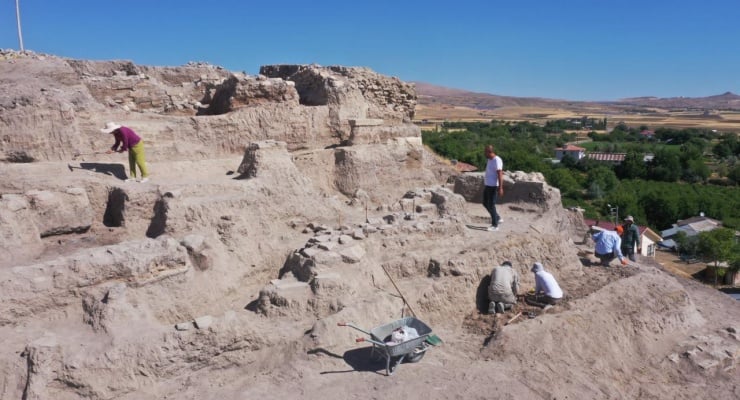
Artifacts uncovered include offering podiums, a sacred hearth, stamp seals, Nakhchivan-style pottery, arrowheads, spindle whorls, and wall remnants. Credit: İsmail Şen / Anadolu Agency (AA)

A Key Site in Anatolian Archaeology

Tadım Höyüğü is now recognized as one of the most promising archaeological sites in eastern Türkiye. The region, located near the Euphrates River, has long been considered a cultural crossroads, linking Mesopotamia to Anatolia. The ongoing excavations are expected to shed further light on trade, agriculture, and belief systems of prehistoric societies.

Ahmet Demirdağ, Elazığ’s Provincial Director of Culture and Tourism, emphasized the significance of the discovery: “This is the first known temple site in the region. The findings give us a rare glimpse into life here 6,000 years ago—how people lived, worked, and worshiped. As we continue to dig, we believe we’ll uncover even older layers of history beneath.”

Excavations are also being carried out at other key locations in Elazığ, including Harput Castle, Palu Fortress, and Salkaya Village, as part of a broader effort to uncover and preserve the region’s rich cultural heritage.

Cover Image Credit: İsmail Şen / Anadolu Agency (AA)

Related Articles

Urartian King Argishti’s shield reveals the name of an unknown country

30 January 2023

30 January 2023

The inscription on a bronze shield purchased by the Rezan Has Museum revealed the name of an unknown country. It...

‘Holy Grail of shipwrecks’ worth $20 billion in treasure to be raised from seabed

10 November 2023

10 November 2023

A treasure ship described as the “holy grail of shipwrecks” will reportedly be lifted from the sea floor where it...

The Surprising Fact About The Roman-Era Female Bust

24 March 2021

24 March 2021

50 years ago, foundation excavation work was started for the construction of Girls’ Institute in Akpınar Neighborhood of Bolu city...

Not Just Warriors: Vikings Were Style Icons Too, New Discovery Shows

29 August 2025

29 August 2025

When most people think of Vikings, they imagine fierce warriors charging into battle with axes and shields. But a tiny...

8000-year-old with balcony architectural structure belonging to the Prehistoric period found in Anatolia

31 October 2021

31 October 2021

During the excavations in Domuztepe mound, it was revealed that an architectural structure thought to be 7-8 thousand years old...

Europe’s Oldest Plough Marks Discovered in Switzerland and Testifying the Use of Animals in Agriculture 7000 Years Ago

8 March 2024

8 March 2024

Excavations at the Anciens Arsenaux site in Sion, Switzerland, researchers revealed evidence that Neolithic farmers used animal traction to pull...

An Egyptian Tomb Decorated with Magic Snake Spells Discovered

9 November 2023

9 November 2023

During excavations at Abusir, between Giza and Saqqara, archaeologists at the Czech Institute of Egyptology (CIE) found an ancient tomb...

Archaeologists in Derbyshire have unearthed a 9th century Anglo Saxon house

15 July 2021

15 July 2021

A nearly complete Anglo-Saxon house, considered to date from the early ninth century and might have been the abode of...

A 1,000-Year-Old Bronze Wheel Cross Discovered in Brandenburg

24 January 2026

24 January 2026

A small bronze cross, recently unearthed in western Brandenburg, is reshaping how archaeologists understand the spread of Christianity in early...

A Roman statue of the sea god Triton discovered near A2, London Road

13 September 2023

13 September 2023

Archaeologists have uncovered a Roman Statue of Triton during excavations in preparation for a housing development in Kent, England. Archaeologists...

Archaeologists find an Anglo-Saxon church at Stoke Mandeville excavation site

13 September 2021

13 September 2021

Archaeologists working on the HS2 project found the remains of an Anglo-Saxon church during their excavations at the former St...

Monumental Roman complex discovered in France

19 March 2023

19 March 2023

In the city of Reims in northeastern France, archaeologists have discovered an ancient Roman-era monumental complex dating from the 2nd...

Maya Archaeological site for sale on Facebook has stirred controversy in Yucatán and across Mexico

31 March 2023

31 March 2023

Over 249 hectares of land for sale on Facebook Marketplace has sparked controversy in Yucatan and across Mexico. The property,...

New Discovery Challenges Origins of Iconic Sutton Hoo Helmet: It Could Radically Alter Our Understanding of 7th Century Northern European Power Dynamics

28 March 2025

28 March 2025

A recent find on the Danish island of Tåsinge has sparked a significant reevaluation of the origins of the renowned...

Burial site for Enigmatic Anglo-Saxon King Cerdic found, author claims

3 May 2024

3 May 2024

The possible final resting place of Cerdic, the enigmatic founder of the Kingdom of Wessex and a key figure in...