

12 November 2025 The Future is the Product of the Past

Researchers Unearthed the First Known Neanderthal Footprints in Portugal

New tracksites reveal how Neanderthals navigated Portugal’s ancient dunes 80,000 years ago

In a groundbreaking discovery, researchers have unearthed the first known Neanderthal footprints in Portugal, providing unprecedented insight into how these early humans used coastal landscapes for survival and mobility nearly 80,000 years ago.

Published in Scientific Reports, the study describes two newly discovered hominin tracksites at Monte Clérigo and Praia do Telheiro, located along Portugal’s southwestern coast. These ancient footprints, preserved in cemented sand dunes known as eolianites, are attributed to Neanderthals and date back to approximately 78,000–82,000 years ago during the Pleistocene epoch.

Tracing the Footsteps of Prehistoric Life

The Monte Clérigo site revealed at least 26 well-preserved footprints arranged in several trackways. Researchers identified impressions left by both adult and child Neanderthals as they moved across steep dune slopes. At Praia do Telheiro, a single isolated footprint—likely from a female adolescent or adult—further confirms Neanderthal presence in the region.

“These sites provide rare, direct evidence of Neanderthal behavior outside of caves and show their ability to navigate complex dune environments,” said lead author Carlos Neto de Carvalho.


📣 Our WhatsApp channel is now LIVE! Stay up-to-date with the latest news and updates, just click here to follow us on WhatsApp and never miss a thing!!


The orientation, depth, and stride length of the footprints suggest deliberate movement across challenging terrain, possibly for hunting or gathering. The evidence points to strategic route planning and may even hint at group movement involving both adults and children.
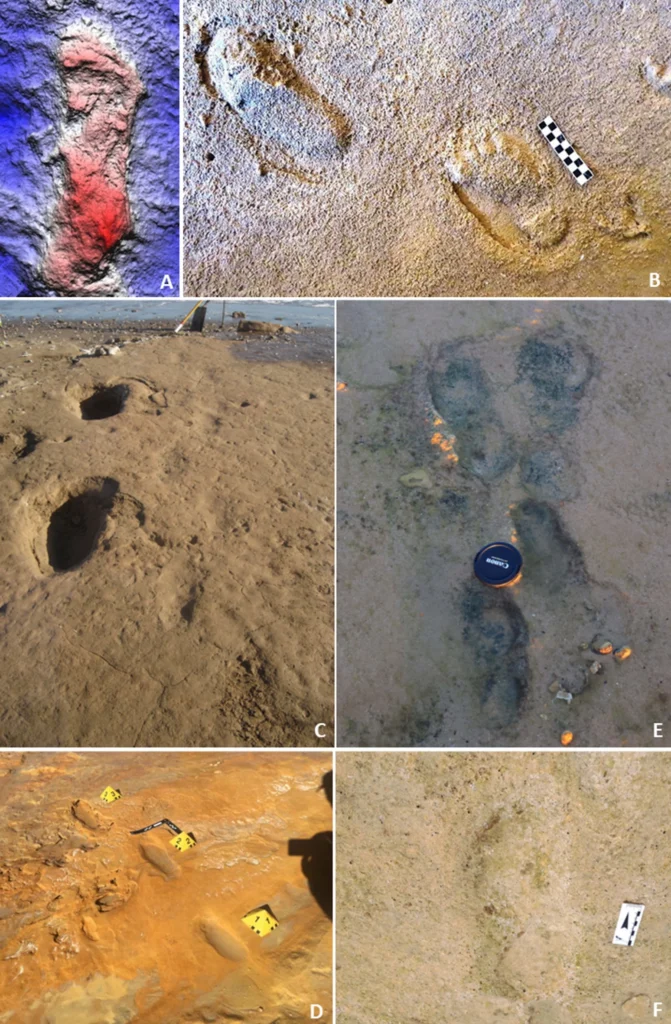

Examples of hominin footprints in Pleistocene coastal deposits: (A–B) Early Anatomically Modern Human tracks from South Africa; (C) human and ground sloth tracks in Argentina; (D–F) Neanderthal footprints from Spain, including overlapping trackways and well-preserved toe impressions. Credit:  https://doi.org/10.1038/s41598-025-06089-4
Examples of hominin footprints in Pleistocene coastal deposits: (A–B) Early Anatomically Modern Human tracks from South Africa; (C) human and ground sloth tracks in Argentina; (D–F) Neanderthal footprints from Spain, including overlapping trackways and well-preserved toe impressions. Credit: https://doi.org/10.1038/s41598-025-06089-4

Coastal Foraging and Dietary Clues

Beyond the physical tracks, the study also sheds light on Neanderthal dietary habits. A network analysis of coastal sites across the Iberian Peninsula reveals that Neanderthals had a broad, flexible diet. While large mammals such as deer, horses, and hares were dietary staples, Neanderthals also exploited resources from nearby littoral (coastal) ecosystems.

The findings support a growing body of research suggesting that Neanderthals were skilled foragers who could adapt to varied environments. Coastal habitats offered predictable food sources like shellfish and small game, which likely contributed to their survival in fluctuating Pleistocene climates.

Preservation Challenges and Scientific Methods

Footprints are a rare form of fossil evidence. Unlike bones or tools, they represent fleeting moments frozen in time—actual steps taken by ancient beings. Their preservation requires very specific conditions: moist, fine-grained sediment that is quickly buried and later fossilized.

To ensure accuracy, the research team employed state-of-the-art methods, including 3D photogrammetry and optically stimulated luminescence (OSL) dating, which confirmed the age of the track-bearing layers. The team also used sediment analysis to reconstruct the paleoenvironment, confirming that the dunes once overlooked a coastal estuary rich in resources.
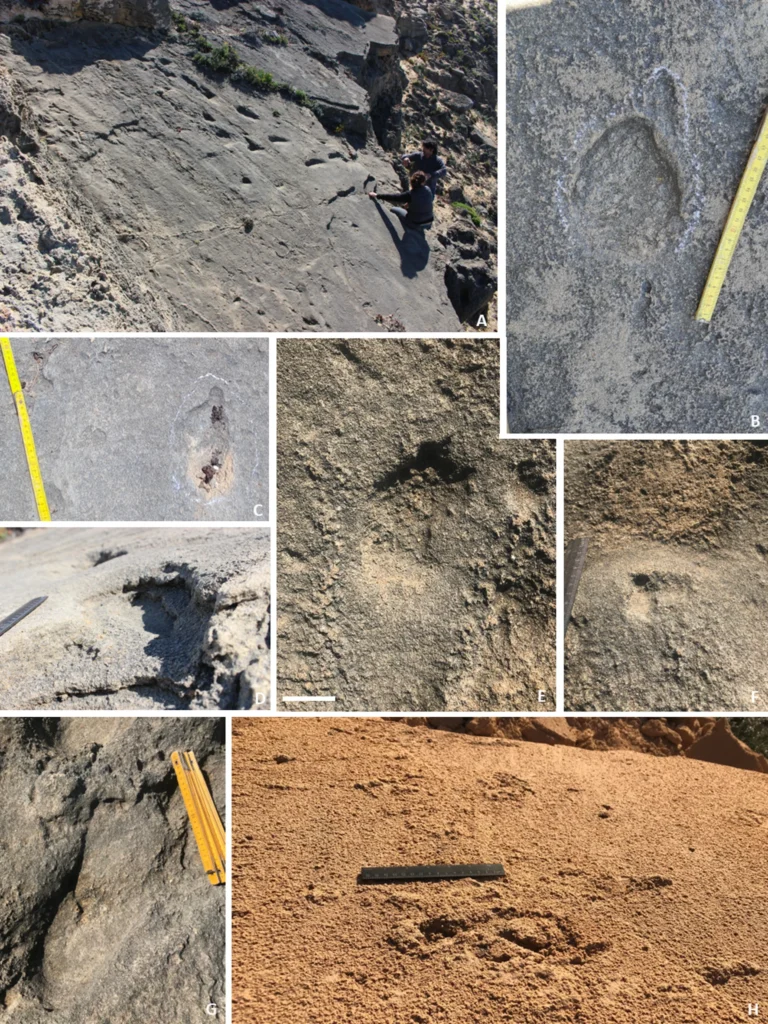
Neanderthal tracksites in southwestern Portugal: (A–C) Hominin footprints from Monte Clérigo showing upslope movement, toe impressions, and anatomical details; (D–G) sediment deformation, child footprints, and slippage traces on dune slopes; (H) isolated footprint from Praia do Telheiro with clear displacement rim. Credit:  https://doi.org/10.1038/s41598-025-06089-4
Neanderthal tracksites in southwestern Portugal: (A–C) Hominin footprints from Monte Clérigo showing upslope movement, toe impressions, and anatomical details; (D–G) sediment deformation, child footprints, and slippage traces on dune slopes; (H) isolated footprint from Praia do Telheiro with clear displacement rim. Credit: https://doi.org/10.1038/s41598-025-06089-4

A Broader Picture of Neanderthal Life

The Portuguese tracksites add to a growing list of Neanderthal ichnosites (footprint-bearing locations) across Europe, including the renowned Le Rozel site in France. However, the new findings are particularly significant because they expand the geographical range of Neanderthal coastal activity and provide insights into their locomotion, group composition, and environmental adaptability.

“This discovery fills a crucial gap in our understanding of Neanderthal occupation along the Atlantic seaboard,” the researchers noted. “It proves that Neanderthals were not just cave-dwellers but also adept at moving through open and dynamic coastal environments.”

A Step Closer to Understanding Neanderthals

The discovery of Neanderthal footprints in Portugal represents a major step forward in human evolutionary research. These ancient impressions offer a literal footprint into the past, revealing how our distant relatives moved, hunted, and lived along Europe’s shores during a time of dramatic climate shifts.

As rising sea levels continue to erode ancient coastlines, the race is on to uncover and preserve these rare traces of prehistoric life. But for now, the footprints at Monte Clérigo and Praia do Telheiro stand as a powerful reminder of our shared human journey through time.

de Carvalho, C.N., Cunha, P.P., Belo, J. et al. Neanderthal coasteering and the first Portuguese hominin tracksites. Sci Rep 15, 23785 (2025). https://doi.org/10.1038/s41598-025-06089-4

Cover Image Credit: Reconstituted scene of Neanderthals at the Monte Clérigo tracksite, based on AI-generated models and finalized by artist J.M. Galán. Created under scientific guidance to visualize prehistoric activity in the Portuguese dune landscape.

Related Articles

Roman soldier’s 1,900-year-old payslip uncovered in Masada

16 February 2023

16 February 2023

During excavations at Masada, archaeologists from the Israel Antiquities (IAA) uncovered a papyrus payslip dated to 72 BC belonging to...

Sensational find in Ephesus: more than 1,400-year-old district discovered

29 October 2022

29 October 2022

During this year’s excavations at Ephesus in Turkey, archaeologists from the Austrian Academy of Sciences (AW) discovered an incredibly well-preserved...

Mysterious and Life-size camel carvings have been found in Saudi Arabian desert

4 October 2023

4 October 2023

Archaeologists have found life-size camel carvings on a rock near the southern border of Saudi Arabia’s Nafud desert. The Neolithic...

Computational Analysis Points to a Non-Traditional Garden of Eden Location – Beneath the Pyramids?

30 April 2025

30 April 2025

A radical new theory proposed by a computer engineer suggests that the biblical Garden of Eden may not be in...

Evidence of the Birth of Archaic Monotheism in Anatolia found at Oluz Höyük, “Havangah prayer at Oluz Höyük”

27 March 2022

27 March 2022

Oluz Höyük, located 25 kilometres west of Amasya, is an ancient city which has rich findings of religious structuring. During...

Remains of ‘female vampire’ found with sickle across her neck and a padlocked toe in Poland

2 September 2022

2 September 2022

A skeleton of what archaeologists believe may have been a 17th-century female vampire has been discovered near Bydgoszcz in Poland....

New Study Finds, 4,000-Year-Old Toolkit Unearthed Near Stonehenge Was Used to Work Gold

16 December 2022

16 December 2022

Archaeologists from the Universities of Leicester and Southampton in the United Kingdom recently published a study claiming that enigmatic artifacts...

Two rock chambers thought to be dining rooms unearthed at ‘House of Muses’ in southeastern Turkey

27 July 2021

27 July 2021

House of Muses, a Roman-era house named after the muse mosaics found in the area located in the ancient city...

HS2 archaeologists discover Romanization of Iron Age village in Britain

12 January 2022

12 January 2022

Archaeologists have uncovered a vast Roman trading town on Britain’s HS2 high-speed rail route. Evidence found during a dig of...

Buddha statue discovered in ancient city of Berenice, Egypt

29 April 2023

29 April 2023

Archaeologists excavating in the ancient Egyptian seaport Berenice Troglodytica on the western shore of the Red Sea have unearthed a...

Riddle of Former Crater Lakes in the Highest Mountains of the Sahara Solved

18 August 2025

18 August 2025

An interdisciplinary research team, led by scientists from the Free University of Berlin and the Max Planck Institute for Meteorology,...

From Researchers, a New İnterpretation of Norse Religion

26 February 2021

26 February 2021

Recent research on pre-Christian Norse religions shows that the variation in Norse religions is far greater than previously imagined. Ten...

Exceptional discovery of a fully frescoed chamber tomb dating back to the Republican and Imperial Roman ages

10 October 2023

10 October 2023

Waterworks in Giugliano, a suburb of Campania (Naples), have uncovered an untouched chamber tomb full of frescoes ceilings, and walls...

Ancient scrolls reveal astonishing information about the life of a Nabatean woman, who lived in the first century AD in Petra

18 December 2023

18 December 2023

Petra was the capital of a powerful trading empire two thousand years ago. It was established by the Nabateans, a...

A large stone monument depicting the goddess Ishtar has been unearthed in the ancient Assyrian city of Nimrud

26 June 2023

26 June 2023

Archaeologists from the University of Pennsylvania Museum of Archeology and Anthropology, working with an Iraqi excavation team, have unearthed a...