
6 December 2025 The Future is the Product of the Past

4,000-Year-Old Flint Arrow Lodged in Human Rib Reveals Direct Evidence of Prehistoric Violence

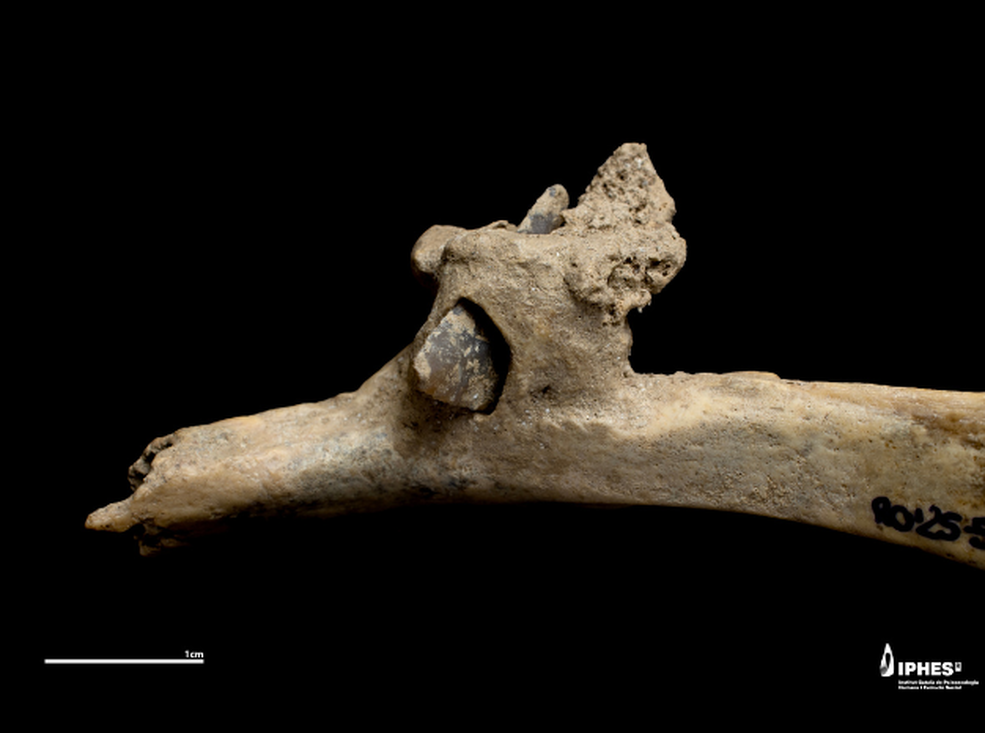
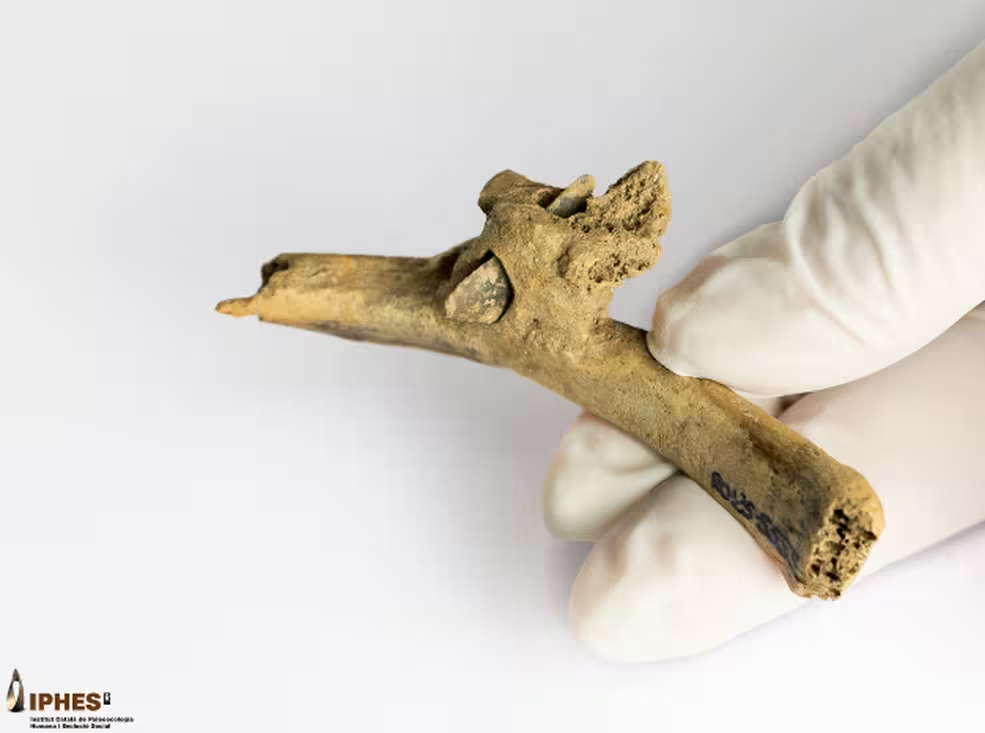
In a discovery shedding light on prehistoric human conflict, archaeologists have found a flint arrowhead embedded in a human rib dating back more than 4,000 years. The remains were unearthed at Roc de les Orenetes, a high-altitude collective burial site in the Catalan Pyrenees (northeast Spain), situated over 1,800 meters above sea level.

This exceptional find—revealing direct evidence of interpersonal violence—was made during recent excavations led by Dr. Carlos Tornero from the IPHES-CERCA and the Universitat Autònoma de Barcelona.

This discovery provides a rare, tangible glimpse into the social tensions within early highland communities of the third millennium BCE. It stands as direct, almost forensic proof of interpersonal conflict—highlighting the critical value of archaeological research in uncovering not just how these people lived, but how they responded to violence and adversity.

A Violent Encounter in Prehistoric Times

The arrow, shot from behind, struck a rib but didn’t kill the individual immediately. Instead, the bone showed signs of healing, suggesting the person survived the attack, at least temporarily. According to osteoarchaeologist Dr. Miguel Ángel Moreno (University of Edinburgh), this opens new possibilities for studying trauma, weapon types, and even the attacker’s position relative to the victim.

Further analysis is underway using X-ray microtomography and advanced biochemical techniques to learn more about the impact and healing processes.


📣 Our WhatsApp channel is now LIVE! Stay up-to-date with the latest news and updates, just click here to follow us on WhatsApp and never miss a thing!!


Another view of the flint arrowhead embedded in a human rib, located at the Roc de les Orenetes site (Queralbs, Ripollès). Credit: Maria D. Guillén / IPHES-CERCA

A Burial Cave Tied to a Close-Knit Mountain Community

Roc de les Orenetes served as a burial site for over 60 individuals between 2200–2000 BCE, likely members of the same community. Excavations since 2019 have recovered more than 6,000 human bone fragments. The skeletal remains suggest a population of robust, physically active herders, deeply adapted to life in the mountains.

Earlier studies had already identified cut marks, fractures, and weapon-related injuries, but until now, it wasn’t clear whether the weapons had actually struck people or were simply grave goods. This embedded arrowhead offers the first unambiguous evidence of a violent encounter.

A Site of Ongoing Discovery

First discovered in the 1960s, the cave has a long archaeological history. It was recently revitalized as part of the ARRELS/RAÍCES Prehistoric Roots Project, supported by the Catalan government, the town of Queralbs, and the Ripoll Ethnographic Museum.
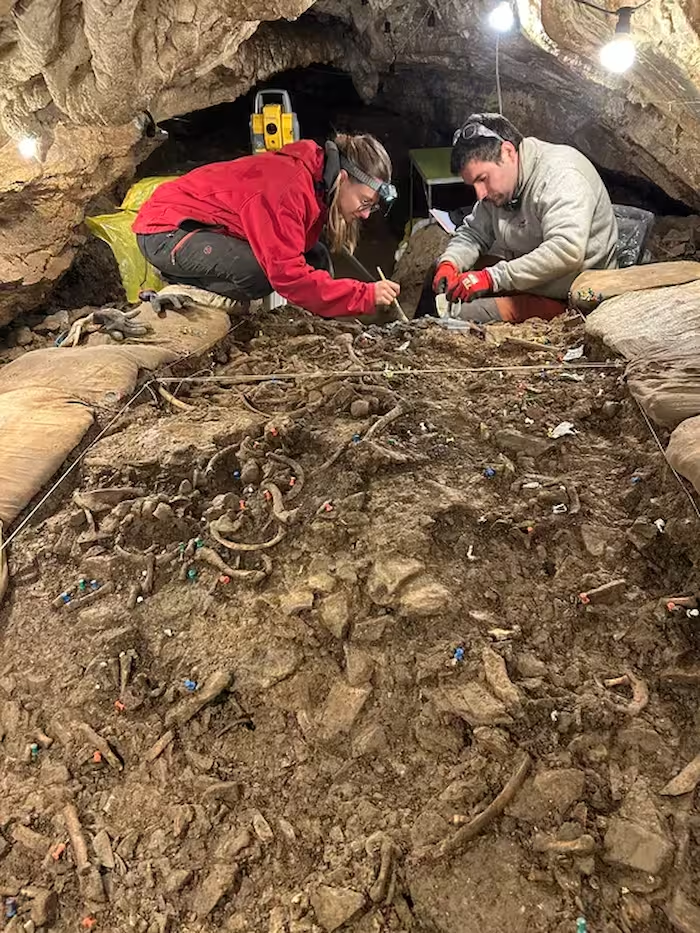
  Archaeologists at work during June excavations at the Roc de les Orenetes site in Queralbs (Ripollès, Catalonia). Image credit: IPHES-CERCA
Archaeologists at work during June excavations at the Roc de les Orenetes site in Queralbs (Ripollès, Catalonia). Image credit: IPHES-CERCA

The site is now considered one of the most important prehistoric high-mountain cemeteries in southern Europe—providing an unprecedented window into the lives, struggles, and resilience of early Pyrenean societies.

Catalan Institute of Human Paleoecology and Social Evolution (IPHES-CERCA)

Cover Image Credit: Flint arrowhead embedded in a human rib, discovered at the Roc de les Orenetes prehistoric burial site in Queralbs (Ripollès, Catalonia). Image credit: Maria D. Guillén / IPHES-CERCA

Related Articles

A 2,000-Year-Old Shoe Discovered in a German Bog

22 June 2021

22 June 2021

Archaeologists discovered a leather shoe that had been lost in a bog for 2,000 years and believe it may have...

Archaeologists Find One of the Long-Lost Holy Cities in Jordan

13 July 2025

13 July 2025

A remarkable archaeological discovery in Jordan has brought one of the Holy Land’s long-lost cities back to light. Researchers now...

Polish archaeologists have uncovered nine crocodile heads within ancient Egyptian tombs of nobles

25 December 2022

25 December 2022

Polish archaeologists excavating the Theban Necropolis in Egypt discovered nine crocodile heads hidden inside two tombs belonging to high-ranking nobles....

Exceptional Intact Etruscan Rock-Cut Tomb Discovered in Italy’s San Giuliano Necropolis

30 June 2025

30 June 2025

A remarkable discovery has emerged from the heart of Etruria: an intact Etruscan rock-cut tomb, sealed for over 2,700 years,...

Unsolvable Megalithic Mystery of ancient Greek “Dragon Houses”

8 January 2025

8 January 2025

The Dragon Houses of Euboea, which probably dates to the Preclassical period of ancient Greece, are one of the historical...

Rare Fresco of Fire-Worship Ritual Discovered in Ancient Sogdian Palace in Tajikistan

6 September 2025

6 September 2025

Archaeologists in Tajikistan have unearthed an exceptionally rare fresco depicting priests performing a fire-worship ritual at the palace of Sanjar-Shah,...

Ancient Synagogue found in Turkey’s popular tourist center Side

27 December 2021

27 December 2021

A 7th-century ancient synagogue has been found in Side, a resort town on Turkey’s Mediterranean coast. The synagogue found was...

Ancient Warrior Vessel Discovered at Chankillo, The Oldest Solar Observatory in the Americas

1 September 2025

1 September 2025

Archaeologists have uncovered a fragmented vessel depicting a warrior at Chankillo, the oldest solar observatory in the Americas, located in...

Bronze Bust of Egyptian Goddess Isis Unearthed in Satala, the Base of Legio XV Apollinaris

25 October 2025

25 October 2025

Archaeologists excavating the ancient city of Satala in northeastern Turkey have uncovered a rare 20-centimeter bronze bust of the Egyptian...

Early Imperial cemetery in Nîmes, in the south of France

4 October 2022

4 October 2022

Inrap archaeologists excavating at Nîmes in southern France have uncovered a cemetery dating to the first to second centuries AD...

A First in Anatolia: Rare Egyptian God Statue Unearthed in Commagene’s ‘Stairway to Eternity’ Tomb

1 September 2025

1 September 2025

In the ancient city of Perre, once a flourishing capital of the Commagene Kingdom in southeastern Türkiye, archaeologists have uncovered...

Researchers able to reconstruct the development of Barbegal’s former watermills over time with the help of carbonate deposits

7 July 2024

7 July 2024

Archaeologists are faced with a difficult task: how can information be obtained about buildings or facilities of which – if...

Archaeologists Discover Old Bulgarian Inscription and Rich Finds at Nikopol Fortress Excavations

2 September 2025

2 September 2025

This summer’s archaeological season at the Nikopol Fortress has yielded one of the most remarkable discoveries in recent years: an...

Export barred on roundel manuscript gifted to Queen Elizabeth I by Archbishop

12 September 2022

12 September 2022

A rare presentation manuscript that Archbishop of Canterbury Matthew Parker gave to Queen Elizabeth I in 1573 has been sold...

5000-year-old jewelry factory found in Rakhi Garhi in India’s Indus Valley region

9 May 2022

9 May 2022

The Archaeological Survey of India (ASI) has made an important discovery by finding the remains of a 5000-year-old jewelry factory...