
10 November 2025 The Future is the Product of the Past

3,000-Year-Old Eyeliner Innovative Formula Discovered in Iran: A Unique Iron Age Kohl Without Lead

Ancient black eyeliner found in Iron Age graves reveals a previously unknown cosmetic recipe using graphite and manganese oxide, predating modern formulations by millennia.

In a groundbreaking archaeological discovery, researchers have uncovered a never-before-seen kohl recipe dating back to the 7th–9th centuries BCE in northwestern Iran. The eye make-up, found in the Kani Koter cemetery on the edge of the former Assyrian Empire, features an innovative formula that completely diverges from traditional lead-based cosmetics of the Ancient Near East.

Led by Dr. Silvia Amicone from the University of Tübingen, the international research team found that the black eye powder was made from natural graphite and manganese oxide, without any traces of lead or organic materials—an unusual combination that suggests a shimmering metallic aesthetic likely favored by the local elite.

“Instead of using lead, as was common across Mesopotamia and Egypt, this community developed a distinctive recipe using locally sourced minerals,” explained Dr. Amicone.

Published in the latest edition of Archaeometry, the study adds a new chapter to the understanding of Iron Age beauty practices, personal adornment, and the material culture of ancient Iranian societies living at the periphery of the powerful Assyrian Empire.


📣 Our WhatsApp channel is now LIVE! Stay up-to-date with the latest news and updates, just click here to follow us on WhatsApp and never miss a thing!!


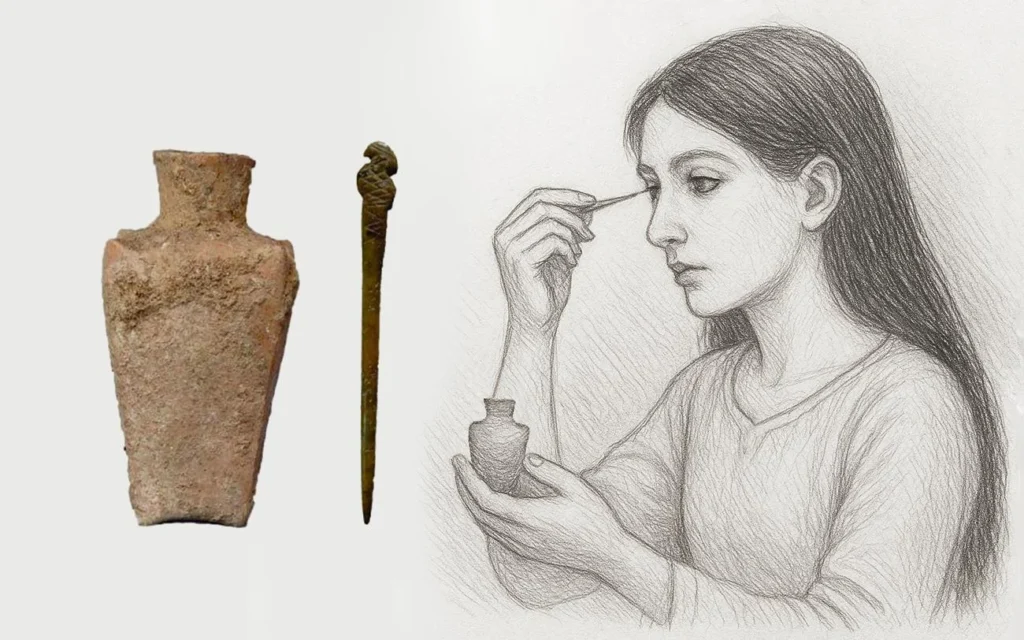
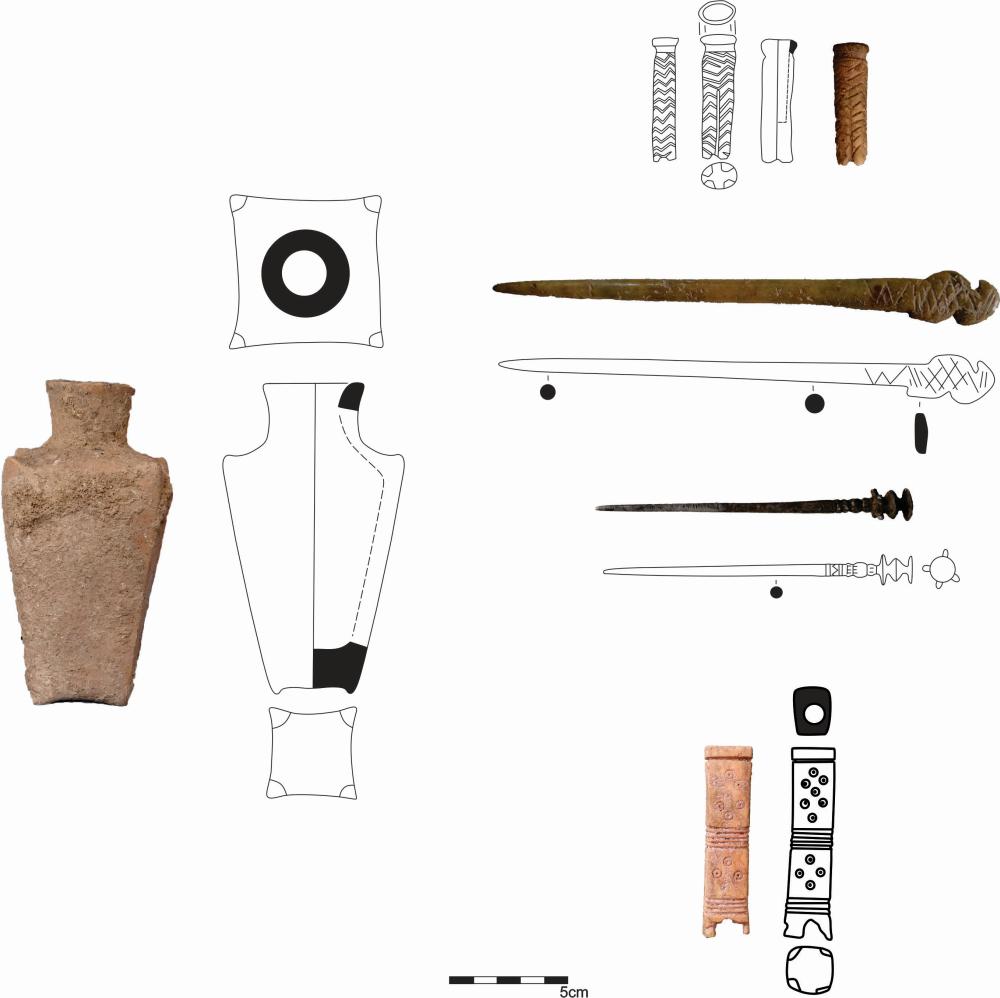
A cosmetic jar from the Kani Koter site. Credit: University of Tübingen

Elite Innovation in the Iron Age

The Kani Koter burial site, nestled in the Zagros Mountains, contains graves from the Iron Age III period, many of which belong to high-status individuals. Alongside typical grave goods like mirrors and grooming tools, researchers found a ceramic vessel containing a black cosmetic powder. Its composition shocked scientists.

“This is the first time we’ve seen kohl made entirely from graphite and manganese oxide,” said co-author Dr. Shelir Amelirad of Heidelberg University. “This points to creative material use and regional innovation—a truly unique signature in the archaeological record.”

Advanced analytical methods confirmed the absence of both lead and organic compounds. While organic components may have decomposed over time, the current findings suggest a deliberate and sophisticated formulation, reflecting a high level of technological and cultural adaptation.

Local Resources, Global Insights

The use of locally sourced minerals such as graphite and manganese oxide points to a sophisticated understanding of natural materials and their applications in personal adornment. These findings suggest that communities on the Assyrian Empire’s eastern frontier were not merely cultural recipients but active innovators in their own right.

“This discovery gives us deeper insights into how people on the periphery of major empires expressed identity and status,” said Amicone. “It adds to our understanding of Iron Age technology, cosmetics, and cultural exchange between Assyria and early Iranian societies.”
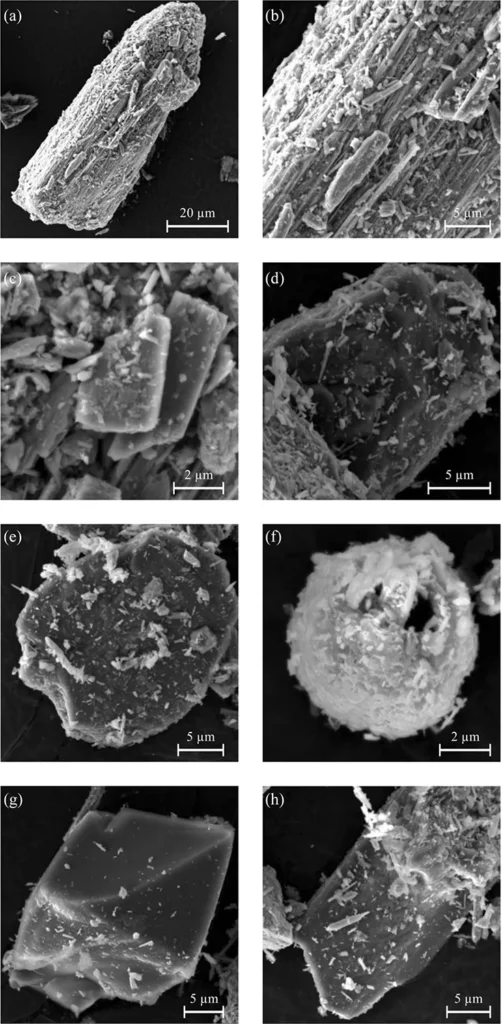

FEG-SEM-SE micrographs of the Kani Koter sample: (a) Pyrolusite crystal with perfect cleavage; (b) detail showing surface mineral phases; (c) K-feldspar; (d) plagioclase; (e) phyllosilicate; (f) clay with pyrolusite; (g) quartz; (h) calcite. Credit: Amicone et al., Archaeometry (2025)

Cultural Significance of Ancient Iranian Cosmetics

These findings contribute to growing evidence that Iron Age communities in Iran were not simply cultural satellites of Assyria, but active innovators with unique aesthetic practices. The choice of minerals—graphite for smooth application and shine, and manganese oxide for deep pigmentation—demonstrates both cosmetic intention and regional resourcefulness.

“Such discoveries allow us to reconstruct not just how people looked, but how they thought about appearance, identity, and status,” said Dr. Amicone.

A Glimpse Into Ancient Beauty Rituals

The president of the University of Tübingen, Professor Dr. h.c. (Dōshisha) Karla Pollmann, emphasized the broader importance of such discoveries:

“Through modern science, we gain access to long-lost worlds—understanding how people lived, expressed themselves, and built their cultures.”

This 3,000-year-old eyeliner opens a new window into the daily life and personal expression of Iron Age elites. It also enriches our understanding of ancient chemical knowledge and cosmetic innovation far ahead of its time.

University of Tübingen


Silvia Amicone, Baptiste Solard, Shelir Amelirad, Eghbal Azizi, Lara Maritan, Maxime Rageot, Christoph Berthold, Karen Radner: Eye makeup in Northwestern Iran at the time of the Assyrian Empire: a new kohl recipe based on manganese and graphite from Kani Koter (Iron Age III). Archaeometry.
DOI: https://doi.org/10.1111/arcm.13097

Related Articles

Runic Alphabet Symbols in the Tombs Found in the Excavations in Istanbul

23 May 2021

23 May 2021

In the excavations carried out by the Istanbul Archeology Museums in the area where the metro station will be built...

At Göbeklitepe, believed to be the earliest known Mesolithic temple complex, grinding stones were discovered

26 October 2022

26 October 2022

A recent discovery at Göbeklitepe, the oldest known Mesolithic temple complex, has revealed grinding stones, new finds expected to shed...

More than 50 pairs of tweezers found during an excavation of a 2,000-year-old Roman settlement – Romans to blame for no-body-hair trend

31 May 2023

31 May 2023

More than 50 pairs of tweezers were found during the major excavation in Wroxeter City, Shropshire, one of the largest...

Well-Preserved Hittite “Bird Omen Text” Discovered at Kayalıpınar–Samuha, a Key Religious Hub of the Ancient Empire

24 July 2025

24 July 2025

Archaeologists working at the ancient Hittite settlement of Kayalıpınar, located in Türkiye’s Sivas province, have uncovered a remarkably well-preserved clay...

Turkey’s second ancient lighthouse found in the Bathonea

28 July 2023

28 July 2023

The excavations in the ancient Greek city of Bathonea, located in the Küçükçekmece Lake basin in the Avcılar district of...

Magnificent Discovery: A Major Tomb Filled with Gold and Ceramic Artifacts was Discovered in Panama

3 March 2024

3 March 2024

In an archaeological find in the El Caño Archaeological Park, located in the district of Natá, province of Coclé, in...

UK’s Oldest Hospice Discovered: Anglo-Saxon Monastery Unearthed in Cookham Reveals Early Medical Care

11 August 2025

11 August 2025

An extraordinary archaeological discovery in Cookham, Berkshire, is rewriting our understanding of healthcare in early medieval England. Unearthed behind the...

Three-Year-Old Discovers 3,800-Year-Old Canaanite Seal at Archaeological Site of Tel Azekah

2 April 2025

2 April 2025

At the site of the famous battle between David and Goliath, a three-year-old girl named Ziv Nitzan discovered a scarab-shaped...

2,000-year-old altar found in Alexandria Troas

9 October 2021

9 October 2021

A 2,000-year-old altar was unearthed during the ongoing excavations in the ancient city of Alexandria Troas, in a region close...

Sensational find in Ephesus: more than 1,400-year-old district discovered

29 October 2022

29 October 2022

During this year’s excavations at Ephesus in Turkey, archaeologists from the Austrian Academy of Sciences (AW) discovered an incredibly well-preserved...

A Previously Unknown Bronze Age Settlement Discovered in Switzerland

18 February 2024

18 February 2024

In advance of a construction project in Heimberg, the Archaeological Service of the Canton of Bern carried out a rescue...

A rare treasure with ornaments nearly a thousand years old was discovered in Staraya Ryazan, Russia

18 August 2021

18 August 2021

During expeditions of the Institute of Archeology of the Russian Academy of Sciences, a rare treasure with ornaments of about...

A basement discovered on the premises of the ruins of Hitoyoshi Castle in Japan could be a Jewish bathing facility!

7 December 2022

7 December 2022

Experts are still indecisive about why there was a bathing area in the basement which was discovered on the site...

Knights-era painting found behind bricked-up arch at Museum of Archaeology in Malta

30 November 2021

30 November 2021

A newly found Knights-era painting hidden behind a bricked-up arch at the Museum of Archaeology might give insight into the...

Theater of Perinthos Ancient City to be unearthed

9 August 2021

9 August 2021

The theater area in the Ancient City of Perinthos, whose history dates back to 600 BC, will be unearthed during...