
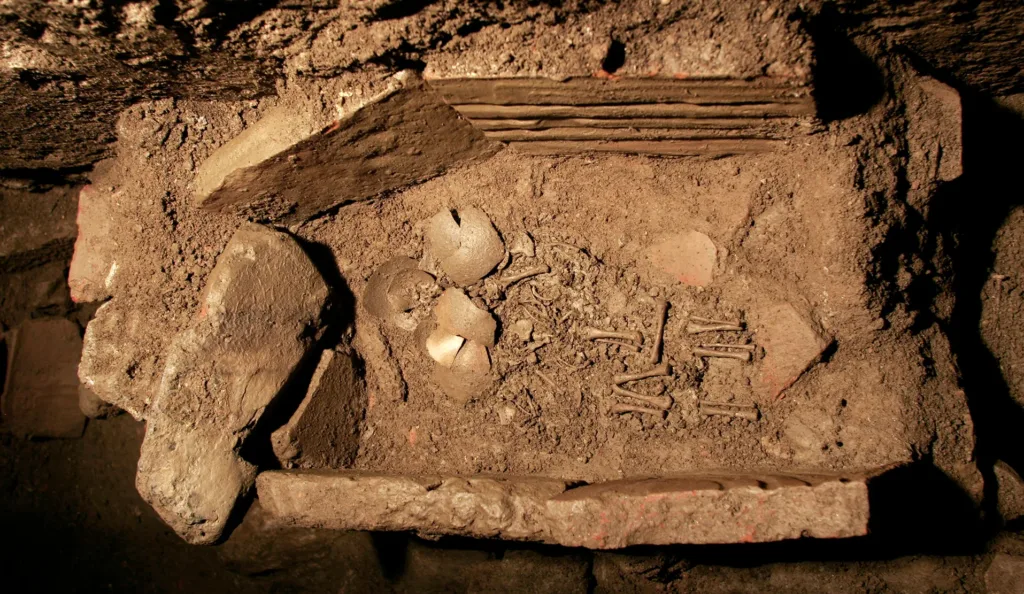
Archaeologists have re-examined an unusual Middle Byzantine grave containing two premature infants—possibly twins—inside the abandoned sewer channel of a Roman public latrine at Ephesus in western Türkiye.
The location initially appears to suggest exclusion or disposal. Yet almost every other detail tells a different story. The infants were placed side by side inside a carefully built stone-and-tile grave, aligned according to Christian burial customs and possibly wrapped in a burial shroud.
Researchers now argue that the former latrine channel was probably selected not as a place to discard the children, but as a protected and secluded space where they could remain undisturbed.
The grave was originally uncovered in 2010 in the Odeion of the Artemision, within the sacred precinct of the Temple of Artemis. New bioanthropological and archaeothanatological analyses carried out in 2025 have now provided the first detailed reconstruction of the burial.
The study, conducted by Caroline Partiot and Lilli Zabrana of the Austrian Archaeological Institute at the Austrian Academy of Sciences, was published in Childhood in the Past.
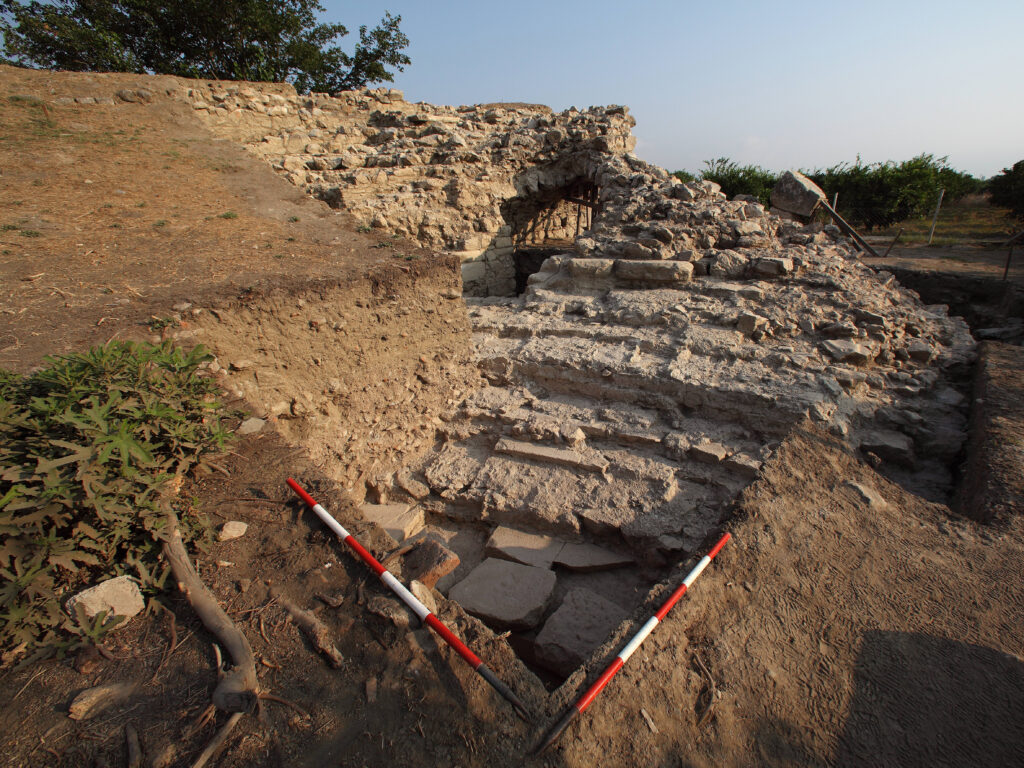
A Byzantine grave inside a Roman latrine
The Odeion stood approximately 175 metres southwest of the Temple of Artemis and was constructed during the first century CE as a venue for musical and vocal performances.
During a major renovation in the late second or early third century, one of its underground chambers was converted into a public latrine containing around 30 seats. The toilet could be entered only from outside the auditorium and was probably added to serve visitors attending events in the building.
The Odeion was abandoned in the fifth or sixth century after a fire and the collapse of its roof. Its marble decoration was systematically removed, while parts of the ruined building were later used for dumping broken ceramics and animal-processing waste.
By the eighth or ninth century, however, the latrine had been out of use for several hundred years. Its drainage channel survived as an empty, partly sheltered structure beneath the ruins.
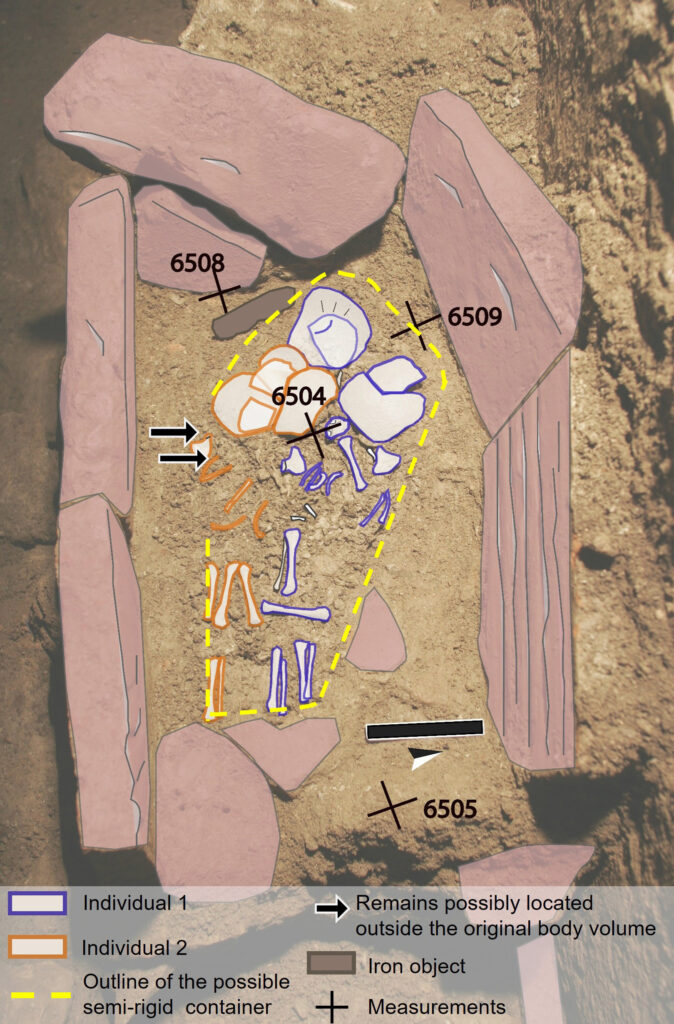
It was there that someone constructed a small cist grave from reused bricks, roof tiles and stone slabs. Measuring only 67 by 42 centimetres, it contained the remains of two perinatal individuals placed closely together.
Radiocarbon dating produced a calibrated range of 692–887 CE, with a 75 percent probability that the burial occurred between 762 and 887 CE. Archaeobotanical evidence also suggests that soil was deliberately brought from elsewhere and placed at the bottom of the grave before the bodies were deposited.
The burial stood outside all known cemeteries at Ephesus. It was separate from the city’s extensive Roman necropolises and from the Byzantine cemetery associated with the Church of Mary.
This isolation is important because the location of cemeteries used at Ephesus during the seventh to ninth centuries remains poorly understood. Although infants have been documented in formal cemeteries, the Odeion grave is currently the only known isolated burial of perinatal individuals from the city.
Despite its unconventional location, the grave itself followed familiar Byzantine funerary practices. The children were laid on their backs with their heads facing west, producing an approximately east–west alignment associated with Christian beliefs concerning resurrection and the Second Coming.
The orientation was slightly offset because the grave builders had to follow the existing direction of the Roman sewer channel. There were no conventional grave goods, another common feature of Christian burials during this period.
Possible twins and a rare anatomical discovery
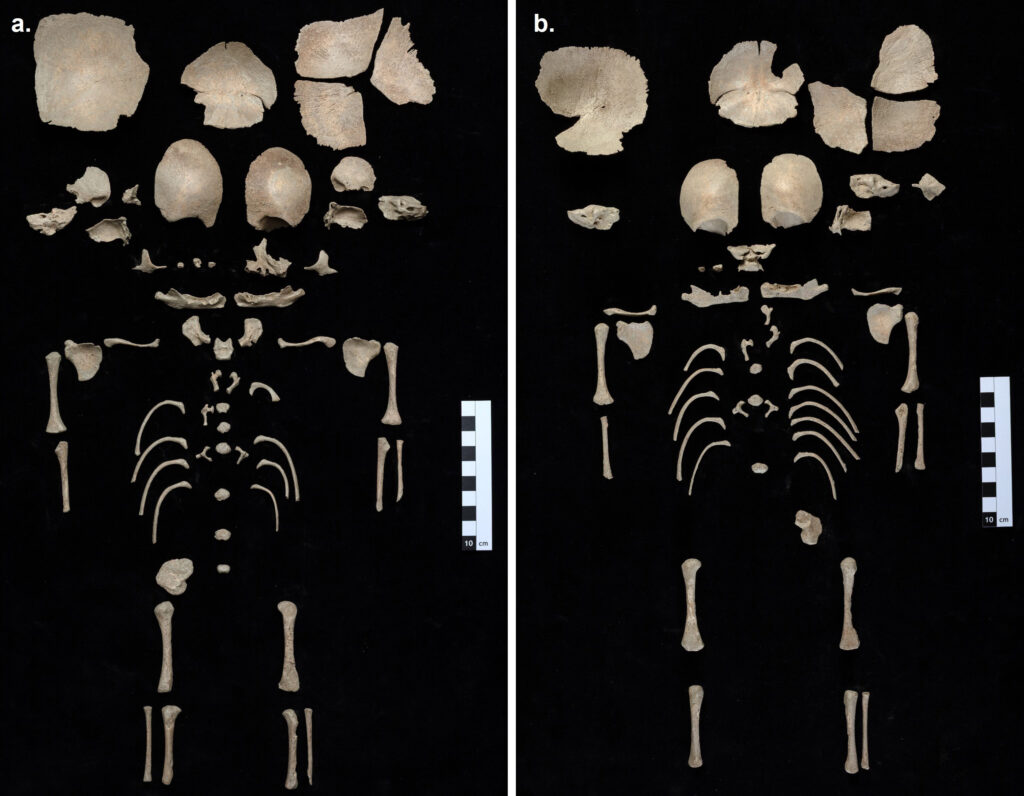
Measurements of the best-preserved upper-arm bones indicate that the infants were approximately 43 and 44 centimetres long at death. Researchers estimated that they had reached around 33 to 34 weeks of gestation—roughly seven and a half to eight months of pregnancy.
Both therefore died before reaching full term.
The skeletal evidence could not determine whether they died in the womb, during childbirth or shortly after delivery. If they were born alive, however, their degree of development suggests that they probably survived only briefly.
Their nearly identical developmental ages, similar body sizes and simultaneous placement in the same grave raise the possibility that they were twins.
A difference of around one centimetre in estimated body length does not rule this out. Twins can develop at different rates because of unequal access to nutrients, differences in placentation or, in the case of fraternal twins, biological sex.
DNA analysis was not conducted, however, meaning that their relationship cannot yet be confirmed. The researchers therefore describe them cautiously as “possibly twins.”
Macroscopic examination found no clear signs of skeletal trauma, infection or inflammation that could explain their deaths. One unusual feature nevertheless suggests that at least one child may have experienced developmental problems.
Among the sieved remains, researchers identified a five-millimetre-long supernumerary cervical rib—an additional rib growing from the neck region.
Cervical ribs occur in a small percentage of adults and are often harmless. In fetuses and infants, however, they can be associated with disrupted embryonic development, congenital abnormalities, genetic disorders, prematurity and reduced chances of survival.
The Ephesus example is only the second published archaeological case of a cervical rib identified in a perinatal individual. According to the researchers, no archaeological case involving possible twins and a cervical rib had previously been documented.
The discovery does not establish a specific cause of death. Many conditions associated with cervical ribs affect internal organs and soft tissues without leaving visible changes on the bones.
The children may have died because of complications related to premature birth, pregnancy, delivery or an underlying congenital condition. Twin pregnancies would also have placed both the mother and infants at greater risk in a period without modern obstetric care.
The position and movement of the bones revealed further evidence about the burial. Although water infiltration displaced several skeletal elements during decomposition, most remained within a clearly defined area.
Researchers believe this pattern may have been created by a soft but partly restrictive wrapping, most likely a burial shroud. A small iron object found near the heads may have been a pin used to fasten the cloth.
Byzantine sources and archaeological evidence indicate that children, like adults, could be washed, perfumed and wrapped in white linen before burial. It remains impossible to determine whether each infant had an individual shroud or whether they were wrapped together.
Why the grave points to protection rather than disposal
The location inside a former latrine inevitably raises the question of whether the infants were deliberately excluded, abandoned or discarded.
Ancient sewers and wells have produced much darker evidence elsewhere in the Mediterranean.
At Ashkelon in present-day Israel, the remains of nearly 100 perinatal infants were discovered commingled inside a sewer with animal bones and broken pottery. Researchers have interpreted the deposit as possible evidence of infanticide and the disposal of unwanted newborns.
In Athens, the Agora Bone Well contained the remains of approximately 460 individuals, most of whom died around the time of birth. Some older children showed possible evidence of abuse.
The Ephesus burial differs fundamentally from such deposits. The infants were not scattered, commingled with refuse or placed in an active sewer. They were carefully positioned together inside a purpose-built grave constructed centuries after the latrine had ceased functioning.
Its unusual setting may instead reflect the ambiguous position of newborns in Byzantine society.
Baptism strongly influenced where children could be buried. It was commonly performed after the period of maternal purification, traditionally around 40 days after birth, although emergency baptism could occur earlier when an infant was in danger.
Children who died before baptism may not always have been accepted into consecrated cemeteries. The researchers stress, however, that the available historical evidence is insufficient to prove that the Ephesus infants were unbaptised or that baptism directly determined their burial place.
Newborns also occupied a socially and spiritually uncertain position. They were highly vulnerable, not yet fully incorporated into the community and situated—at least symbolically—between life and death.
This tension was intensified in cases involving premature, malformed or multiple births, which could be surrounded by fear, religious anxiety and older beliefs that continued alongside Christian teachings.
The former Artemision may therefore have offered a practical compromise.
The Odeion itself was no longer consecrated and had no recognised funerary function. Yet it still stood within the boundaries of one of the ancient world’s most famous sacred precincts. The channel provided a physically protected space, while its location inside the former sanctuary may have retained a sense of spiritual security long after the worship of Artemis had ended.
The grave remained intact beneath later sediments for centuries. Rather than being exposed to disturbance, the two infants rested together until archaeologists opened the tomb in 2010.
For Partiot and Zabrana, the care invested in the burial is the decisive evidence. The grave’s construction, Christian orientation, probable shrouding and protected setting all indicate that the children’s deaths affected those who buried them.
The abandoned latrine was not simply a place associated with waste. By the Middle Byzantine period, it had become a sheltered void within a ruined sacred landscape.
There, a family or community created a small but carefully ordered grave—one that recognised the infants’ brief existence and attempted to protect them in death.
Partiot, C., & Zabrana, L. (2026). Peace in Unexpected Places: The Middle Byzantine Burial of Two Perinates, Possibly Twins, in a Latrine Canal of the Odeion in the Artemision of Ephesos. Childhood in the Past, 1–21. https://doi.org/10.1080/17585716.2026.2682804
Cover Image Credit: OeAW-OeAI / L. Zabrana.
