
7 November 2025 The Future is the Product of the Past

Ancient Guests, Exotic Gifts: Wild Boars Traveled Miles to a Prehistoric Feast in Iran

New research suggests prehistoric communities in Iran’s Zagros Mountains transported wild boars over 70 kilometers to participate in elaborate communal feasts—long before the dawn of agriculture.

In a remarkable discovery that reshapes our understanding of prehistoric social life, archaeologists have uncovered evidence of large-scale feasting in the Zagros Mountains of western Iran—dating back more than 11,000 years. At a site known as Asiab, researchers found the skulls of 19 wild boars neatly packed into a pit, their butchery marks revealing they were used in a grand communal celebration.

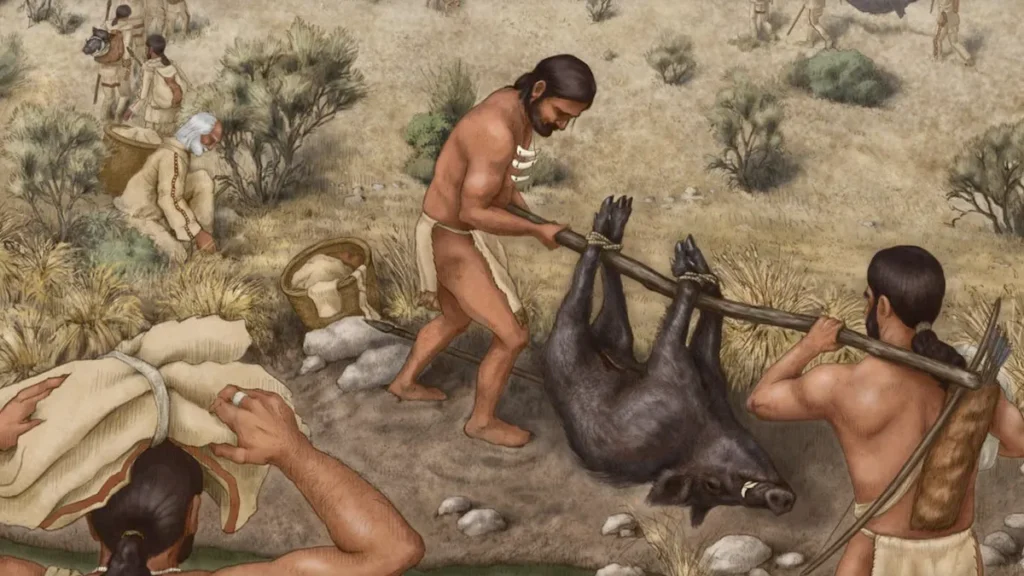
What makes this discovery truly extraordinary, however, is not just the age of the feast—but the lengths to which participants went to contribute. According to a study published in Nature Communications Earth & Environment and summarized in The Conversation by lead author Dr. Petra Vaiglova, isotope analysis of tooth enamel revealed that at least some of the wild boars were transported over mountainous terrain from distances of 70 kilometers or more.

“Just like bringing a bottle of regional wine to a dinner party today, these animals appear to have served as meaningful gifts,” wrote Vaiglova, a researcher in archaeological science.

A Prehistoric Tradition of Sharing and Symbolism

Feasting is commonly associated with agricultural societies, which had the means to produce surplus food. However, the Asiab site challenges this narrative. It demonstrates that pre-agricultural communities were capable of organizing complex social events involving symbolic exchanges and long-distance resource transport.


📣 Our WhatsApp channel is now LIVE! Stay up-to-date with the latest news and updates, just click here to follow us on WhatsApp and never miss a thing!!


The findings support the idea that such feasts may have played a key role in shaping early human social bonds—possibly even contributing to the eventual development of farming practices. In a broader cultural sense, the effort to bring animals from distant locations implies a powerful form of gift-giving, echoing modern traditions where regional foods are shared during holidays or celebrations.

“Reciprocity is at the heart of social interactions,” Vaiglova noted. “Just like a thoughtfully chosen bottle of wine does today, those boars brought from far and wide may have served to commemorate a place, an event and social bonds through gift-giving.”
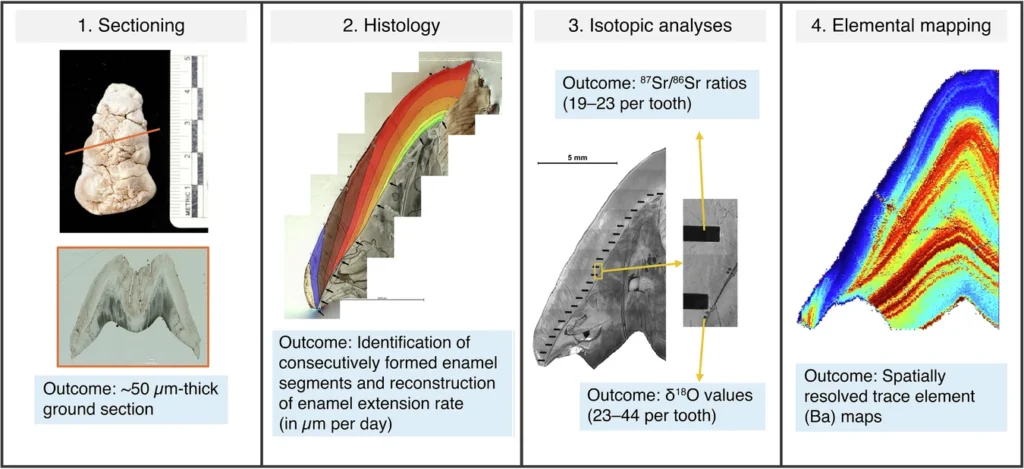
Summary of the analyses carried out in this study. Credit: Nature Communications Earth & Environment

Teeth Tell the Tale

The team used a technique that examines microscopic growth patterns in tooth enamel—much like counting tree rings—to determine the animals’ life histories and movements. Isotopic data indicated varied environmental conditions during tooth development, suggesting the boars originated in different parts of the region before converging at Asiab.

This is the first time such behavior has been documented in a pre-agricultural society in the Near East. Similar findings have been observed at Stonehenge in the UK, where people brought pigs from across Britain to large ceremonial feasts—but those occurred much later, in farming contexts.

Redefining Ancient Community Life

The Asiab feast offers a rare glimpse into how prehistoric humans expressed community identity, maintained social cohesion, and marked significant occasions—all through the medium of food.

Whether it’s crocodile jerky from Australia or French cheese, food still serves as a cultural ambassador today. The ancient boars of Iran prove that this tradition has roots deeper in history than we ever imagined.

Vaiglova, P., Kierdorf, H., Witzel, C. et al. Transport of animals underpinned ritual feasting at the onset of the Neolithic in southwestern Asia. Commun Earth Environ 6, 519 (2025). https://doi.org/10.1038/s43247-025-02501-z

This edited article is republished from The Conversation under a Creative Commons license. Read the original article.

Cover Image Credit: Artistic reconstruction of early humans transporting a wild boar across rugged terrain to a communal feast in ancient Iran. (Illustration by Kathryn Killackey)

Related Articles

The first and largest astronomical observatory of the 6th century BC discovered in Egypt’s Kafr El-Sheikh

24 August 2024

24 August 2024

Archaeologists in Egypt unveiled the first and largest astronomical observatory from the 6th century BCE in the Buto Temple at...

Archaeologists Uncover lost Indigenous Settlement of Sarabay, Florida

9 June 2021

9 June 2021

The University of North Florida archaeological team is now quite sure that they have uncovered Sarabay, a lost Indigenous northeast...

Newly Found 2,600-Year-Old Seal Could Be From a Royal Official in King Josiah’s Time

6 August 2025

6 August 2025

Newly discovered clay seal may connect to a high-ranking official from King Josiah’s court, offering a rare, tangible link to...

Analysis of Butchered Bones, Somerset Pit Reveals Bronze Age Cannibalism

17 December 2024

17 December 2024

Archaeologists have uncovered the bloodiest massacre in early Bronze Age Britain and evidence of Bronze Age cannibalism. It is the...

Artifacts for sale offered at a Dutch auction house returned to Peru

9 July 2021

9 July 2021

The Dutch government announced in a press release today that the artifacts that were put up for sale at an...

Archaeologists find remains of Norman Bridge during dig in Chichester’s Priory Park, England

1 June 2024

1 June 2024

During an excavation in West Sussex, England, archaeologists uncovered the remains of a military causeway, or bridge, that led to...

Stone Age Swiss Army Knife? Experimental Archaeology Reveals Surprising Use of Bone Tools at Estonia Site

22 May 2025

22 May 2025

A groundbreaking new study published in February 2025 has revealed that mysterious bone tools discovered at Estonia’s oldest known human...

Archaeologists uncover Europe’s oldest lakeside stilt village behind a fortress of defensive spikes

11 August 2023

11 August 2023

Under the turquoise waters of Lake Ohrid, the “Pearl of the Balkans” Scientists have uncovered what may be one of...

2700-year-old Ancient Blacksmith Workshop Unearthed in Oxfordshire

6 February 2024

6 February 2024

Archaeologists have uncovered a “master blacksmith’s” Iron Age workshop in South Oxfordshire, a local government center in the ceremonial county...

The first Bull Geoglyph discovered in central Asia

29 September 2021

29 September 2021

Archaeologists from the Russian Academy of Sciences’ Institute of History of Material Culture (IIMK RAS) and LLC Krasnoyarsk Geoarchaeology discovered...

A Mysterious 1,800-year-old Roman Statue Unearthed During Car Park Construction Work in UK

13 March 2024

13 March 2024

A 1,800-year-old Roman marble statue of a woman’s head was discovered during construction in the parking lot of Burghley House...

Rare Roman Cavalry Swords Lead to Major Archaeological Discovery of Iron Age to Roman Settlement in Gloucestershire

4 July 2025

4 July 2025

A remarkable archaeological excavation in Gloucestershire has unveiled a vast settlement site dating back over 2,000 years, bridging the Iron...

Viking Gold Treasure Unearthed on Isle of Man by Veteran Metal Detectorist

2 June 2025

2 June 2025

A remarkable piece of Viking gold has been unearthed on the Isle of Man, shedding new light on the island’s...

World’s Oldest Architectural House Model from 12,000-Year-Old Çayönü Hill Now on Display in Türkiye

6 July 2025

6 July 2025

Unearthed at the 12,000-year-old Çayönü Hill, the world’s oldest architectural house model is now on display at the Diyarbakır Museum,...

Fragments of the World’s Oldest Known Rune Stone Discovered in Norway

3 February 2025

3 February 2025

Archaeologists have found fragments of the world’s oldest known rune stone at the Svingerud burial field in Norway and fitted...