
13 January 2026 The Future is the Product of the Past

4,500-Year-Old Three Warrior Graves Found in Germany, One Still Wearing an Arm Guard

Extraordinary discovery during the construction of a New Power Line: Archaeologists unearth a cemetery from the Copper Age with Three Warrior Graves. One of the deceased even wore part of his armor.

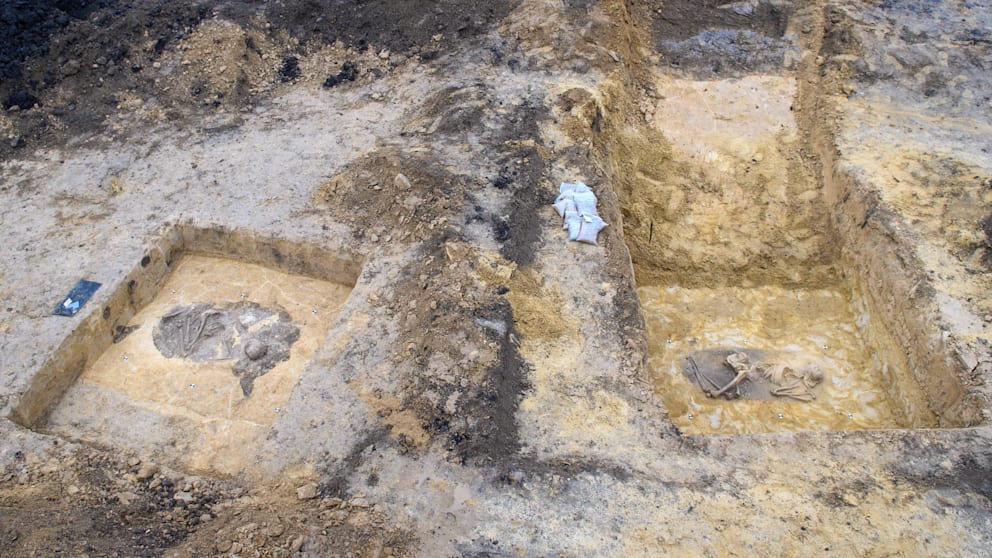
Archaeologists have discovered an approximately 4,500-year-old cemetery with ten graves from the Bell Beaker culture near Förderstedt, located in the Salzlandkreis district of Germany.

Currently, three particularly well-preserved burials have been uncovered. The deceased, buried in a hunched position facing east, were interred under a common burial mound. Women were laid on the right side, while men were on the left side of the body.

“A common burial mound covered all three deceased,” said project leader Susanne Friederich from the State Office for Heritage Preservation and Archaeology of Saxony-Anhalt.

In the Bell Beaker culture, the dead were always buried in a hunched position facing east. The name comes from the bell-shaped ceramic vessels that were filled with food and placed in the grave for the journey to the afterlife.


📣 Our WhatsApp channel is now LIVE! Stay up-to-date with the latest news and updates, just click here to follow us on WhatsApp and never miss a thing!!


Among the most striking discoveries are the grave goods found within the tombs. In one grave, archaeologists unearthed a bell-shaped ceramic vessel, approximately 15 centimeters in diameter, filled with food to accompany the deceased on their journey to the afterlife.
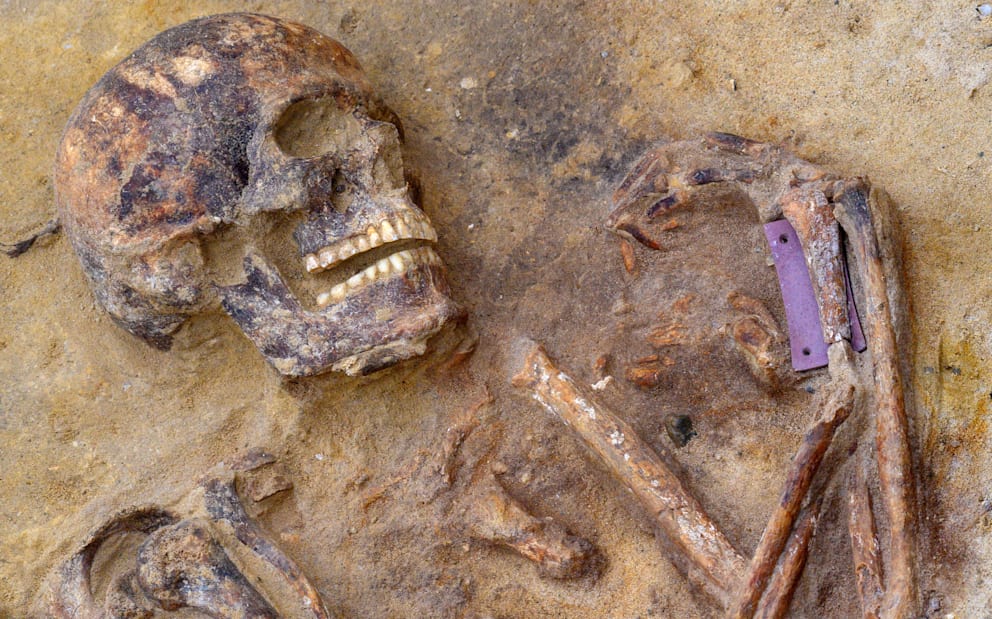

At the time of burial, the deceased was still wearing his arm guard, which helps archers avoid injuring themselves with the bowstring.
Photo: Klaus-Dietmar Gabbert/dpa
At the time of burial, the deceased was still wearing his arm guard, which helps archers avoid injuring themselves with the bowstring. Photo: Klaus-Dietmar Gabbert/dpa

This vessel was found in one of the three central burials. In the second burial, a stone arm guard was discovered. The archaeologist stated, “This indicates a male hunter or warrior.” The arm guard, measuring approximately eight by four centimeters, cushioned the snapping bowstring and thus prevented injuries.

“The third grave is remarkably well-preserved. In the back area of a warrior, two arrowheads were found. They were very close together,” Friederich noted. “Additionally, a quiver was faintly outlined in the sediment. This container for the arrows was made of organic material and has decayed. Only a different color and structure in the sediment indicate that the deceased was buried with his equipment.”

Graves Well-Preserved by Loess Clay

Although the graves were discovered at a depth of about two meters, they were originally much deeper or well-protected by a high burial mound. Excavation leader Christian Lau explained, “The graves were not placed on the surface, as is often observed with artificially mounded graves. Instead, the burial pit was dug through the upper soil layers and the loess clay down to the sand and filled with unmixed loess clay.”

This has allowed the bones to remain very well preserved. If they had been lying directly in the sand, the state of preservation would have been significantly worse. The graves will now be excavated in their entirety and examined more closely in the laboratory.

The excavations are taking place in advance of the expansion of the direct current line “SuedOstLink.”  The entire power line is approximately 540 kilometers long, stretching from Wolmirstedt near Magdeburg to the Isar site near Landshut in Bavaria.

Sachsen Anhalt

Cover Image Credit: Klaus-Dietmar Gabbert/dpa

Related Articles

The migration movement that started from Siberia 30,000 years ago may have shaped Göbeklitepe

24 June 2022

24 June 2022

Professor Semih Güneri, retired faculty member from Dokuz Eylul University (DEU) Caucasus Central Asia Archeology Research Center, stated that they...

Not From Denmark After All: Legendary Hjortspring Boat Linked to Baltic Raiders

11 December 2025

11 December 2025

One of Northern Europe’s most enigmatic archaeological finds—the 2,400-year-old Hjortspring Boat—may finally be giving up its secrets. New scientific analyses,...

4,900-year-old Copper Age Fortress with a Violent Past and Odd Roman Burial Found in Spain

13 February 2025

13 February 2025

A remarkable 4,900-year-old Copper Age fortress, featuring a pentagon shape, three concentric walls, 25 bastions, and three ditches, has been...

The world’s oldest wine discovered in liquid form was found in a Roman tomb in Spain

18 June 2024

18 June 2024

Archaeologists discovered an urn with a reddish liquid in a family mausoleum dating to the 1st century AD in the...

A 2,000-Year-Old Roman Inkwell Found in Portugal Contains a Technological Recipe That Shouldn’t Exist

17 November 2025

17 November 2025

A 2,000-year-old Roman inkwell found in Conimbriga reveals an advanced mixed-ink formula, challenging what we know about ancient writing technology...

Scientists discover 4 new Nazca Geoglyphs using AI deep learning

4 June 2023

4 June 2023

Scientists from Japan used AI deep learning to discover new geoglyphs in the Arid Peruvian coastal plain, in the northern...

A 2,500-Year-Old Mysterious Idol Discovered in the Ancient Urartian Fortress in Armenia

13 October 2025

13 October 2025

Archaeologists in Armenia have discovered a 2,500-year-old mysterious idol carved from volcanic tuff inside the ancient Urartian fortress of Argishtikhinili,...

2000-year-old anchor discovered at the bottom of the North Sea

26 September 2022

26 September 2022

A possible Iron Age anchor made from wrought iron was found at the bottom of the southern North Sea during...

Alexander the Great’s Sacred Purple Tunic Found in a 2,400-year-old Macedonian Tomb?

29 October 2024

29 October 2024

Archaeologists have found a sacred chiton (tunic) in a 2400-year-old royal tomb in the Macedonian city of Vergina in northern...

Earliest evidence for intestinal parasites in the UK came from Stonehenge

20 May 2022

20 May 2022

Researchers think they have discovered the earliest evidence for intestinal parasites in the UK. Ancient poop found at the site...

Hoysala temples inch closer towards UNESCO recognition

7 February 2022

7 February 2022

The Indian Union government recently proposed the Somanathapura temple in Mysuru district and Chennakeshava and Hoysaleshwara temples in Belur and...

Norwegian Boy in Search of Granddad’s Wedding Ring Finds 1500-year-old Roman Jewellery

11 August 2021

11 August 2021

Sander Magnus Vang (12) needed to find his grandfather’s lost wedding ring. Instead, he found a 1500-year-old ring. The golden...

One of the Largest Prehistoric Burial Grounds Ever Found in Bavaria Unearthed During Power Line Work

11 September 2025

11 September 2025

Archaeologists call the discovery a “sensation” as 22 prehistoric skeletons and rare artifacts are uncovered near Regensburg. Archaeologists in Bavaria...

Paleontologists Unearth Dozens of Giant Dinosaur Eggs in Fossilized Nest in Spain

15 November 2021

15 November 2021

Spain was the scene of a new paleontological discovery. Paleontologists extracted 30 Titanosaurus dinosaur eggs from a two-ton rock in...

The Highest Prehistoric Petroglyphs in Europe Discovered at 3000 Meters in the Italian Alps

20 November 2024

20 November 2024

The highest petroglyphs in Europe were found at Pizzo Tresero (Valfurva) in the Stelvio National Park in the northern Italian...