
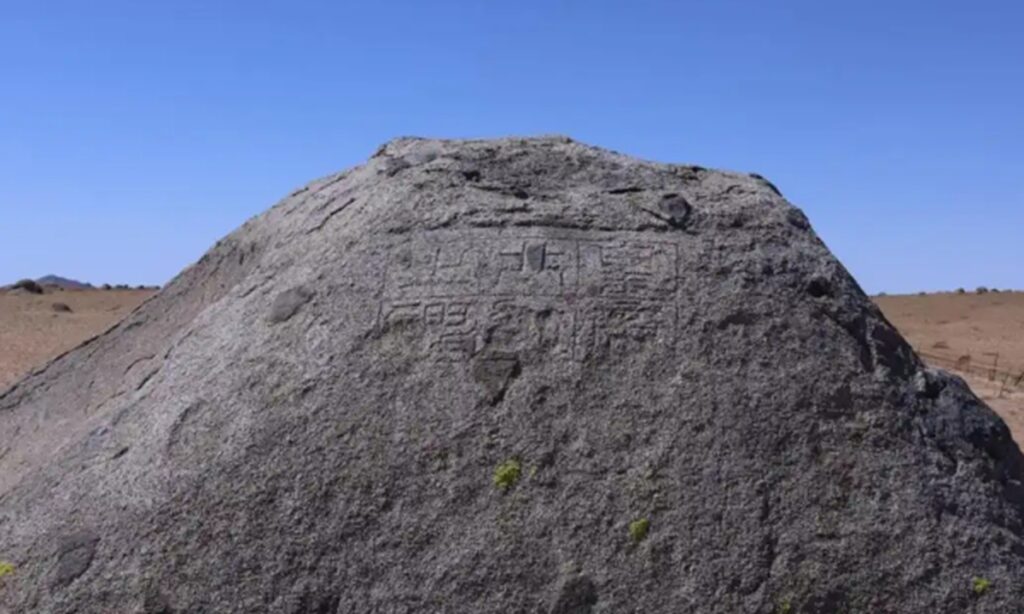
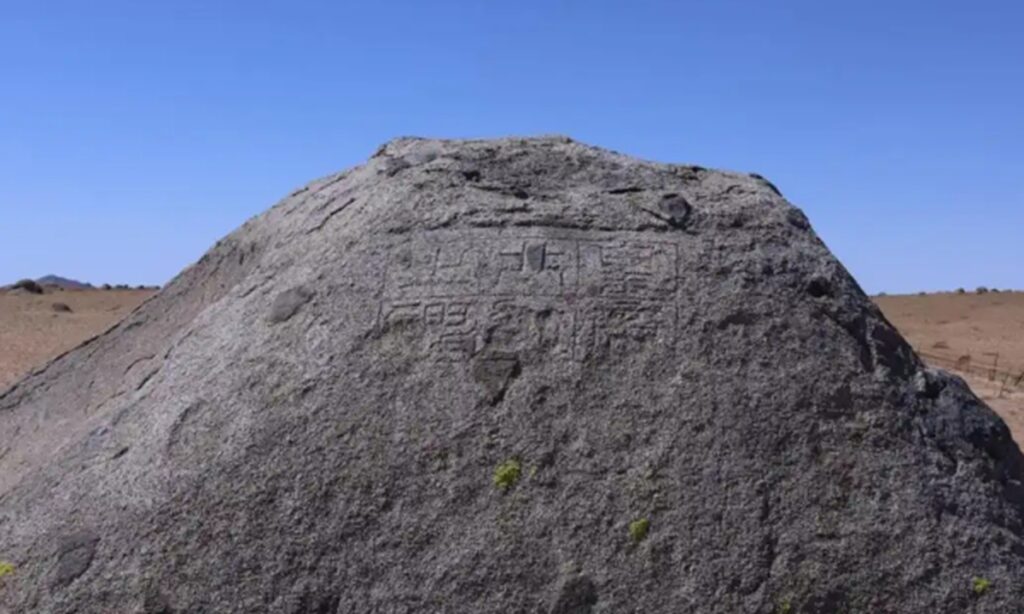
A newly unearthed stone inscription, tentatively named the “Stele of the Emperor’s Northern Tour,” has been discovered in the vast grasslands of Ulanqab, Inner Mongolia Autonomous Region, North China.
The inscription, carved onto a naturally formed granite boulder, was identified during a joint field survey by the Inner Mongolia Institute of Cultural Heritage and Archaeology and local cultural heritage authorities. Scholars believe it could be one of the most significant archaeological discoveries related to the Northern Wei Dynasty (386–534 CE) in recent years.
A Rare Epigraphic Find
At the top of the inscription, the words “Stele of the Emperor’s Northern Tour” appear in elegant seal script. The carving covers a 1.9-meter-wide by 2.6-meter-high section of the boulder. Although the surface has endured centuries of erosion, embedded basalt inclusions have preserved more than 50 recognizable characters. Among these are the terms dai (dynasty), yiyue (first month), zhuguozixiyushang (sons of various states, merchants from China’s Western Regions), and Mofu—a title historically used for tribal leaders of the Eastern Hu lineage in northern China.
The word Mofu appears at least seven times, suggesting the inscription may have emphasized alliances or hierarchies involving frontier tribes. Researchers have conducted high-resolution digital scans and produced ink rubbings to aid in preservation and analysis. Emergency conservation measures are also being planned to protect the stele from further weathering, with the goal of listing it among China’s nationally protected cultural relics.
Tentative Link to Emperor Daowu’s 399 CE Campaign
While the surviving text lacks explicit chronological markers such as reign titles, personal names, or detailed geographic locations, experts are cautiously linking the stele to Emperor Daowu’s northern expedition of 399 CE. This campaign, directed against the Gaoche tribes, is described in the Zizhi Tongjian (Comprehensive Mirror in Aid of Government).
Historical accounts note that in the first lunar month of 399, Emperor Daowu departed from Pingcheng (modern Datong, Shanxi Province) and divided his forces into eastern and western columns. Personally leading the central column of the eastern force, the emperor defeated nearly 40 Gaoche clans in a decisive series of battles. The following month, the army returned south of the Gobi Desert and conducted a grand hunt at Niuchuan, during which the Bushan Commemorative Stele was inscribed. Scholars suggest the newly found inscription may have been created in a similar context, celebrating imperial authority and military success on the northern frontier.
Connections with Other Northern Wei Stelae
The Northern Wei court was known for commemorating military campaigns with monumental inscriptions. Previously identified examples include the “Stele of the Emperor’s Eastern Expedition” and the “Ode to the Emperor’s Southern Gobi Expedition.” The former is known only through rubbings cited in the Commentary on the ShuiJingzhu (Commentary on the Water Classic), while the latter survives in fragmentary form and has been relocated to Datong for preservation.
If confirmed, the “Stele of the Emperor’s Northern Tour” would join this small but highly significant group of imperial inscriptions, offering new evidence of how the Northern Wei celebrated their frontier campaigns and consolidated authority in contested territories.
Ulanqab: A Historical Crossroads
The discovery’s location further enhances its importance. Ulanqab, situated in south-central Inner Mongolia, covers more than 54,000 square kilometers and borders Mongolia to the north, with Shanxi and Hebei provinces to the south. Known historically as Jininglu, Ulanqab served as a strategic transport hub along the Tea Road, a vital Eurasian trade corridor linking China with Mongolia and Russia.
Archaeological evidence shows the region has been a cultural crossroads for millennia. The Laohushan Culture, dating from around 2700–2200 BCE, was first identified in Liangcheng County, Ulanqab, and represents one of the earliest Bronze Age urban societies in northern China. The area is also home to numerous rock paintings and petroglyphs, some dating back to the Neolithic period. These artworks depict animals, hunting scenes, celestial symbols, and human figures, providing valuable insight into the beliefs and lifestyles of early steppe inhabitants.
Today, Ulanqab is not only an archaeological treasure trove but also a modern logistics hub. Under China’s Belt and Road Initiative, freight trains from Ulanqab connect directly with Europe, revitalizing its historic role as a link between East and West. Against this backdrop, the discovery of the “Northern Tour Stele” highlights the region’s enduring significance as both a cultural and geopolitical frontier.
Scholarly Importance and Future Prospects
According to Sun Jinsong, director of the Inner Mongolia Institute of Cultural Heritage and Archaeology, ongoing assessments will focus on authenticating the inscription’s age and historical context. “We have conducted digital scanning and created ink rubbings of the stele, and are organizing on-site investigations and expert evaluations,” he said.
Scholars emphasize that the inscription, whether directly linked to Emperor Daowu’s 399 campaign or not, sheds light on the complex interactions between the Northern Wei state and the steppe tribes. It also illustrates the dynasty’s use of monumental texts to project imperial authority across vast frontier zones.
As preservation efforts continue, experts anticipate that the stele will contribute to a deeper understanding of Northern Wei history, frontier governance, and cultural exchange. Findings from the ongoing analysis will be released to the public once further evidence is compiled.
Cover Image Credit: Global Times
