
8 December 2025 The Future is the Product of the Past

2,500-Year-Old Saka Warrior Found Holding Bronze Sword in Pristine Burial

Archaeologists in central Kazakhstan have unearthed an exceptionally well-preserved tomb of a Saka warrior, revealing a pristine 2,500-year-old bronze sword still clutched in its owner’s hand. The discovery, made at the Karabiye burial site in the Aktogay district of the Karaganda region, has been hailed as one of the most significant archaeological finds from the early Iron Age in recent decades.

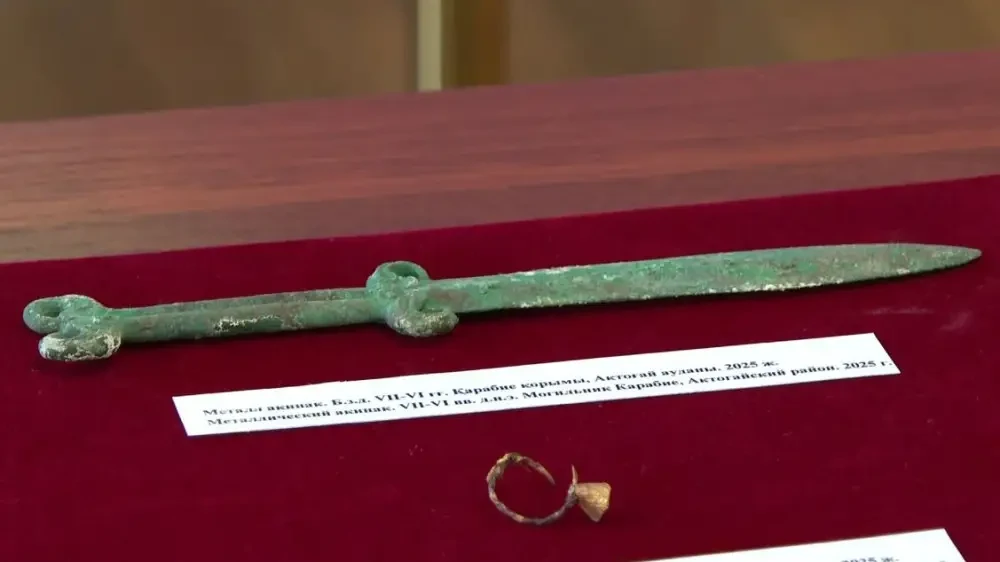
The excavation, carried out by a team from the Karaganda Regional History Museum, uncovered an untouched burial mound—known as Kurgan No. 1—dating to the 7th–6th centuries BC. Such undisturbed graves are extremely rare among Saka sites, many of which were looted long ago. Beneath layers of stone slabs lay the remains of a warrior positioned carefully according to ancient funerary traditions, his right hand still gripping a bronze akinak—a short sword emblematic of the Saka elite.

“After removing the covering slabs, we saw a skeleton in correct anatomical order. In his right hand was an akinak. We haven’t had such findings in many years,” said Dauren Zhussupov, head of the Archaeology Department at the regional museum.

The bronze weapon, about 30 centimeters long, is double-edged and intricately decorated with figures of steppe birds of prey and argali horns—symbols deeply associated with power and the free spirit of the nomads. Archaeologist Arman Beissenov described the sword as “a masterpiece of ancient metallurgy” and noted that no similar example has yet been found elsewhere in Kazakhstan.
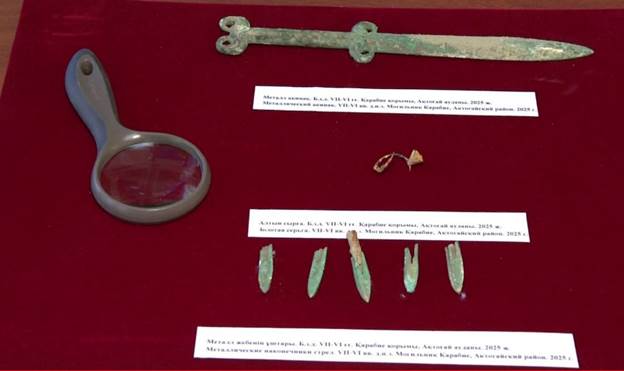
Karabiye tomb contained five metal arrowheads and a gold earring, believed to have once adorned the warrior or served as an offering to accompany him into the afterlife. Credit: Karaganda Regional History Museum

A Window Into Saka Craftsmanship

The sword’s exceptional quality reveals the advanced metallurgical and artistic skills of the Saka, a confederation of nomadic tribes who dominated the Central Asian steppes from roughly the 8th to 3rd centuries BC. Known to the ancient Persians as Saka and to the Greeks as Scythians, these horseback warriors forged a sophisticated culture defined by mobility, animal symbolism, and elite artistry in gold and bronze.


📣 Our WhatsApp channel is now LIVE! Stay up-to-date with the latest news and updates, just click here to follow us on WhatsApp and never miss a thing!!


Their weapons and ornaments were not only tools of war but also symbols of status and spirituality. The birds of prey etched into the akinak’s hilt may have represented divine guardianship or the sharp vision of warriors scanning the open plains. Similar motifs appear on the legendary “Golden Man” burial unearthed in Kazakhstan’s Issyk kurgan, suggesting a shared visual language of power across the Saka world.

Signs of a Warrior Elite

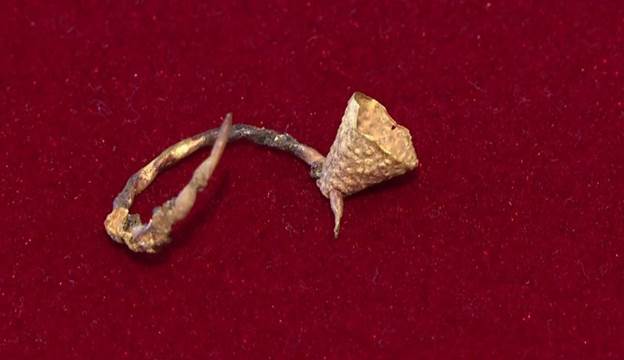
In addition to the sword, the Karabiye tomb contained five metal arrowheads and a gold earring, believed to have once adorned the warrior or served as an offering to accompany him into the afterlife. The presence of precious metal ornaments indicates that the man held a high social rank—perhaps a chieftain or a noble fighter.

The Saka were famed for their mounted archers, whose speed and precision transformed steppe warfare. Classical authors such as Herodotus described them as fierce yet disciplined, capable of defeating much larger armies through hit-and-run tactics. Their skill with the bow and their elaborate burial customs inspired later steppe cultures, including the early Turkic tribes.
Credit: Karaganda Regional History Museum

Preserving the Past

The Karaganda team plans to conduct metallographic, radiocarbon, and anthropological analyses to determine the warrior’s age, origins, and the specific composition of the bronze alloy. The results, expected next winter, may shed new light on trade routes and technological exchanges in the early Iron Age.

The find underscores Kazakhstan’s growing importance as a center of archaeological discovery in Eurasia. Recent decades have seen the recovery of multiple Saka “Golden Men,” richly adorned with gold regalia, each rewriting part of the region’s early history. Yet, unlike many royal tombs, this latest discovery stands out for its untouched state—an unbroken link to a civilization that vanished over two millennia ago.

As Beissenov summarized, “This burial allows us to look directly into the world of the Saka. Every detail—from the weapon to the ornamentation—tells the story of people who lived, fought, and dreamed across the great steppes of Kazakhstan.”

Cover Image Credit: Karaganda Regional History Museum

Related Articles

Rare Medieval Seal of Basel Cathedral Cantor Found From the Rhine in Basel

27 November 2025

27 November 2025

Rare, well-preserved medieval seal of Basel Cathedral cantor Rudolf Kraft discovered in the Rhine, alongside Roman coins and 19th-century bath...

1,900-Year-Old Medusa Cameo Unearthed in Hallstatt: One of the Most Significant Roman-Era Finds in Alpine Austria

5 December 2025

5 December 2025

An exquisite Roman gemstone unearthed in Hallstatt is challenging long-held assumptions about Rome’s presence in the Alpine region and revealing...

8,000-year-old Yarmukian ‘Mother Goddess’ figurine discovered in Israel

9 July 2022

9 July 2022

An 8,000-year-old Yarmukian Mother Goddess figurine was found at Sha’ar HaGolan archaeological site, located on the northern bank of the...

Antibiotic bacteria that fight E. coli and other dangerous bugs found in the Roman Baths at Bath in England, “Bath’s waters may really be good for you”

9 June 2024

9 June 2024

The popular Roman Baths in the city of Bath in southwest England are home to a diverse range of microorganisms...

Denisovans or Homo Sapiens: Who Were the First to Settle Permanently on the Tibetan Plateau?

8 December 2021

8 December 2021

The Tibetan Plateau has long been considered one of the last places to be populated by people in their migration...

Hidden Royal Trove of rulers of Poland and Lithuania discovered in the underground vaults of Vilnius Cathedral in Lithuania

17 January 2025

17 January 2025

A unique find was made in the dungeons of the Vilnius Cathedral: The royal funerals of the Polish and Lithuanian...

Explore 1,400-year-old ruins, submerged in Eastern China – Atlantis of China

10 June 2023

10 June 2023

Deep in Qiandao Lake, between China’s Five Lion Mountains, lie the mysterious ruins of two ancient cities, dating back to...

Astonishing Find in the Czech Republic: Hikers Discover a 3.7 Kilogram Serbian/Bosnian Gold Treasure

29 April 2025

29 April 2025

A leisurely hike on the slopes of Zvičina Hill in the Czech Republic turned into an extraordinary discovery for two...

Knife and Lost Armor: First-Ever Verified Artifacts from Emperor Nintoku’s 5th-Century Kofun Tomb Revealed

13 August 2025

13 August 2025

In a discovery that is already rewriting the history of Japan’s ancient Kofun period, researchers have confirmed the existence of...

The Discovery of a Historic Wooden Shipwreck in the North Sea

27 January 2025

27 January 2025

A section of a wooden shipwreck was uncovered near Rantum, a coastal village located on the island of Sylt in...

Using 3D scanners, archaeologists have identified the person who carved Jelling Stone Runes

29 September 2023

29 September 2023

Researchers at the National Museum of Denmark using 3D scans have identified who carved the Jelling Stone Runes, located in...

Mystery of the ‘Deserted Castle’ Unraveled: Austria’s First Roman Bridgehead Fort Discovered

18 April 2025

18 April 2025

Researchers have identified the first confirmed Roman bridgehead fort in Austria, located near Stopfenreuth on the Lower Austrian Danube floodplains....

Zeus Temple’s entrance was found in western Turkey’s Aizanoi Ancient City

31 July 2021

31 July 2021

During recent digs, the monumental entrance gate of the Zeus Temple sanctuary in the ancient city of Aizanoi, located in...

The Earliest Evidence of Christianity on Bulgarian Territory Found in Roman city of Deultum

13 July 2024

13 July 2024

A silver amulet was discovered during excavations of the Deultum-Debelt National Archaeological Reserve, near the village of Debelt in the...

Tanzania’s mysterious footprints were made by early humans, not bears

6 December 2021

6 December 2021

The prehistoric footprints discovered by archaeologists caused confusion because scientists looked at them again to determine whether they were left...