
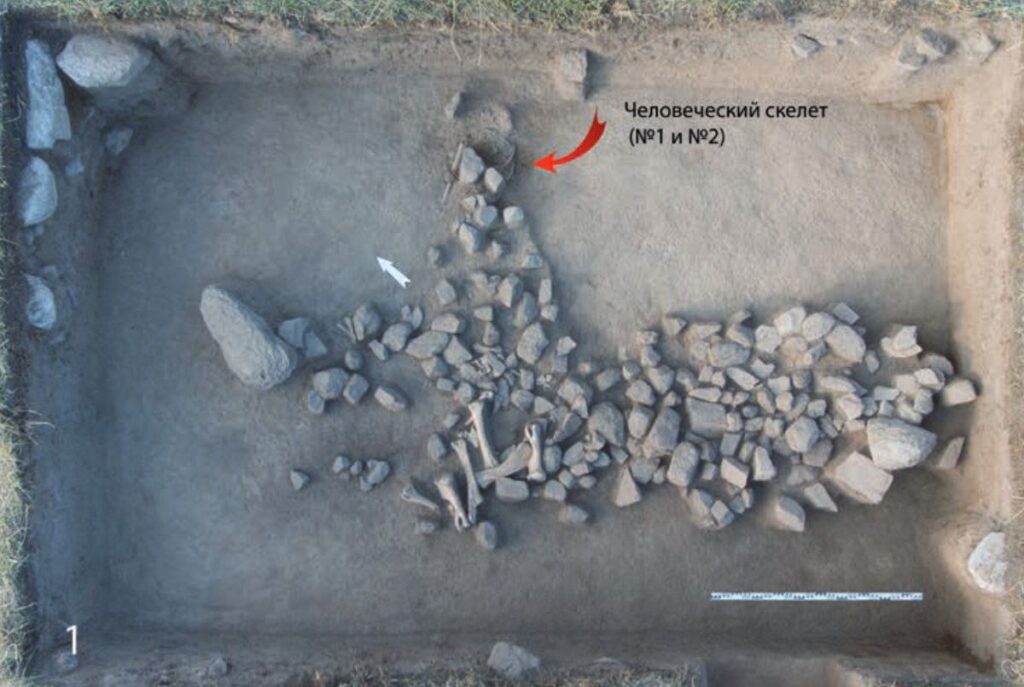
Archaeologists in eastern Kazakhstan have uncovered the country’s oldest known human burial, dating back around 7,000 years. Found beneath Bronze Age layers at the Koken settlement near the Kokentau Mountains, the grave provides the first radiocarbon-dated evidence of human presence in Kazakhstan during the Early Neolithic period — long before the emergence of herding or farming in the region.
The burial was discovered by an international research team led by Dr. Paula Doumani Dupuy (Nazarbayev University), Dr. Zhuldyz Tashmanbetova (Washington University in St. Louis), and Academician Zainolla Samashev (Margulan Institute of Archaeology). Their findings, published in Kazakhstan Archaeology, shed light on how early hunter-gatherers adapted to the arid steppe environment of the eastern Eurasian plains.
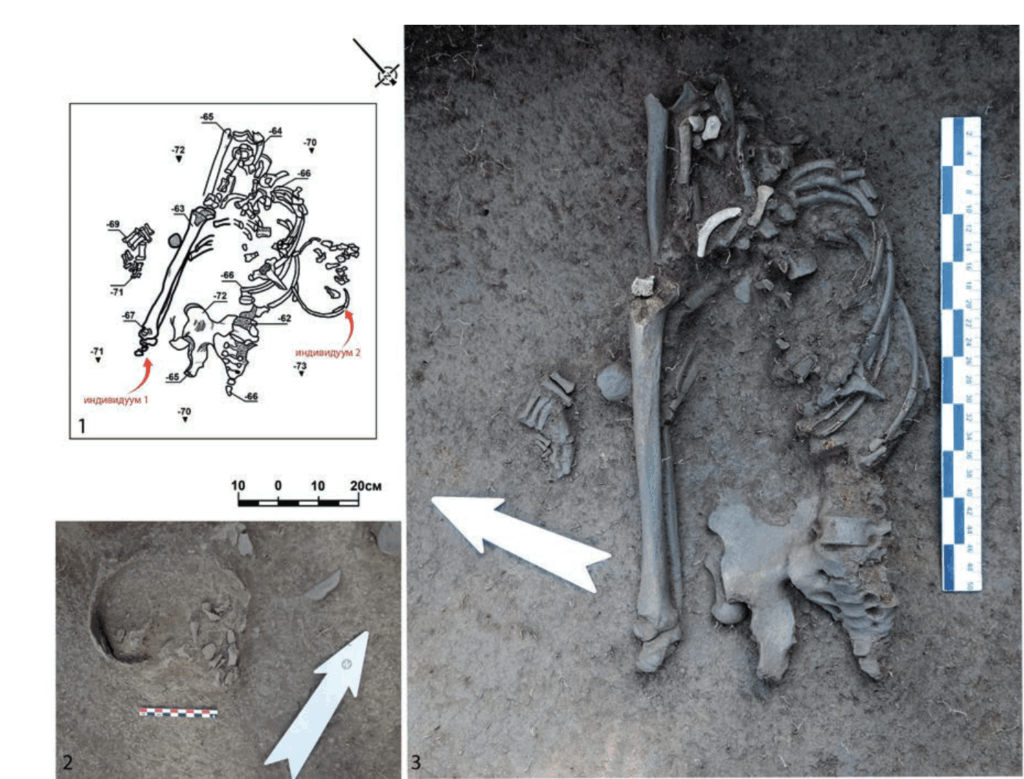
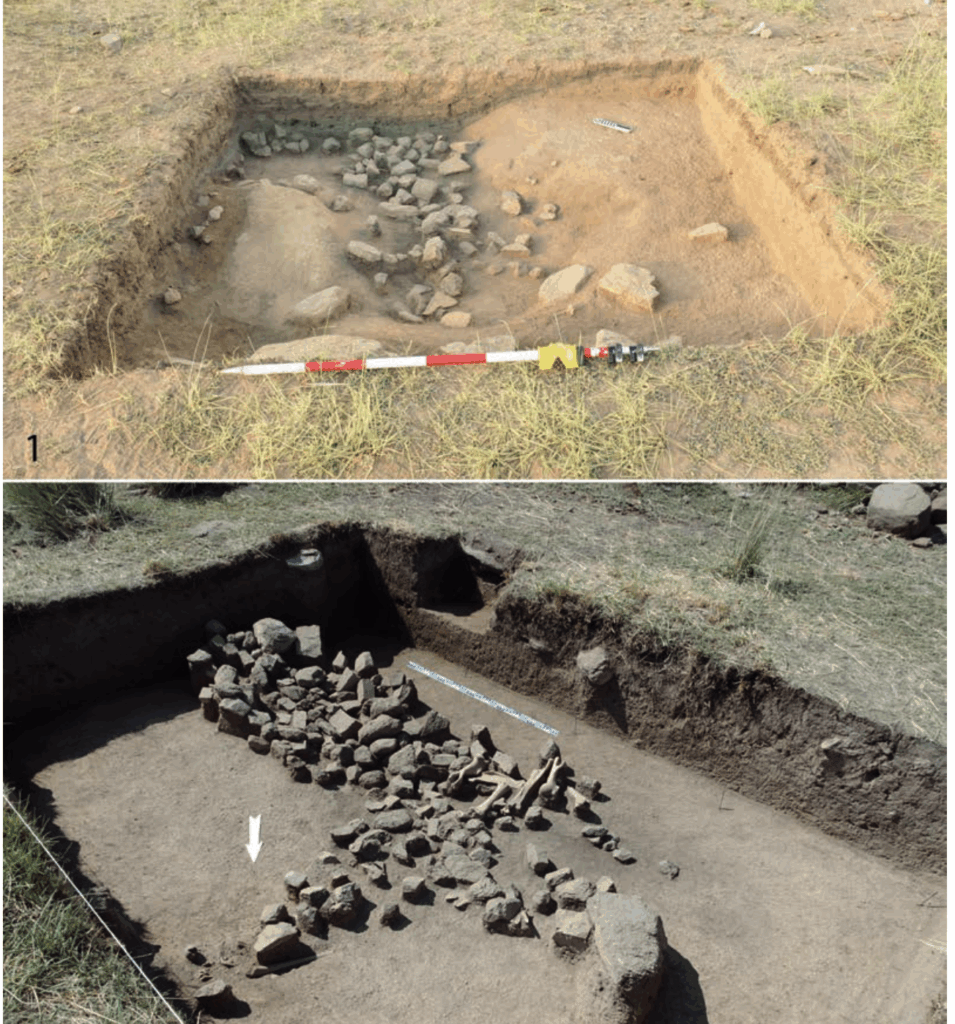
Excavations revealed that under the remains of a Bronze Age settlement lay stratified deposits from the Stone Age. Within these earlier layers, archaeologists encountered an oval-shaped pit containing the remains of two individuals: a tightly flexed adult skeleton resting on its right side, and a separate skull belonging to a younger person. Radiocarbon dating of the bones yielded calibrated dates between 5471 and 5222 BC, making it the earliest directly dated human burial in Kazakhstan.
According to the researchers, the posture and arrangement of the bones suggest a complex funerary practice. The adult was buried in a strongly contracted position, knees drawn close to the chest and oriented northeast, while the adolescent’s cranium faced northwest. This tightly bound posture may indicate that the body was tied or wrapped before burial, symbolizing a ritual return to the womb of the Earth — a belief observed among early Holocene communities across Siberia and Central Asia.
“This discovery opens a new chapter in the study of the earliest inhabitants of the Kazakh steppe,” said Dr. Doumani Dupuy. “It offers a rare glimpse into how prehistoric hunter-gatherers perceived death, ritual, and their relationship with the land.”
Layers of Time Beneath the Steppe
The Koken settlement, situated near Semey (formerly Semipalatinsk), occupies a semi-arid landscape at the foot of the Kokentau range. Beneath its Bronze Age occupation levels, the team identified older cultural horizons dating to the Mesolithic and Neolithic periods. The burial was found directly below a much later ethnographic-period refuse pit, whose builders had unknowingly disturbed parts of the ancient grave.
Traces of ash, animal bones, and pottery fragments above the burial indicate that the site was reused for domestic purposes millennia later. Radiocarbon analysis of a horse bone from the overlying layer dated to between 1690 and 1920 AD — showing that the area remained inhabited almost continuously for over seven thousand years.
Despite this disturbance, much of the skeleton remained in situ, preserving valuable osteological information. Preliminary analysis determined that the main burial (Individual 1) belonged to a young adult, while the isolated skull (Individual 2) came from a teenager. Ongoing DNA and isotopic tests aim to establish kinship and ancestry links between the two.
Tools of a Stone Age Community
Alongside the human remains, archaeologists recovered stone artifacts — flakes, blades, and prismatic cores made of flint, jasper, and carnelian. These indicate that Koken’s earliest inhabitants practiced a microlithic stone-tool industry, comparable to contemporaneous Neolithic cultures around Lake Baikal and the Altai. Such evidence suggests that by the mid-6th millennium BC, communities in eastern Kazakhstan had already developed sophisticated techniques for crafting hunting and processing tools from local raw materials.
A Rare Glimpse into Early Ritual Life
The simplicity of the Koken grave — an unmarked pit without visible surface structures or grave goods — contrasts with later Bronze Age burial traditions of the steppe. Yet the arrangement of the bodies echoes burial customs found across Neolithic Siberia, Mongolia, and Central Asia. Comparable flexed-body interments with missing or separately buried skulls are known from sites such as Shamanka II and Lokomotiv near Lake Baikal, as well as Khariulyn Gozgor in northern Mongolia.
In these regions, archaeologists have interpreted such practices as part of secondary burial rituals, in which skulls or bones were deliberately removed or re-interred as symbols of ancestral veneration. The Koken find thus extends this symbolic behavior westward into the Kazakh steppe for the first time.
Rewriting the Prehistory of Kazakhstan
Before this discovery, the oldest confirmed burials in Kazakhstan were those from Zhelezinka and Bestamak, dated to around 5000 BC — roughly a millennium later than Koken. The new find not only pushes back the timeline of human occupation but also provides direct evidence of a settled or semi-sedentary population thriving in the region during the Early Holocene.
“Koken is a key site for understanding the roots of Eurasian civilization,” notes academician Samashev. “It bridges the cultural and genetic landscapes of Central Asia, Siberia, and the early peoples of the steppe who later shaped the nomadic world.”
Future excavations at Koken aim to uncover deeper layers that may preserve even older traces of human activity from the Mesolithic, potentially illuminating how early foragers adapted to Kazakhstan’s harsh continental climate long before the dawn of agriculture.
For now, the 7,000-year-old grave at Koken stands as the earliest known testimony to human presence in Kazakhstan — a silent echo of the first steppe dwellers whose descendants would one day roam the vast grasslands of Eurasia.
Doumani Dupuy, P. N., Tashmanbetova, Z., Kiyasbek, G., Merts, V., Coil, R., Zhuniskhanov, A., & Samashev, Z. (2025). Earliest human burial in Kazakhstan: Neolithic findings from the Koken settlement. Kazakhstan Archaeology, 3(21), 164–186. https://doi.org/10.52967/akz2023.3.21.164.186
Cover Image Credit: Dr. Paula Doumani Dupuy
