

8 November 2025 The Future is the Product of the Past

Frozen but Not Forgotten: 2,500-Year-Old Tattoos of Siberian Ice Mummy Digitally Reconstructed

Siberian Ice Mummy: Unveiling Ancient Tattoo Traditions of Iron Age Siberia

In a groundbreaking fusion of archaeology and modern imaging, scientists have revealed never-before-seen details of ancient tattooing practices in Iron Age Siberia, offering new insight into one of humanity’s oldest forms of body art.

Using high-resolution near-infrared imaging and 3D photogrammetry, researchers have re-examined the preserved tattoos of a 2,500-year-old Pazyryk mummy from the Altai Mountains. The tattoos, hidden beneath layers of mummified skin and centuries of degradation, are now being brought back to life—digitally.

A New Look at Ancient Skin

The Pazyryk people, part of the wider Scythian cultural world, are known for their elaborate tombs, intricate artwork, and—for a select few—their richly decorated bodies. Until now, archaeologists relied on hand-drawn interpretations of these tattoos, but this new study has uncovered far more: evidence of multiple tattoo artists, advanced design techniques, and the tools likely used to create them.

“This is the first time we’ve been able to distinguish the hands of different artists on a single body,” said Dr. Gino Caspari, lead researcher from the Max Planck Institute of Geoanthropology. “What we’re seeing is not just decoration, but craftsmanship and collaboration.”


📣 Our WhatsApp channel is now LIVE! Stay up-to-date with the latest news and updates, just click here to follow us on WhatsApp and never miss a thing!!


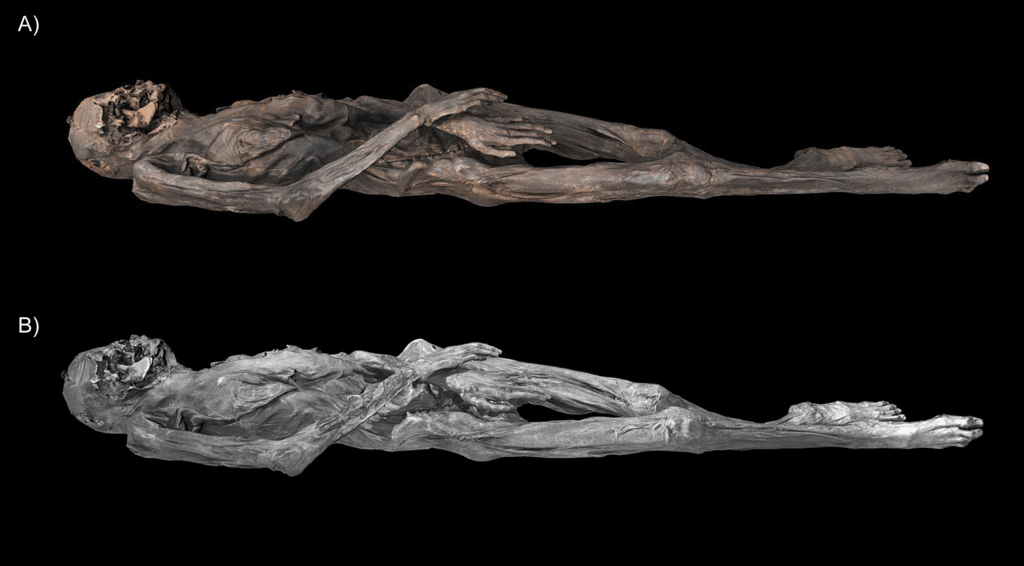
Photogrammetrically created 3D model of the female mummy from Pazyryk Tomb 5, showing: A) texture derived from visible-spectrum photographs; B) texture derived from near-infrared photography.
(Figure by M. Vavulin) Credit: Caspari, G., Deter-Wolf, A., Riday, D., Vavulin, M., & Pankova, S. - Antiquity
Photogrammetrically created 3D model of the female mummy from Pazyryk Tomb 5, showing: A) texture derived from visible-spectrum photographs; B) texture derived from near-infrared photography. (Figure by M. Vavulin) Credit: Caspari, G., Deter-Wolf, A., Riday, D., Vavulin, M., & Pankova, S. – Antiquity

Technological Breakthroughs Rewrite Tattoo History

The team applied near-infrared photography to reveal pigment embedded deep in the skin layers—details previously invisible to the naked eye. Paired with experimental tattooing techniques, the data shows that multi-point and single-point tools were used, debunking older theories that ancient tattoos were applied only by stitching or incision.

One arm features complex animal motifs, such as deer and tigers, arranged with striking anatomical accuracy and perspective—suggesting a seasoned artist. The other arm’s simpler lines may have been inked by an apprentice or a different artist entirely.

Living Ink, Lost in Death

Perhaps most revealing, researchers found that post-mortem burial incisions sliced through the tattoos with no apparent effort to preserve them—indicating these images held meaning only for the living.

“There’s no sign the tattoos had religious or afterlife significance,” Caspari explained. “They were part of identity, status, maybe storytelling—but once the person died, that chapter closed.”

An illustration of the tattoo on the woman's left forearm revealed in new scans. Credit: Daniel Riday
An illustration of the tattoo on the woman’s left forearm revealed in new scans. Credit: Daniel Riday

Ink of the Ancients, Lessons for Today

The Pazyryk used carbon-based pigments—likely soot—mirroring tattoo traditions around the globe. Despite the millennia that separate modern artists from their Siberian ancestors, the tools, techniques, and intentions behind these tattoos offer a striking sense of continuity.

As climate change threatens the frozen tombs that preserved these remains for centuries, researchers stress the urgency of digital preservation. This study is not just about understanding the past—it’s about saving it.

Caspari, G., Deter-Wolf, A., Riday, D., Vavulin, M., & Pankova, S. (2025). High-resolution near-infrared data reveal Pazyryk tattooing methods. Antiquity, 1–15. doi:10.15184/aqy.2025.10150

Cover Image Credit: An illustration of the tattoo on the woman’s right forearm revealed in new scans. Credit: Daniel Riday

Related Articles

An inscription containing 15 headless falcons and unknown ancient rituals found in an ancient Egyptian temple

8 October 2022

8 October 2022

Archaeologists have discovered a shrine containing previously unknown ancient rituals during excavations at Berenike, a Greco-Roman port in Egypt’s eastern...

Enigmas Roman Dodecahedron Uncovered by Amateur Archaeologists in the UK

24 January 2024

24 January 2024

Amateur archaeologists have unearthed a striking Roman dodecahedron in the serene countryside of Norton Disney, England, a mysterious class of...

Ancient city site unearthed in Central China produces fortune-telling relics

8 February 2024

8 February 2024

Bone slips used for “fortune-telling activities” and “ancient sacrificial ceremonies” were unearthed during excavations at an archaeological site in Puyang,...

Polish archaeologists have uncovered nine crocodile heads within ancient Egyptian tombs of nobles

25 December 2022

25 December 2022

Polish archaeologists excavating the Theban Necropolis in Egypt discovered nine crocodile heads hidden inside two tombs belonging to high-ranking nobles....

Evidence of Medieval Scotland in Inverness revealed by building work

19 June 2021

19 June 2021

Archaeologists in Scotland have discovered medieval remains during excavations for construction work, and they are exposing mysteries about the industrial...

The migration movement that started from Siberia 30,000 years ago may have shaped Göbeklitepe

24 June 2022

24 June 2022

Professor Semih Güneri, retired faculty member from Dokuz Eylul University (DEU) Caucasus Central Asia Archeology Research Center, stated that they...

A rare Saint George seal was found during excavations near Suzdal

27 June 2023

27 June 2023

The archaeological survey of the Suzdal Opole, initiated by the Institute of Archeology of the Russian Academy of Sciences more...

A Hoard of Gold and Silver Roman Coins Dating Back to the Reign of Emperor Nero was Found in Worcestershire

7 December 2024

7 December 2024

A hoard of Roman and Iron Age silver coins dating back to Emperor Nero’s reign has been found during building...

3 Bronze Shields and Helmet of 2700 Years Old Belonging to Urartians Found in Ayanis Castle

8 September 2024

8 September 2024

Three bronze shields and a bronze helmet dedicated to Haldi, the chief god of the Urartians, were discovered during excavations...

A Mysterious Partially Submerged Structure in Ireland is a Prehistoric Tomb, archaeologist says

25 October 2022

25 October 2022

New research has revealed that a mysterious structure found many years ago on the eastern shore of Cork Harbor in...

1,500-year-old feast mosaic found in Turkey

2 February 2022

2 February 2022

A 50-square-meter mosaic depicting an open-air feast dating back 1,500 years ago was unearthed during excavations in the ancient city...

On the beach of Herculaneum, a victim of the Vesuvius explosion was discovered with his bag

4 December 2021

4 December 2021

Archaeologists released haunting images Wednesday of the skeletal remains of a man buried by the eruption of Mount Vesuvius in...

“Urartian Royal garbage dump” was found during excavations at Ayanis Castle

3 September 2022

3 September 2022

During the excavations carried out in the Ayanis Castle, which was built by the Urartian King Rusa II on the...

AI Unlocks Ancient Secrets: Dead Sea Scrolls May Be Centuries Older Than Previously Thought

8 June 2025

8 June 2025

New research blends cutting-edge artificial intelligence with advanced radiocarbon dating and offers a transformative perspective on the origins of the...

An ancient melon genome from Libya reveals interesting insights regarding watermelon relatives

2 August 2022

2 August 2022

The earliest known seeds from a watermelon related were discovered during an archaeological dig in Libya, going back 6,000 years...