
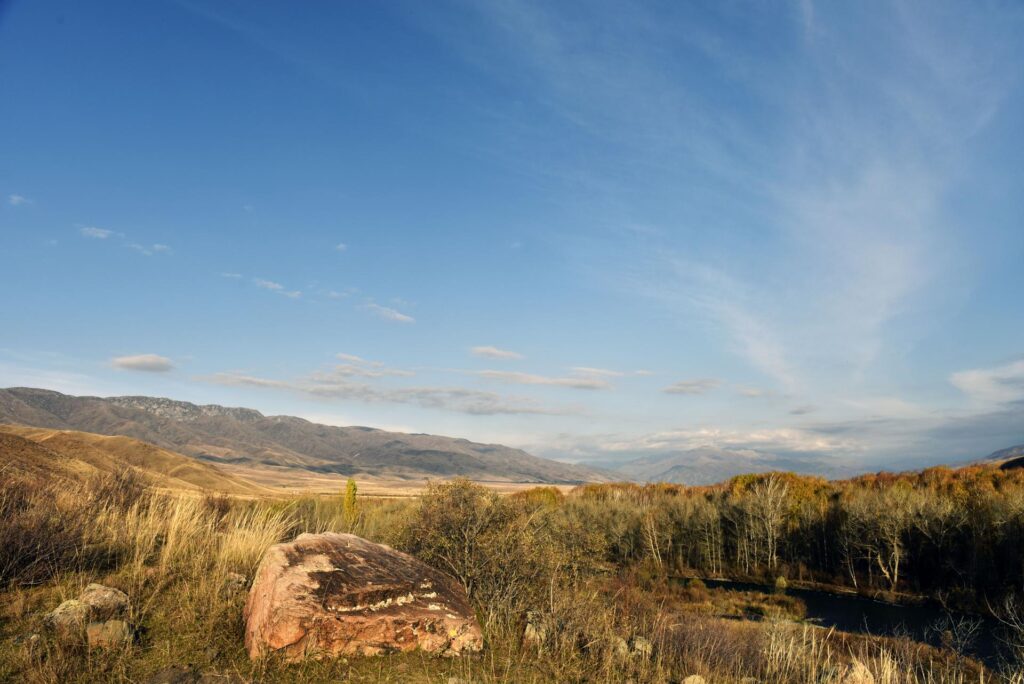
An ancient deer with towering, branching antlers has reappeared in the mountains of southeastern Kazakhstan, exactly where a 19th-century explorer described it. Archaeologists following historical travel diaries have located a remarkable collection of rock carvings, including images associated with the early Saka culture, while tracing a route that also leads to a centuries-old Buddhist sanctuary.
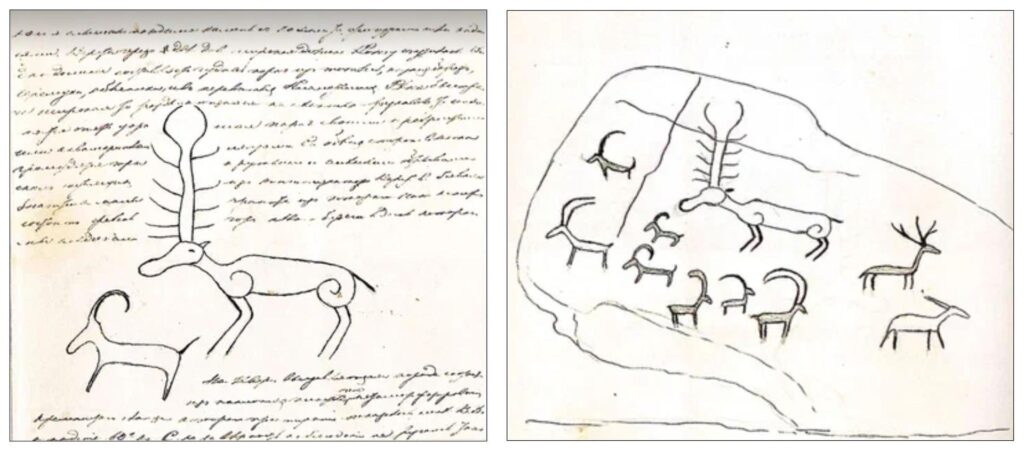
The discovery began with a drawing Russian geographer Pyotr Semyonov-Tyan-Shansky made in 1856. While travelling through the Koksu River valley, he heard about unusual figures carved into a rock and left his main route to investigate. He eventually found images of animals, which he recorded in his travel diary without knowing their precise age or cultural significance.
For generations, those sketches remained an unusual record of rock art whose exact location was no longer known. Now, a joint Russian-Kazakh archaeological expedition has identified the original carvings and documented them using modern survey techniques, according to the Institute of Archaeology of the Russian Academy of Sciences.
A Mysterious Deer Hidden in the Koksu Valley
Among the carvings, one figure immediately stood apart: a large deer crowned with unusually tall, branching antlers. Researchers associate its distinctive appearance with early Saka art, a tradition familiar from ancient metalwork and jewelry found across parts of Central Asia.
The image was carved into an enormous boulder in the Koksu River valley in Kazakhstan’s historical Zhetysu region. Other figures recorded by Semyonov, including wild goats and sheep, represent different periods, ranging from the Early Iron Age to the Middle Ages. The collection therefore preserves evidence of artistic activity extending across centuries rather than a single episode of carving.
Elena Levanova, head of the Paleoart Center at the Russian Academy of Sciences’ Institute of Archaeology, emphasized the deer’s resemblance to Saka animal imagery known from Kazakhstan and Tuva. Comparable artistic motifs also appear on objects from the Zhalauly treasure, an important assemblage of ancient ornamental metalwork.
The boulder’s imposing size has prompted another possibility. Archaeologists suggest it may once have served as a place of veneration for nomadic Saka communities, although its ritual function remains unproven.
How an Explorer’s Drawings Led Archaeologists Back to the Rock
In August 1856, Semyonov travelled down the Koksu valley after hearing reports of strange markings on stone. His diary described the journey through narrowing mountain scenery, the granite rocks near the river, and the animal figures he found on one of the boulders.
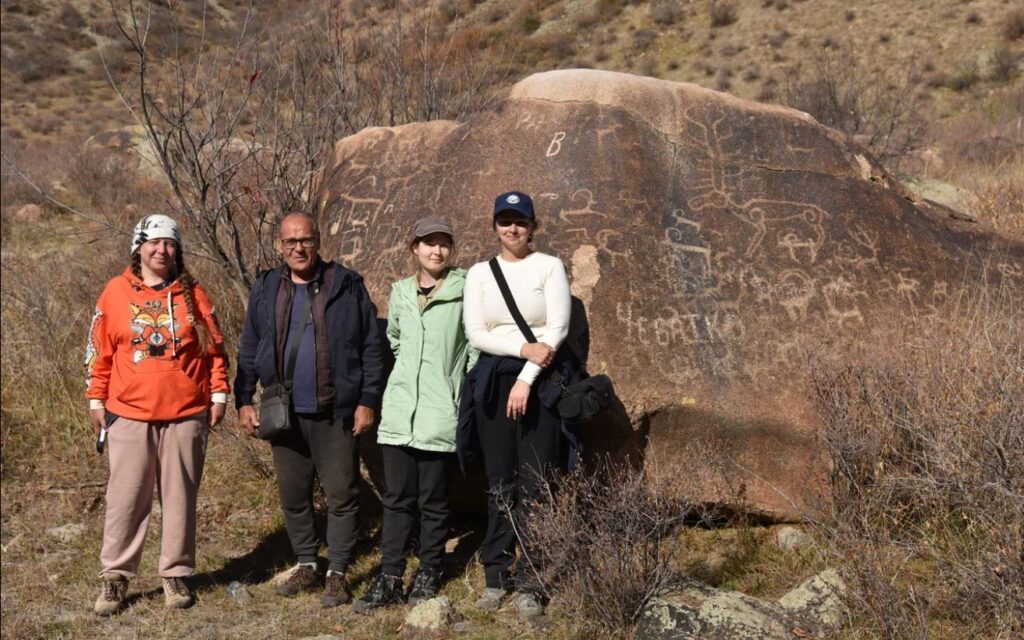
Those details proved remarkably useful to modern researchers. Although the original sketches were simple, archaeologist Alexey Rogozhinsky of Kazakhstan’s Tanbaly Museum-Reserve reported that the drawings matched the surviving carvings with surprising accuracy. Even Semyonov’s descriptions of the surrounding landscape helped the team identify the site.
The achievement lies not simply in finding a previously described rock. For the first time, the researchers have established the location of the carvings precisely and recorded their present condition through modern archaeological documentation. This creates a basis for comparing their imagery with other examples of early Saka rock art and investigating changes at the site over time.
The joint expedition brought together specialists from the Russian Academy of Sciences and Kazakhstan’s Tanbaly Museum-Reserve. Supported by the Russian Geographical Society, the project retraced sections of Semyonov’s travels through southeastern Kazakhstan, connecting historical observations with surviving archaeological monuments.
From Saka Rock Art to a Buddhist Sanctuary
The expedition also followed the historical route toward Tamgaly-Tas, a Buddhist sanctuary beside the Ili River. Its religious imagery and inscriptions belong to a much later chapter of the region’s history, generally dated to the 17th and 18th centuries.
Here, the researchers drew on another set of historical images, created by artist Pavel Kosharov, who accompanied Semyonov’s travels in 1857. By comparing Kosharov’s illustrations with the surviving rock carvings, the team could examine how the monuments had been recorded in the 19th century and how they appear today.
The two locations should not be mistaken for parts of a single religious complex. The Koksu deer carvings and the Buddhist sanctuary are separated by geography and centuries of cultural change. Their connection lies in the expedition’s route, which brought together archaeological evidence from very different periods of Kazakhstan’s past.
Across nearly 600 kilometers, the researchers also visited other historical and natural landmarks described during Semyonov’s journeys. The result is a broader record of a landscape where prehistoric and ancient rock art, later religious traditions, and the history of scientific exploration intersect.
Bringing Historical Discoveries Into the Digital Age
The original explorers relied on handwritten descriptions and drawings. Their modern counterparts have added geodetic mapping, aerial photography, and three-dimensional documentation to the investigation, allowing researchers to record archaeological features with far greater precision.
The fieldwork has now been completed, and specialists are processing the collected information to produce detailed digital models of selected rock carvings and inscriptions. The project also aims to develop an interactive map of Semyonov’s historical route through southeastern Kazakhstan, making the findings more accessible for future research.
For archaeologists, the newly documented deer is particularly valuable because its form can now be studied alongside other examples of Saka animal art. Its elaborate antlers, prominent setting, and possible ritual associations offer new questions about how early nomadic communities represented animals in their cultural landscape.
