
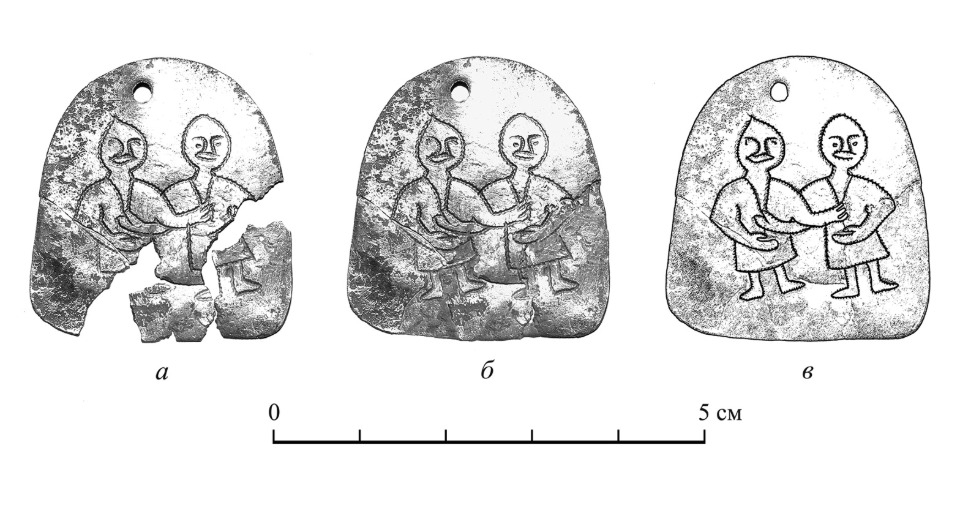
Archaeologists working in Russia’s Perm Krai have uncovered an unusual medieval silver ornament engraved with two human-like figures, a small but striking object that may have moved from personal adornment into the world of funerary ritual.
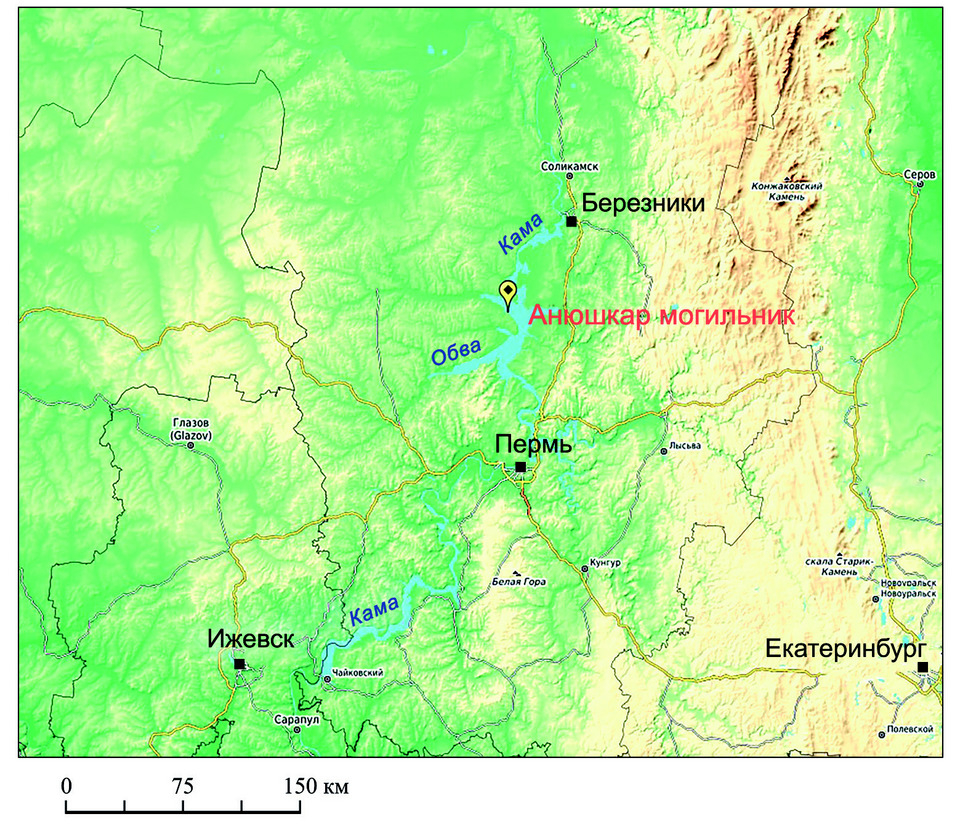
The find was made during 2025 excavations at the medieval Anyushkar cemetery, located on the bank of the Kama River in the Perm Cis-Urals. According to a study published in Brief Communications of the Institute of Archaeology, the artifact dates most likely to the second half of the 11th century or the first half of the 12th century.
What makes the object stand out is not its size. The silver plate measures only about 30 millimeters high and 27 to 30 millimeters wide. Its importance lies in its image: two frontal anthropomorphic figures, shown standing close together, possibly holding each other under the arms.
A small silver plate with a rare human scene
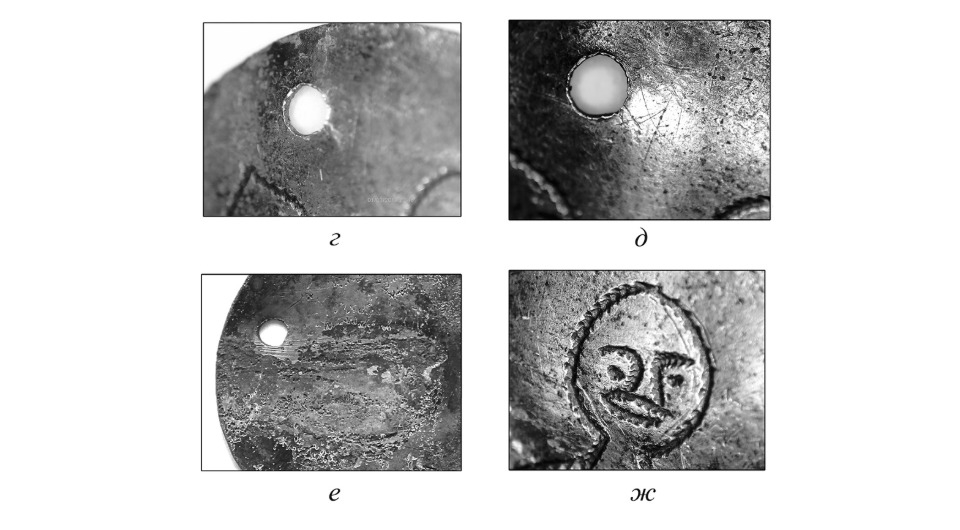
The artifact is an arched silver plate with a rounded upper section and a small hole near the top. Traces on the back suggest it may once have been attached to clothing, leather, fabric, or another object. The hole could also have allowed it to be suspended, sewn, or fixed into place.
On the front, a medieval craftsperson engraved two human figures in broad clothing with V-shaped necklines. Their heads are unusually large and almond-shaped, and one appears to narrow toward the top. Researchers also noticed traces of a preliminary sketch beneath the finished engraving, suggesting that the design was planned before it was cut into the metal.
Elemental analysis detected small traces of gold on the front of the plate. This raises the possibility that the ornament was originally partly gilded, giving the figures a brighter appearance when the object was new.
Found near disturbed medieval burials
The Anyushkar cemetery has been known since 1960, when it was discovered after a village affected by flooding was moved to a new location. Local residents encountered graves while working in their gardens. The latest excavation took place in one of these garden plots after its owners temporarily stopped cultivating the land.
Across an area of nearly 50 square meters, archaeologists investigated six disturbed burials and recovered a number of artifacts from grave fills and the space between graves. The silver ornament was found near one of the burials, although researchers cannot prove that it belonged directly to that grave.
That uncertainty is important. The object may have been displaced by later disturbance, or it may have been deposited in a position that reflected a specific funerary practice rather than ordinary personal use.
Pendant, ritual object, or funerary face-plate?
Researchers suggest that the ornament may originally have functioned as a pendant. Its shape, rear attachment traces, and upper perforation all fit that possibility. Yet its role in the cemetery may have been different from its role in life.
The authors of the study propose that the silver plate may have been sewn onto a funerary covering, possibly through the hole at the top. In that setting, it could have served as a ritual object or even as a funerary face-plate.
This interpretation is especially interesting because it points to a transformation in meaning. A personal ornament may have become part of the ritual treatment of the dead. The engraved figures, once decorative, may have carried symbolic value in the burial ceremony.
The image itself remains open to interpretation. The two figures could represent companionship, kinship, ritual participants, ancestors, or a protective scene. The study does not force a single answer, which is one reason the find is so intriguing.
Local craftsmanship in the medieval Kama region
The artifact’s technology, iconography, and figure details led researchers to suggest a local origin in the Kama region. This is significant because the Perm Cis-Urals were not a cultural backwater in the Middle Ages. The area sat within a network of river routes, local traditions, and long-distance exchange.
The nearby fortified settlement of Anyushkar stood on a high promontory near the confluence of the Inva and Kama rivers. It appears to have emerged around the 10th century, while its main period of activity likely came between the 12th and 15th centuries. The site is associated with the Rodanovo archaeological culture and is also described as having functioned as a Bulgar trade and craft outpost.
Today, Anyushkar is threatened by the Kama Reservoir, whose waters continue to erode parts of the medieval landscape. That makes new excavations particularly valuable. Each recovered object adds detail to a region where written sources are limited and material culture remains the main guide.
A rare glimpse of belief, identity, and death
The silver plate is small enough to fit in the palm of a hand, but it brings together several major themes of medieval archaeology: personal display, local metalworking, burial practice, and symbolic imagery.
Its date, the second half of the 11th to the first half of the 12th century, places it in a period of active cultural interaction across the Kama and Volga regions. The wider Cis-Ural world was home to Finno-Ugric-speaking communities and was connected to Volga Bulgaria, trade routes, craft production, and shifting medieval identities.
For archaeologists, the value of the Anyushkar ornament lies in this layered story. It was not simply a silver decoration. It may have been worn in life, altered in meaning at death, and placed within a ritual setting where image, material, and memory mattered.
The two engraved figures still resist a clear explanation. That is part of their force. More than 900 years after the plate was made, they remain side by side on a piece of silver from the Kama River region, preserving a rare trace of medieval belief in a landscape still being reshaped by water.
Lychagina, E. L., Podosyonova, Y. A., & Bryukhova, N. G. (2026). Redkoe ukrashenie iz raskopok srednevekovogo mogil’nika Anyushkar (Permskoe Predural’e) [Rare ornament from the excavations of the medieval Anyushkar cemetery (Perm Cis-Urals)]. Kratkie Soobshcheniya Instituta Arkheologii [Brief Communications of the Institute of Archaeology], 282, 180–191. https://doi.org/10.25681/IARAS.0130-2620.282.180-191
Cover Image Credit: Evgenia Lychagina et al. / Brief Communications of the Institute of Archaeology, 2026.
