
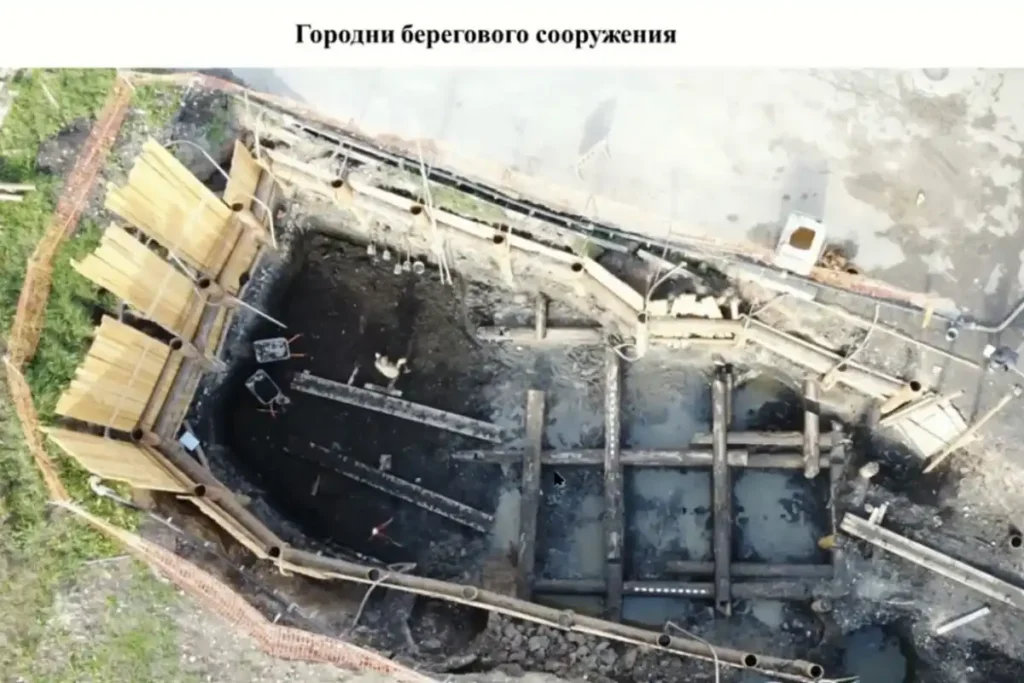
Archaeologists in Veliky Novgorod, one of Russia’s oldest historic cities, have uncovered the remains of a large wooden riverside structure that may be part of a 16th-century river pier. The discovery, made on the banks of the Volkhov River, is being described by experts as unprecedented for the region and could significantly reshape understanding of the city’s early river infrastructure and trade history.
The structure was found during excavations on the Sofia Side of Veliky Novgorod, near the Victory Monument and close to the Novgorod Kremlin. On the opposite bank lies Yaroslav’s Court, historically known as the Torq, which served as the city’s main commercial and economic center in medieval times. Despite Novgorod’s rich archaeological record, its riverbank zones have remained largely unexplored, making this find particularly important.
A Unique Wooden Structure Unlike Any Found Before
According to archaeologists, the newly uncovered structure consists of massive wooden logs, primarily pine, with diameters reaching up to 50 centimeters. The remains extend toward the river and have been traced for a length of approximately 24 meters.
“This is an exceptionally powerful construction made of large logs,” said Pyotr Gaidukov, advisor to the director of the Institute of Archaeology of the Russian Academy of Sciences and a leading researcher at Novgorod State University. “We believe this is the lower foundation of a major riverside structure, possibly a navigable river pier. Nothing like this has ever been discovered in Novgorod before.”
Initially, archaeologists assumed the remains were part of a defensive wall running parallel to the riverbank. However, that theory was abandoned once it became clear that the structure sloped downward toward the Volkhov River, suggesting a functional connection to water transport rather than fortification.

Dating the Pier to the Early 1500s
The age of the structure was determined using dendrochronological analysis, a method that dates wood based on tree-ring patterns. Results showed that one log was cut in 1509 and another in 1510. These findings were further supported by coins and seals discovered within the same cultural layer.
Historians believe the construction of the pier may be directly linked to the devastating fire of 1508, which destroyed much of Novgorod’s Trade Side and reportedly claimed at least 2,000 lives. During the disaster, the Great Bridge across the Volkhov River was also destroyed.
“According to one of the Novgorod chronicles, the bridge was rebuilt in 1509, shortly before the visit of Grand Prince Vasily III of Moscow,” Gaidukov explained. “It is very likely that large-scale construction was taking place throughout the city at that time, including the structure we uncovered.”
Evidence from a 17th-Century City Plan
Additional support for this theory comes from a 1611 city plan of Novgorod, which shows a bulwark extending into the river precisely at the location of the discovery. Archaeologists suggest that when this later riverside fortification was built, it may have incorporated or reused elements of the earlier wooden structure.
Experts also believe the pier fell out of use before 1582, when construction began on the Small Earthen Town, a system of defensive fortifications surrounding the city’s detinets (inner fortress). During the digging of defensive moats, earth was piled over the pier’s foundation, effectively burying it for centuries.

Preservation and Public Display
After careful documentation and excavation, all wooden elements of the structure were removed and transferred to the Vitoslavlitsy Museum of Wooden Architecture, located near Veliky Novgorod.
“The logs are currently undergoing conservation under specialist supervision,” said Gaidukov. “Once the process is complete, the Novgorod Museum plans to present this unique early 16th-century architectural structure to the public.”
The findings were officially presented at the 40th Scientific Conference ‘Novgorod and the Novgorod Land: History and Archaeology’, with contributions from researchers of the Institute of Archaeology of the Russian Academy of Sciences, including Oleg Oleinikov, Sergey Chernykh, Andrey Berezkin, and Vyacheslav Kolobrodov.
Archaeologists say the discovery not only sheds new light on river transport and trade in medieval Novgorod, but also highlights how much remains to be learned from the city’s underexplored riverbanks. As research continues, the structure may become one of the most significant archaeological finds in the region in recent years.
Cover Image Credit: Novgorod State University
