

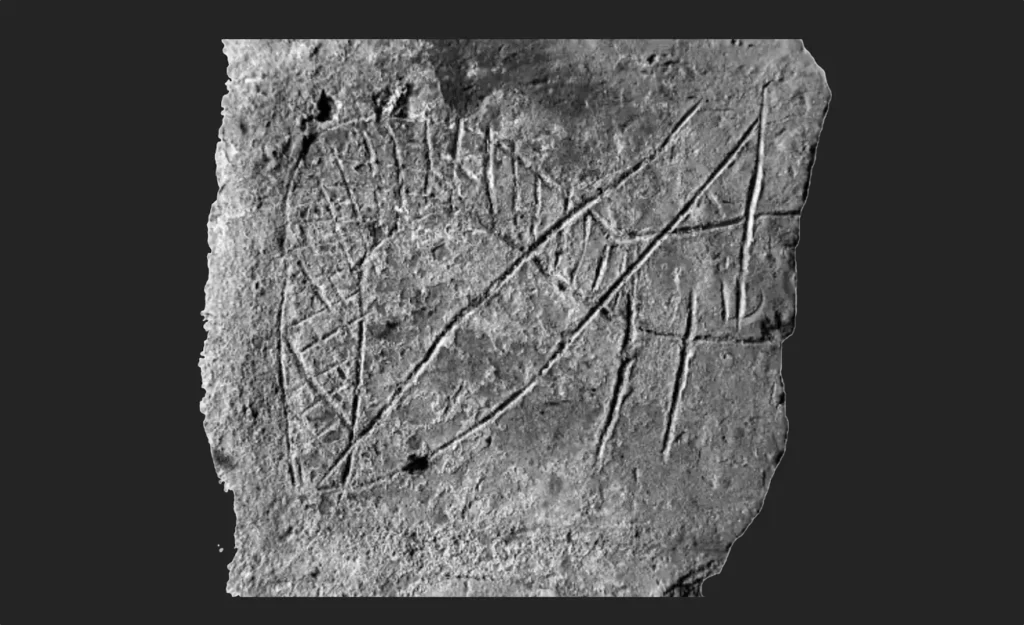
A modest fragment of brick unearthed in central Spain is now at the center of a major historical debate that could reshape our understanding of ancient warfare. Discovered at the archaeological site of Cerro de la Muela—also known as El Pulpón—in the province of Cuenca, the artifact features a crude yet compelling engraving: a mounted rider whose depiction may include what appears to be the earliest known stirrup in Western Europe.
If confirmed, this finding would push back the introduction of the stirrup in the West by more than a century, challenging long-held assumptions about the evolution of cavalry and military technology in Late Antiquity.
A Small Artifact with Big Implications
The engraved brick fragment, measuring approximately 25 x 22 cm, was found during renewed excavations at El Pulpón, a site that had remained largely overlooked since initial digs in the 1970s. Archaeological evidence places the artifact between the late 4th and early 5th centuries A.D., a period marked by political instability and military transformation in the late Roman world.
The dating is supported by associated finds, including ceramics typical of the era and coins issued under the usurper Magnus Maximus (r. 383–388 A.D.). This contextual evidence provides a firm chronological framework, making the engraving particularly significant in discussions of early military innovation.
Decoding the Engraving
At first glance, the drawing appears rudimentary. The horse is outlined with simple lines, while the rider is represented by a single vertical stroke. However, closer inspection reveals key details that have captured the attention of researchers.
The horse’s head and neck are decorated with crosshatched and diamond-shaped patterns, interpreted as protective gear—likely a chamfron (head armor) and crinet (neck defense). These features are associated with heavy cavalry units such as cataphracts, which were known for their armored horses and riders.
The most controversial element lies beneath the rider: a curved line extending from the base of the figure. According to the study’s authors, this is unlikely to represent a foot. Given the otherwise simplistic depiction of the rider, the deliberate inclusion of this curved feature suggests it may instead represent a stirrup.
This interpretation is crucial. If accurate, it would constitute the earliest visual evidence of a stirrup in Western Europe.
Why the Stirrup Changed Warfare Forever
The stirrup is not just a minor accessory—it is widely regarded as a transformative innovation in the history of warfare. By providing stability and balance, stirrups allowed mounted soldiers to fight more effectively, particularly in delivering powerful lance strikes or using ranged weapons.
Historians have traditionally believed that stirrups were introduced to Western Europe in the 6th century A.D., likely by the Avars, a nomadic people from the Eurasian steppes. Written references, such as those in the Byzantine military manual Strategikon, appear only in this later period.
However, the El Pulpón engraving suggests that stirrup-like technology may have been present much earlier—possibly as early as the late 4th century.
Challenging the Historical Consensus
The absence of earlier written records has long been used as evidence against early stirrup use in the West. But researchers caution that this “argument from silence” is not definitive.
Comparable cases exist elsewhere. In China, archaeological evidence shows that stirrups were in use by the 4th century A.D., yet written documentation only appears decades later. This discrepancy highlights the limitations of relying solely on textual sources.
The El Pulpón engraving adds a new dimension to the debate by providing tangible, datable evidence. While not definitive proof, it strengthens the argument that stirrup technology may have diffused into Western regions earlier than previously thought.
Parallels Across Eurasia
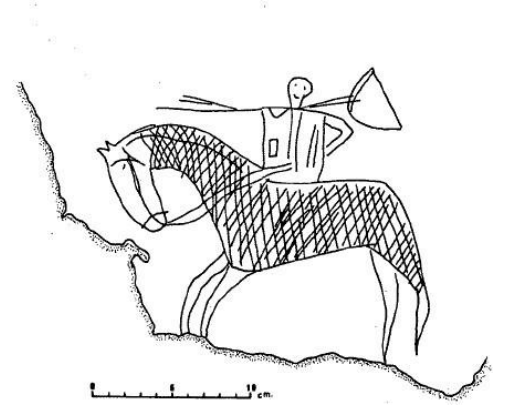
To support their interpretation, researchers have identified similar artistic representations from other regions and periods. These include engravings from Bulgaria’s Madara site and reliefs from Taq-i Bostan in modern-day Iran, both depicting armored riders.
Interestingly, stylistic parallels also exist with much later medieval engravings in Spain. These similarities are attributed not to chronological overlap but to the schematic nature of such drawings, which follow standardized visual conventions regardless of period.
The presence of armored horses in the El Pulpón engraving aligns with known developments in Roman and Near Eastern military practices. Heavy cavalry units—often inspired by Parthian and Sasanian models—were increasingly prominent during Late Antiquity.
A Snapshot of a Turbulent Era
The historical context of the late 4th and early 5th centuries provides a plausible explanation for the appearance of advanced cavalry equipment in Hispania.
This was a time of political upheaval, marked by usurpations, civil wars, and the movement of diverse military forces across the Roman Empire. Figures such as Magnus Maximus and Constantine III brought troops from various regions, including the eastern frontiers where heavy cavalry was more common.
The El Pulpón site itself may have witnessed the presence of such units. The diversity of artifacts and the strategic location suggest it was part of a broader network influenced by these turbulent events.
Who Drew the Image—and Why?
One of the most intriguing questions is why this scene was engraved on a brick. The answer may lie in the practicalities of ancient construction. Bricks were left to dry before firing, providing a window during which drawings could be made on the soft clay.
Researchers propose that the artist was likely not a trained craftsman but someone familiar with military life—perhaps a soldier or a local observer. The engraving may have been created spontaneously, as a way to illustrate or explain unfamiliar equipment.
The emphasis on certain details—such as the horse’s armor and the possible stirrup—suggests that the artist was highlighting features that stood out as unusual or noteworthy.
A Debate Far from Settled
Despite its potential significance, the interpretation of the El Pulpón engraving remains contested. Critics point to the lack of corroborating evidence from other archaeological or textual sources.
Yet, the discovery underscores an important principle in historical research: new evidence can challenge established narratives. As more findings emerge, the timeline of technological innovations like the stirrup may need to be revised.
For now, the El Pulpón brick stands as a compelling piece of the puzzle—a small artifact with the power to reshape our understanding of how warfare evolved in the ancient world.
The engraved brick from central Spain offers a rare glimpse into a transformative period in military history. Whether it ultimately proves to be the earliest depiction of a stirrup in Western Europe or not, its discovery has already sparked renewed debate among historians and archaeologists.
As research continues, this humble fragment may help bridge gaps in our knowledge and illuminate the complex pathways through which innovation spread across ancient civilizations.
Barroso Cabrera, R., Morín de Pablos, J., & Urbina Martínez, D. (2025). Grabado de un jinete sobre ladrillo procedente del yacimiento de El Pulpón (Carrascosa del Campo, Cuenca). ARPI: Revista de Arqueología y Prehistoria del Interior Peninsular, (10), 16–29. https://hdl.handle.net/10017/68655
Cover Image Credit: Cerro de la Muela Roman archaeological site in Cuenca. Public Domain
