
Archaeologists have made a groundbreaking discovery in Saint-Césaire, Charente-Maritime, uncovering what is now considered the oldest shell jewellery workshop in Western Europe. Dating back at least 42,000 years, this extraordinary find sheds new light on the cultural dynamics at the dawn of the Upper Palaeolithic era and provides rare insights into the interactions between Neanderthals and Homo sapiens.
The site, known as La Roche-à-Pierrot, revealed an unprecedented assemblage of pierced shells accompanied by red and yellow pigments. The findings, led by a team of researchers from the CNRS, Université de Bordeaux, the French Ministry of Culture, and Université Toulouse 2 Jean Jaurès, have been published in the Proceedings of the National Academy of Sciences (PNAS). This discovery not only marks the first known instance of shell jewellery production in Western Europe but also offers clues about mobility, trade, and cultural exchange during one of prehistory’s most transformative periods.
A Window Into the Châtelperronian Culture
The workshop is associated with the Châtelperronian culture, a prehistoric tradition documented in France and northern Spain between 55,000 and 42,000 years ago. This period was marked by a profound shift: the gradual replacement of the last Neanderthal populations by incoming Homo sapiens migrating out of Africa.
Traditionally, Châtelperronian sites yielded bone tools and ornaments made from animal teeth. The newly discovered shell beads, however, represent an unprecedented form of symbolic expression in this cultural context. They suggest that the people of this era were experimenting with new materials and forms of ornamentation, possibly influenced by the arrival of early Homo sapiens in Europe.
One of the long-standing debates in prehistoric archaeology concerns the identity of Châtelperronian artisans. Were these ornaments created by Neanderthals adopting new practices, or by early Homo sapiens who introduced their symbolic traditions? The Saint-Césaire discovery adds crucial evidence to this debate, suggesting cultural contact, transmission, or even coexistence between the two human groups.
Evidence of a True Jewellery Workshop
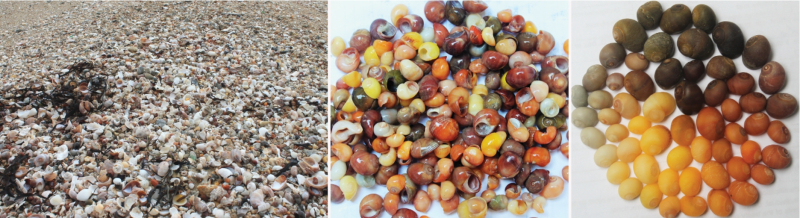
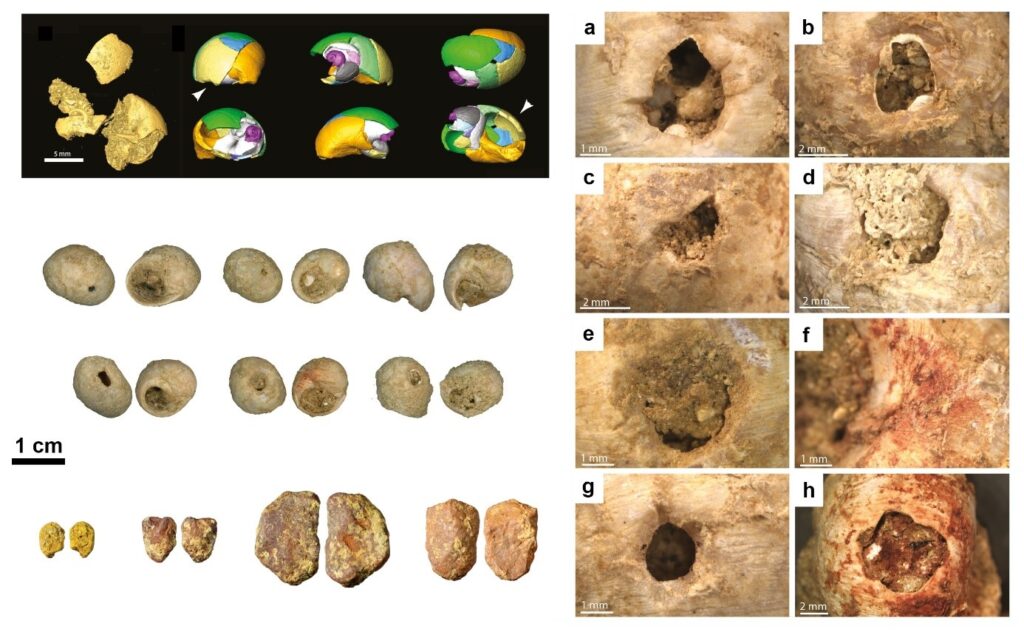
Excavations at La Roche-à-Pierrot revealed dozens of perforated Littorina obtusata shells, some unworked and others showing traces of pigment and piercing. The absence of wear marks on certain perforations, combined with the presence of unpierced shells, indicates that this was not simply a collection of ornaments but rather a genuine workshop where jewellery was manufactured.
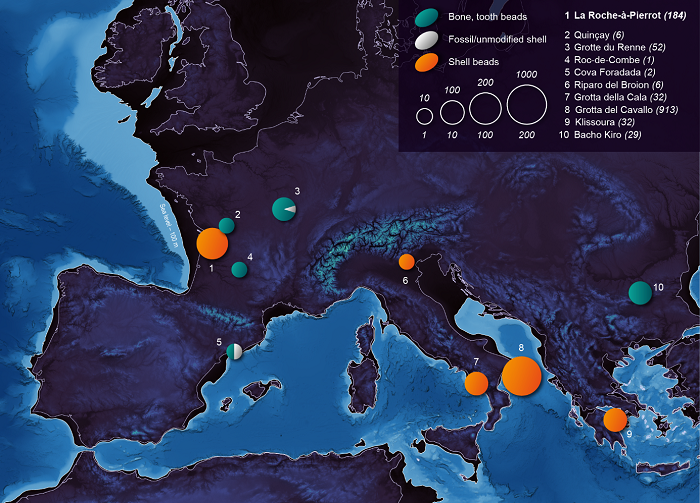
The raw materials also reveal fascinating details about mobility and trade. The shells originated from the Atlantic coast, located around 100 kilometres from Saint-Césaire at the time, while the pigments came from deposits more than 40 kilometres away. Such distances suggest either long-range trade networks or significant human mobility during this period.
Other artefacts discovered at the site include typical Neanderthal stone tools and remains of hunted animals such as bison and horses, reflecting the complexity of life in this multi-faceted settlement.
Symbolism and Identity in Early Human Societies
The shell beads and pigments from Saint-Césaire provide powerful evidence of the rise of symbolic practices in Europe. Ornamentation in prehistory is often associated with social differentiation, identity, and symbolic communication—traits strongly linked with Homo sapiens.
The Saint-Césaire findings therefore reinforce the idea that symbolic behaviour was spreading rapidly during this transitional period. Whether adopted by Neanderthals through contact with Homo sapiens, or introduced directly by early modern humans, these practices represent a crucial step in the development of human cultural complexity.
A Unique Site for Understanding Human Interactions
Saint-Césaire is no stranger to groundbreaking discoveries. Excavations at La Roche-à-Pierrot have been ongoing since 1976 and have yielded significant insights into Neanderthal and Homo sapiens occupation. The site is particularly famous for the 1979 discovery of a well-preserved Neanderthal skeleton, which remains one of the most important finds of its kind.
With its nearly 30,000 years of continuous human occupation, Saint-Césaire is considered a natural laboratory for studying the dynamics of prehistoric settlement, cultural exchange, and adaptation. The new jewellery workshop discovery adds yet another layer of importance, showing that the site played a pivotal role in the story of human evolution in Europe.
Since 2013, researchers have revisited earlier collections while applying new excavation and analytical methods, resulting in fresh insights like the shell jewellery workshop. These advancements highlight how modern science continues to rewrite our understanding of the past.
Collaboration and Scientific Impact
The study involved eleven laboratories, coordinated by the CNRS and supported by institutions across France. Specialists in archaeology, anthropology, geology, and palaeoenvironmental studies contributed to analysing the artefacts. The participation of the Musée national de Préhistoire also ensured that the findings were contextualised within broader collections of early human artefacts.
The discovery of the oldest shell jewellery workshop in Western Europe confirms the Châtelperronian as one of the earliest Upper Palaeolithic industries, bridging the cultural worlds of Neanderthals and Homo sapiens. It not only illuminates the symbolic practices of our ancestors but also redefines how we understand the origins of art, identity, and human connection in prehistory.

Cultural Insights
The Saint-Césaire jewellery workshop offers an extraordinary glimpse into a pivotal moment in human history. Dating back 42,000 years, it stands as the earliest known evidence of shell ornament production in Western Europe. More than an archaeological curiosity, this discovery underscores the cultural dynamism of the Châtelperronian and the deep roots of human creativity and identity.
As researchers continue to study this unique site, Saint-Césaire will remain a crucial landmark for understanding the encounters, exchanges, and symbolic breakthroughs that shaped the course of human evolution.
Cover Image Credit: CNRS – S. Rigaud
