
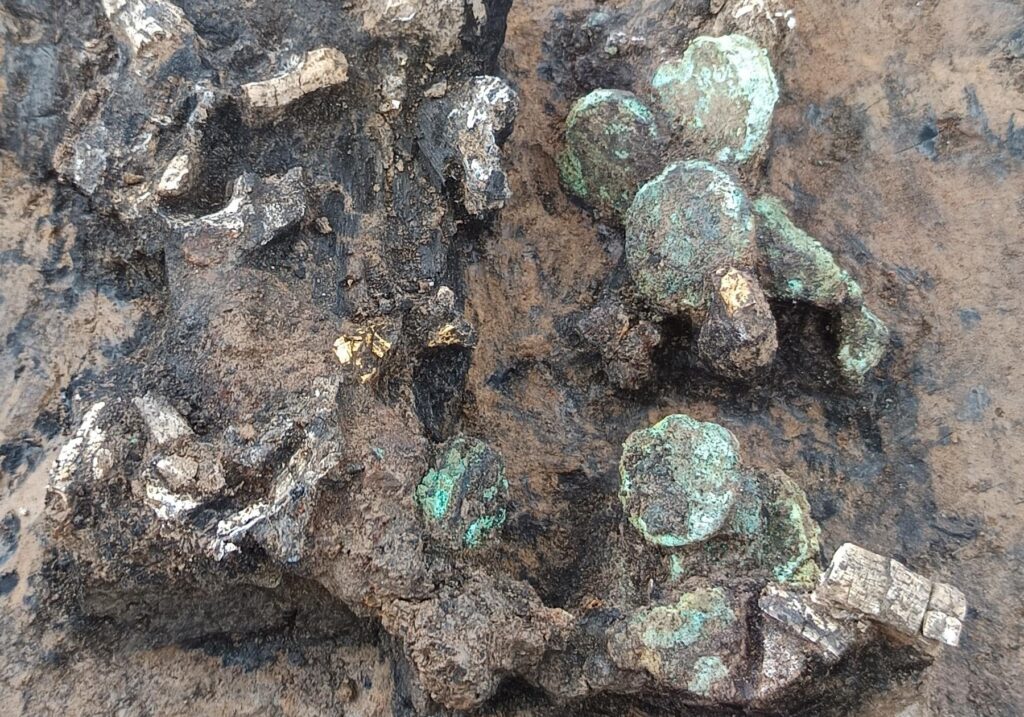
A remarkably rich Roman-era funeral pyre was discovered in Dordogne, France, revealing a rare 1st–2nd century cremation structure with luxury grave goods.
A newly discovered Roman funerary structure in Lamonzie-Saint-Martin (Dordogne), southwestern France, is reshaping archaeologists’ understanding of death rituals, cultural identity, and settlement patterns in the region during the Early Roman Empire. Found during a preventive excavation ahead of private construction near the locality of La Bourgatie Ouest, the richly furnished bustum—a type of cremation grave used only once—stands out as one of the most significant archaeological revelations in the area in recent decades.
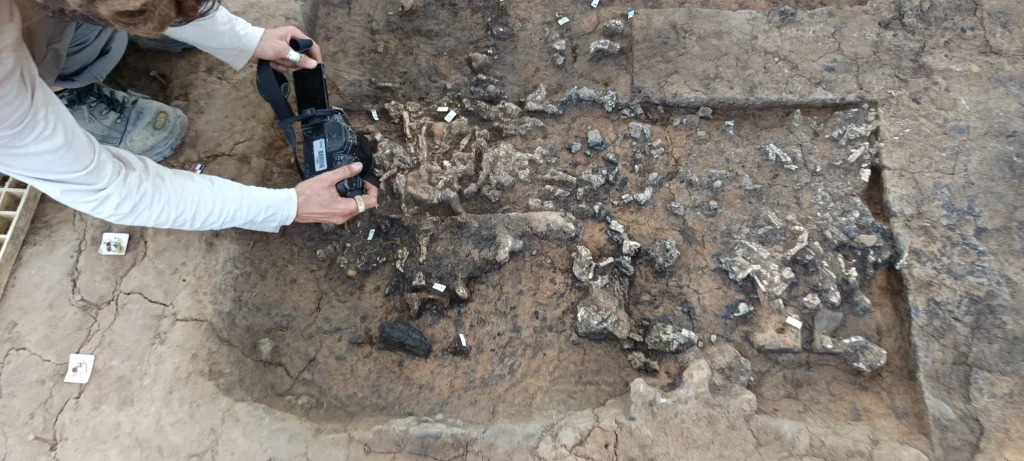
The excavation, spanning 8,000 m², originally promised little more than traces of Late Neolithic and medieval agricultural activity. Yet, beneath a cluster of medieval silos, archaeologists uncovered something entirely unexpected: a rectangular funerary structure immaculately outlined by heat-baked walls, preserving the remains of an individual cremated in situ along with an exceptionally opulent collection of grave goods.
A Surprising Discovery Beneath the Dordogne Loam
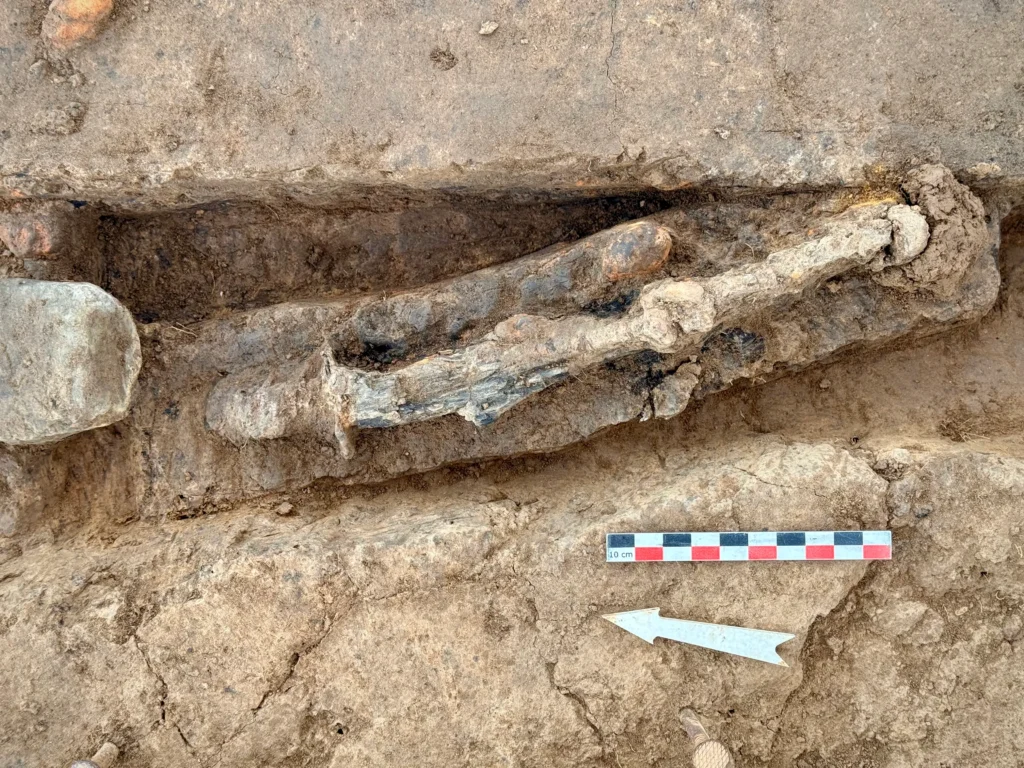
The structure’s form—a 2.20 × 1.05 m rectangle carved into the brown overflow sediments of the Dordogne River—immediately raised questions. Inside, researchers identified a sigillata ceramic goblet, a transparent glass vial, fragments of cremated bone, and a bronze coin. These elements quickly confirmed that the feature was not an ordinary burial but a bustum, a funeral pyre that served simultaneously as a cremation platform and a grave. Unlike the ustrinum, a multi-use cremation site where remains are later transferred to a separate tomb, a bustum preserves everything exactly where it burned: ash, bone, and offerings.
This practice is characteristic of certain Roman funerary traditions between the 1st and 2nd centuries CE—an era known as the Early Empire or High Empire—and is relatively rare in southwestern France, making this discovery especially valuable.
Meticulous Excavation Reveals a Wealth of Artifacts
The fill of the structure consisted of a 15 cm layer of ash and charcoal, sealed by sterile silt. Archaeologists employed a precise grid system to collect sediment for detailed sieving, while every object and bone fragment was digitally recorded through photogrammetry. A total of 487 individual items were mapped, providing an extraordinary blueprint of how the pyre collapsed, how the body was positioned, and where ritual offerings were placed.
Many questions remain:
– Were all objects placed on the pyre before ignition?
– Were additional offerings deposited afterward?
– Did any post-cremation removal of objects occur, as was sometimes customary?
Upcoming analyses by anthropologists, numismatists, and specialists in ancient materials are expected to shed light on these rituals and the identity of the deceased.
Luxury Artifacts Suggest High Social Status
Among the best-preserved grave goods is a sigillata goblet—likely produced in the Montans workshops of southern Gaul—and a still-mysterious iron object, possibly a jointed bit or tool, now undergoing radiographic study.
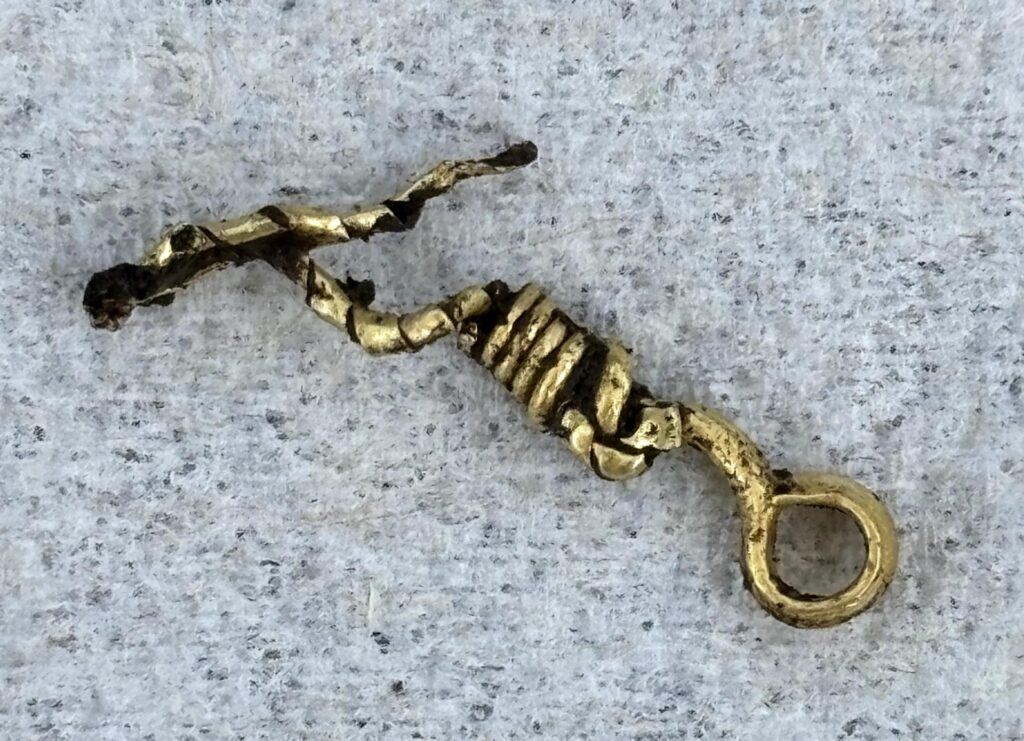
But the most striking finds are the precious metals. Archaeologists uncovered at least ten bronze coins accompanied by small gold sheets—possibly once sewn to a purse or box—and an impressive spread of 22 gold objects, including wires, droplets, decorative foil, and three standout pieces:
A twisted-band gold bracelet with a loop clasp
A probable bulla, a protective pendant traditionally worn by high-status Roman youths
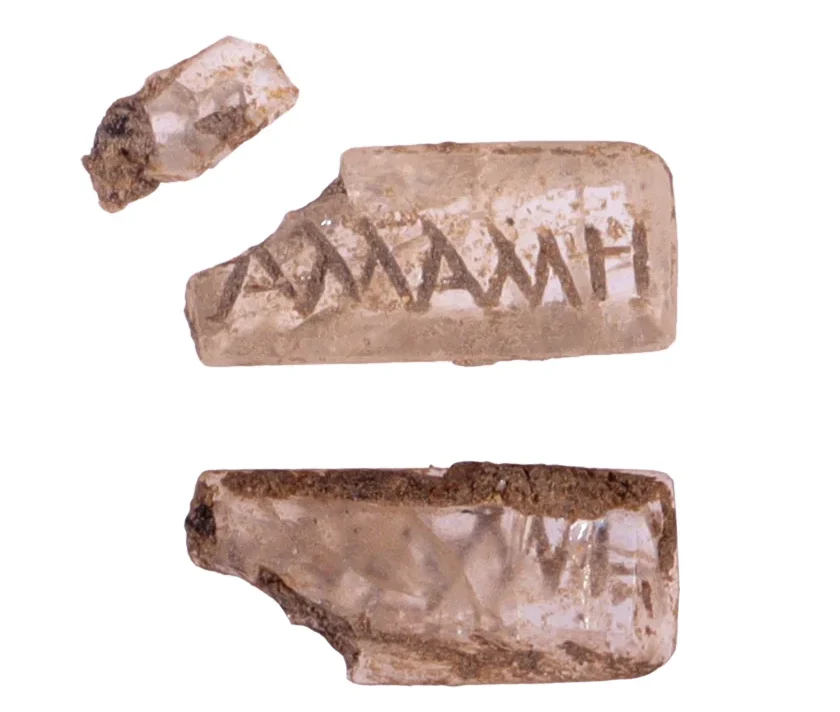
A tiny ring set with an engraved gem (intaglio)
The ring, warped by the pyre’s heat, holds a crystal-like stone engraved with seven Greek letters: Allallé. If this is indeed a personal name, it may indicate the deceased—or their family—had Greek origins, an unexpected clue that could reshape assumptions about mobility and cultural mixing in Roman Aquitania.
A Window into Ancient Life Along the Dordogne
Beyond the personal story of the deceased, the bustum raises broader questions about the surrounding landscape: Where was the associated settlement? Was there a nearby necropolis? How did a potentially Greek or Hellenized family come to reside in rural Périgord?
The Dordogne valley is known for its deep prehistory—home to sites like Lascaux, La Ferrassie, and Laugerie-Basse, which preserve some of the most iconic Paleolithic art and Neanderthal remains in Europe. However, its Roman-era history remains comparatively less explored. Discoveries like the Lamonzie-Saint-Martin bustum help fill that gap, offering insight into local elite communities, trade connections, and cultural identities during the first centuries CE.
The presence of high-quality sigillata, fine glassware, imported goods, and elaborate gold jewelry suggests that the individual belonged to a wealthy household deeply integrated into Mediterranean trade networks. The fact that the burial was placed in what appears to be an agricultural area may reflect a rural estate—villa rustica—whose foundations have yet to be identified.
A Discovery Poised to Reframe Regional History
As specialists begin to analyze the cremated bones, metals, ceramics, and inscriptions, researchers anticipate major revelations about the individual’s health, age, status, and cultural background. The site’s broader study may also illuminate how Roman-era communities organized their funerary spaces within the Dordogne landscape.
Above all, the discovery highlights how even small-scale excavations can radically transform the archaeological map. What began as a routine assessment for private construction has instead opened a new chapter in the ancient history of southwestern France.
Cover Image Credit: Gold sheets and a coin deposit found mixed with the cremated bone fragments. Frédéric Prodeo, Inrap
