
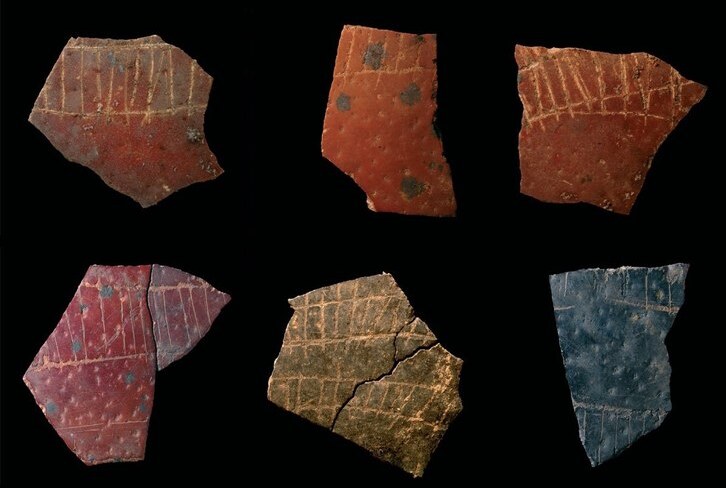
A groundbreaking study published in PLOS One has revealed that some of the earliest known human engravings were not random doodles—but carefully structured geometric compositions created more than 60,000 years ago. The research, led by scholars from the University of Bologna, offers compelling new evidence that early Homo sapiens possessed advanced abstract thinking and spatial planning abilities far earlier than previously proven.
The study, titled “Earliest geometries: A cognitive investigation of Howiesons Poort engraved ostrich eggshells,” focuses on engraved ostrich eggshell (EOES) fragments recovered from archaeological sites in South Africa and Namibia. These artifacts date back to the Howiesons Poort technocomplex of the Late Middle Stone Age—roughly between 65,000 and 60,000 years ago—and represent some of the oldest examples of systematic graphic behavior ever identified.
Ancient Engravings from Southern Africa
Researchers analyzed 112 ostrich eggshell fragments from three key archaeological sites: Diepkloof Rock Shelter, Klipdrift Shelter, and Apollo 11 Rockshelter. These fragments were originally part of eggshell containers likely used as water flasks by prehistoric communities.
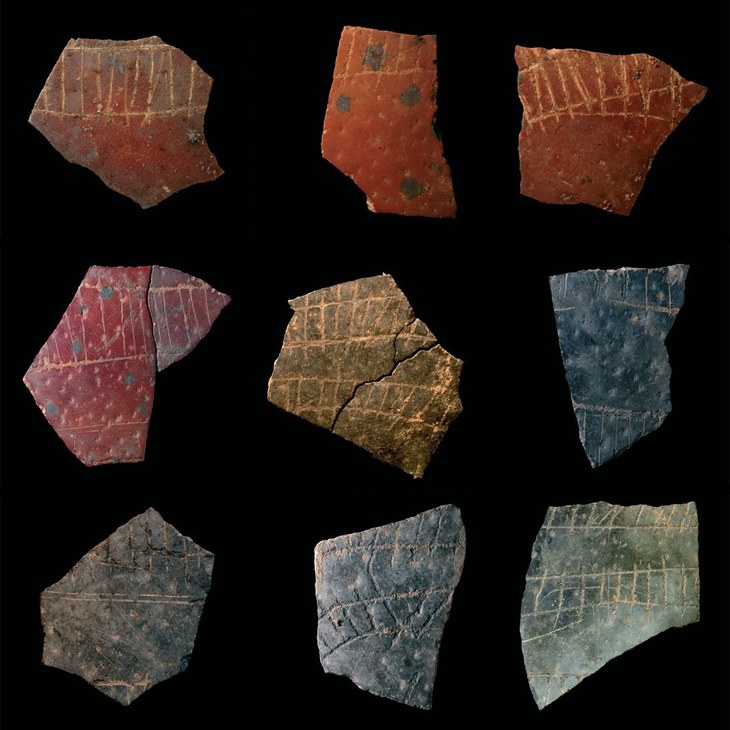
While previous studies had classified the engravings into motif groups—such as hatched bands, grids, and diamond patterns—this new research marks the first quantitative geometric and spatial analysis of the engravings. Instead of simply describing the motifs visually, the team applied statistical modeling and geometric measurements to evaluate whether the patterns reflected genuine cognitive structuring.
The results were striking.
More than 80 percent of the engraved segments displayed systematic spatial regularity. Straight lines dominated the compositions, and over 83 percent of the segments formed parallel alignments. A substantial proportion of the angles clustered around 90 degrees, demonstrating consistent use of orthogonality. These were not casual scratches. They were constructed according to recurring geometric principles.
A “Geometric Grammar” 60,000 Years Ago
Professor Silvia Ferrara, who coordinated the study, explains that the engravings reveal a surprisingly structured geometric mindset. Rather than simply repeating marks, the ancient engravers organized lines through parallelism, rotation, translation, and hierarchical embedding.
Lead author Valentina Decembrini emphasizes that these patterns required visual planning. In many cases, it appears the engraver conceived of the overall layout before incising the shell surface.
The researchers describe this structured system as a form of “geometric grammar”—a rule-based method for organizing visual elements. Just as language relies on syntax, these engravings relied on procedural operations. Parallel lines were iterated at regular distances. Grids were created by intersecting perpendicular lines. Hatched bands emerged from carefully bounded spatial frameworks.
In diamond motifs, the geometry is even more remarkable: the spatial field is implied rather than physically outlined. The composition itself generates the sense of structure. This suggests abstract spatial reasoning rather than purely mechanical repetition.
Cognitive Foundations of Abstract Thought
The significance of this discovery extends beyond archaeology. It touches on the origins of abstract thinking in human evolution.
The study connects the engraved eggshell patterns to cognitive research showing that humans possess innate “geometric primitives”—basic concepts such as lines, points, parallelism, and right angles. These intuitive principles can be combined through operations like iteration and embedding to produce complex visual systems.
By statistically demonstrating consistent use of these operations in 60,000-year-old artifacts, the researchers argue that early Homo sapiens already had the cognitive capacity to organize visual space according to abstract rules.
Importantly, the team did not focus on interpreting symbolic meaning. Instead, they examined the structural logic behind the engravings. Their conclusion: the patterns reflect deliberate visuo-spatial planning and rule-based construction rather than random decoration.
Statistical Evidence of Visual Planning
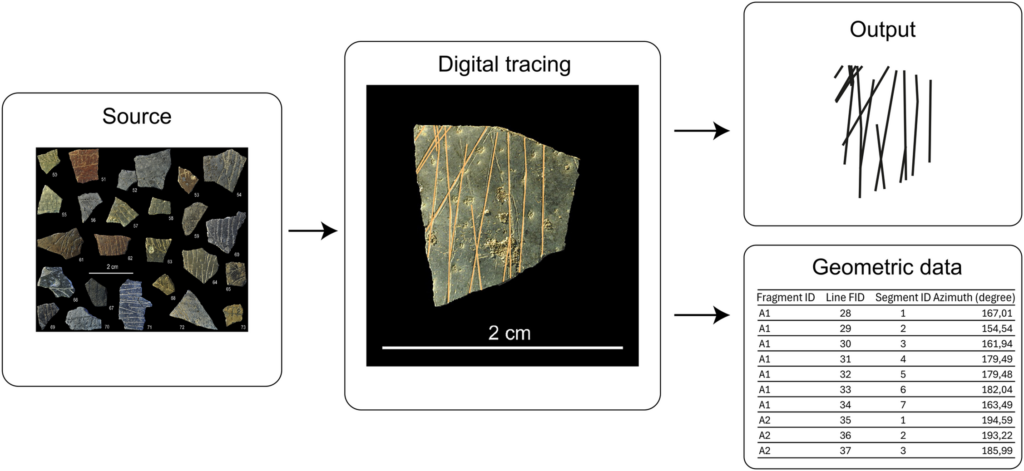
To reach these conclusions, the team manually retraced each engraved line using digital mapping software, extracting geometric variables such as angular inclination and intersection spacing. They then applied regression analysis and principal component analysis (PCA) to identify structural regularities.
The findings show that over 90 percent of the fragments conform to predictive models of geometric organization. Only a small minority of pieces displayed irregularities, which researchers interpret as either material constraints or intentional variation.
Spatial clustering analysis further demonstrated that many engravings maintained consistent distances between intersections—evidence of controlled execution rather than spontaneous marking.
Such precision indicates not only motor skill but cognitive foresight.
Implications for Human Evolution
The engraved ostrich eggshells from southern Africa are among the earliest material expressions of structured graphic behavior. They push back the timeline for organized geometric thought and provide new insight into the evolution of symbolic cognition.
For decades, archaeologists have debated when “behavioral modernity” emerged. These findings suggest that by 60,000 years ago, Homo sapiens were already capable of abstract spatial reasoning, hierarchical composition, and systematic graphic planning.
In other words, the roots of geometry—and perhaps the foundations of writing and symbolic systems—may reach far deeper into human prehistory than previously assumed.
As Professor Ferrara notes, transforming simple lines into complex systems governed by rules is a deeply human trait. From prehistoric engravings to architectural design and written language, this cognitive ability has shaped millennia of cultural development.
The ostrich eggshell fragments from Diepkloof, Klipdrift, and Apollo 11 Rockshelter now stand as powerful evidence that the story of geometry began tens of thousands of years earlier than textbooks once suggested.
And remarkably, it began on the curved surface of an eggshell.
Decembrini, V., Ottaviano, L., Cartolano, M., Spinapolice, E. E., & Ferrara, S. (2026). Earliest geometries: A cognitive investigation of Howiesons Poort engraved ostrich eggshells. PLOS One, 21(2), e0338509. https://doi.org/10.1371/journal.pone.0338509
Cover Image Credit: Decembrini et al. (2026)
