
A marble stele from Antioch’s necropolis offers a rare glimpse into elite female identity, death, and divine imagery in the Late Hellenistic world
A 2,100-year-old funerary stele discovered in ancient Antioch is shedding new light on how women of the Late Hellenistic period were remembered after death, and how local identity was shaped through the image of one of the city’s most powerful divine symbols.
The marble monument was found in 2017 during rescue excavations in Antakya, in Türkiye’s Hatay province, within the necropolis area of Antioch on the Orontes. Now preserved in the Hatay Archaeology Museum, the stele has been examined in detail by Murat Çekilmez, Nilay İğrek, and Ali Çelikay in a new typological and iconographic study published in OLBA.
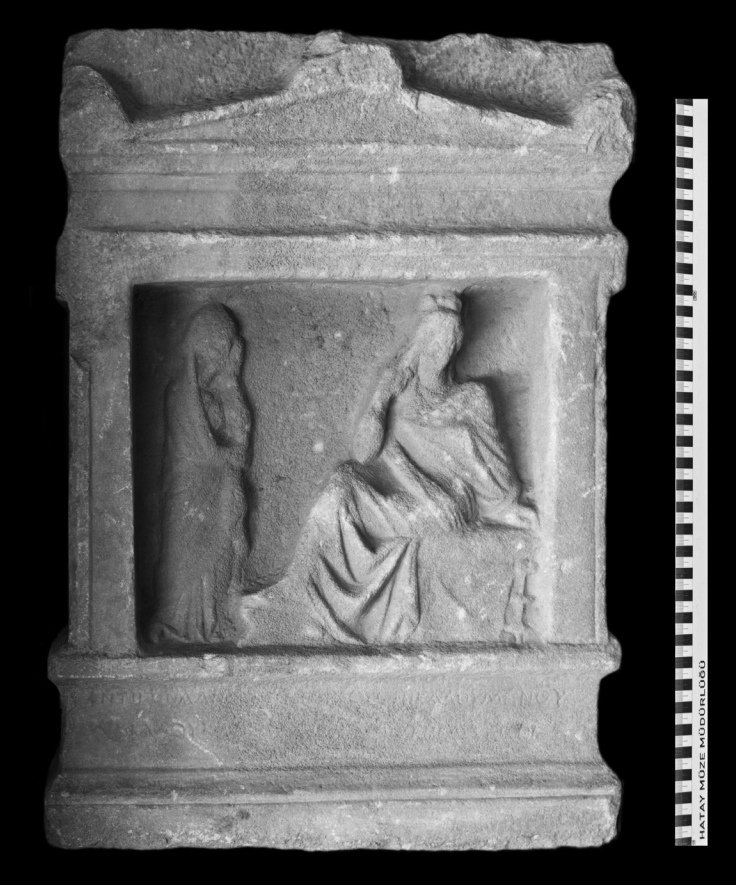
The artifact is largely intact despite minor cracks, erosion, and missing sections. Carved from fine-grained white marble, it measures 76 centimeters high and takes the form of a schematic naiskos, a small temple-like architectural frame commonly used in Hellenistic funerary monuments. Its upper section includes acroteria, a plain pediment, and an undecorated architrave, while the central relief panel preserves a carefully arranged scene with two female figures.
A deceased woman shown in the image of Tyche
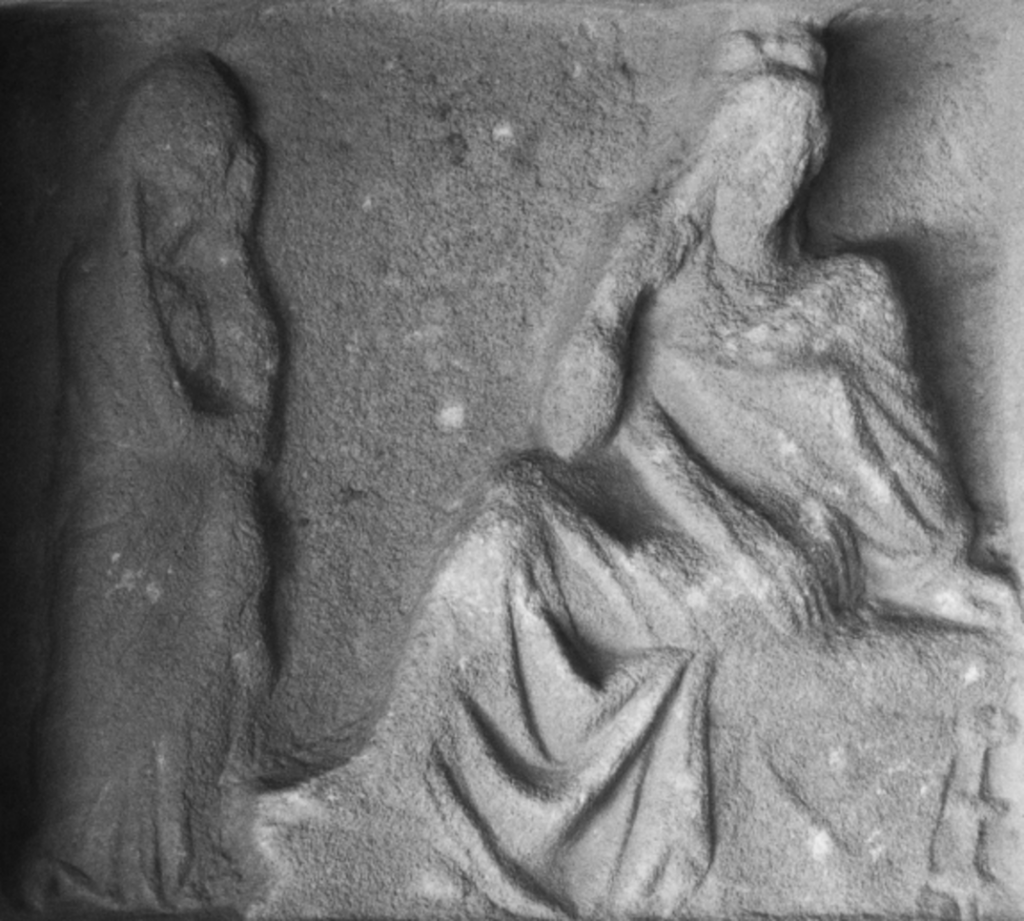
The most striking figure appears on the right side of the relief. She is seated on a covered wooden diphros and shown larger and more carefully worked than the standing woman opposite her. Researchers identify her as the deceased, most likely a woman named Antigona, based on the two-line Greek inscription preserved below the scene.
What makes the figure especially important is her visual connection to the famous Tyche of Antioch, the protective goddess of the city. The original statue of Tyche, created by Eutychides of Sicyon in the early Hellenistic period, became one of the most recognizable images of Antioch. She was typically shown seated, wearing a mural crown, with the Orontes River represented below her feet.
The woman on the stele does not carry all of Tyche’s divine attributes. She has no river figure beneath her feet, no wheat ear or palm branch in her hand, and no monumental city crown. Instead, she wears a smaller polos and sits on a modest stool rather than a symbolic mountain. This difference matters. The image does not present the woman as a goddess, but as a mortal woman deliberately represented through the visual language of Antioch’s divine protector.
That choice suggests status, identity, and devotion. By adopting the pose of Tyche, the deceased woman was associated with the city’s most prestigious symbol while still remaining recognizably human. The result is a carefully balanced funerary image, one that links personal memory with civic and religious imagery.
A second woman in mourning
The second figure stands on the left side of the relief. She is smaller, slimmer, and less detailed, wearing a chiton and himation that cover her body. Her pose belongs to a variation of the Pudicitia type, a well-known female figure type associated with modesty, grief, and respectable womanhood in Hellenistic funerary art.
Researchers suggest that this standing figure may represent either a servant or a female relative of the deceased. Her smaller scale and position opposite the seated woman support the interpretation that she was not the central person commemorated by the monument. Her raised hand and covered body also fit the visual language of mourning and restrained emotion found in many funerary steles of the period.
Together, the two figures create a scene of farewell, memory, and social distinction. The seated woman receives the main visual emphasis, while the standing woman reinforces the emotional and domestic character of the monument.
A temple-like frame for immortality
The architectural form of the stele is also central to its meaning. The figures are placed inside a framed space resembling the façade of a small Ionic temple. This was not simply decoration. In Hellenistic funerary art, such naiskos-like settings could elevate the deceased by placing them within a sacred architectural space.
The study argues that the two women were represented almost as if they stood within the cella of a temple. This visual setting expressed ideas of immortality, rebirth, and continued existence after death. In the ancient imagination, death could be framed not as absolute disappearance but as a kind of temporary sleep, followed by a continued form of presence.
Dating the stele to 150–100 BC
Because the stele was not recovered from a secure archaeological layer, researchers could not date it through stratigraphy. Instead, they relied on stylistic comparison with similar funerary steles from Antioch, Western Anatolia, Smyrna, Ephesus, Chios, and other Hellenistic centers.
The comparison points to a date between 150 and 100 BC. The thick, band-like folds of the clothing, the reduced movement of the bodies, and the adaptation of earlier Classical and Early Hellenistic figure types all fit the artistic language of the Late Hellenistic period.
The inscription also adds an unusual detail. It names Antigona and includes the term “alypoi,” meaning “carefree” or “free from sorrow.” Researchers note that the wording may indicate that the stele was later reused for another burial, possibly a male one, even though the relief itself depicts only female figures.
A rare window into Antioch’s funerary world
The stele is important because it brings together several layers of Late Hellenistic culture: elite female commemoration, local devotion to Tyche, funerary symbolism, and the artistic traditions shared between Antioch and the wider eastern Mediterranean.
It also reminds us that ancient funerary monuments were not passive grave markers. They were statements about identity, status, belief, and belonging. In this case, a woman from Antioch was remembered through the image of the city’s own goddess, framed inside a marble temple of memory.
Çekilmez, M., İğrek, N., & Çelikay, A. (2026). A FUNERARY STELE FROM ANTIOCHEIA AD ORONTES: TYPOLOGICAL AND ICONOGRAPHIC EVALUATION. OLBA, XXXIV, 205-221. https://izlik.org/JA66MK43MR
Cover Image Credit: Çekilmez, M., et. al., 2026, OLBA
