
9 June 2026 The Future is the Product of the Past

Khresis Mosaic Reveals the Hidden Wealth of Ancient Troy in Hatay

The Khresis Mosaic, one of the most remarkable archaeological discoveries in southern Türkiye, continues to draw attention for its historical depth and symbolic meaning. Dating back to the early 4th century AD, the mosaic was uncovered in the Daphne (Harbiye) Ancient City, specifically within the House of the Triumph of Dionysos.

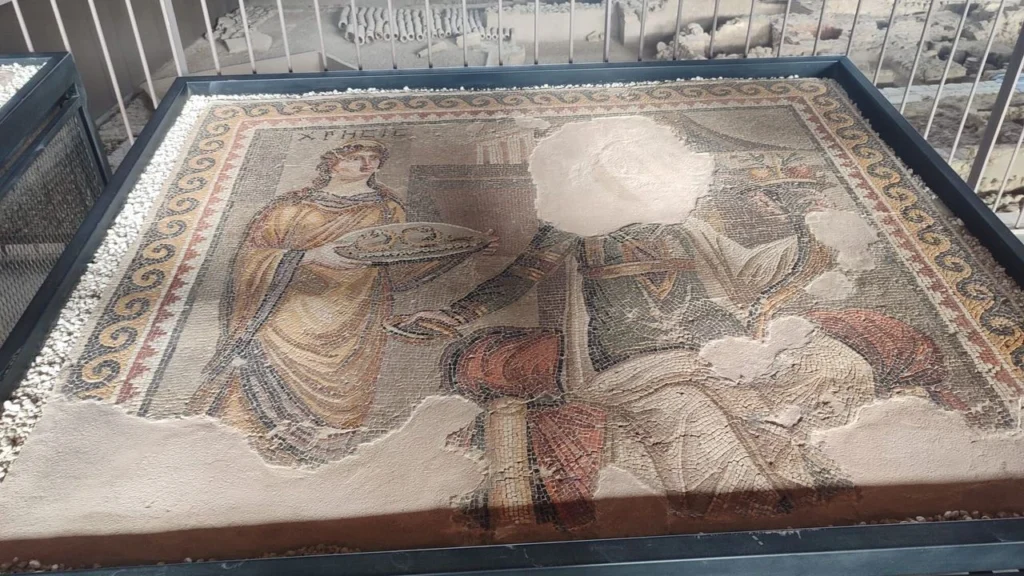
Today, the artwork is exhibited at the Hatay Necmi Asfuroğlu Archaeology Museum, where it is considered one of the most popular and significant pieces in the museum’s extensive collection. The site attracts visitors interested in ancient art, mythology, and cultural heritage.

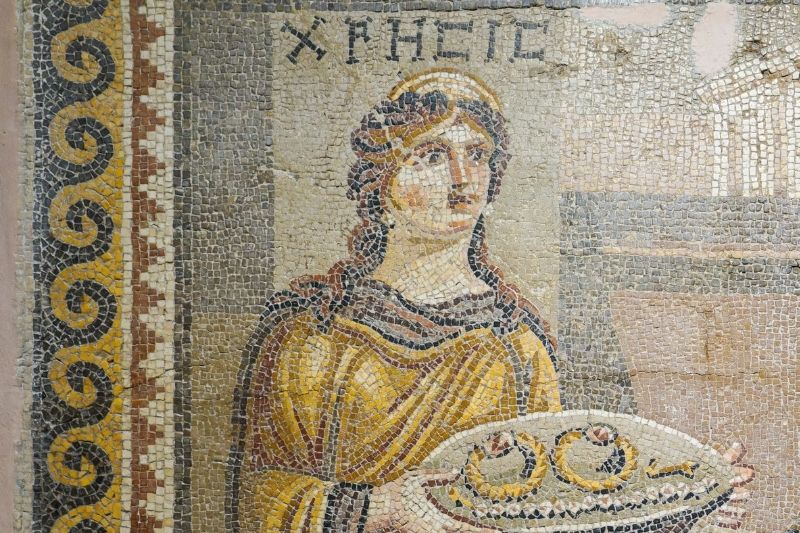
At the center of the mosaic is a female figure identified as Khresis, a name derived from Ancient Greek meaning “acquired wealth.” Scholars interpret this figure as the personification of the riches taken from the ancient city of Troy. According to mythological narratives, Khresis is believed to be the daughter of a priest of Apollo and a captive of King Agamemnon during the Trojan War.
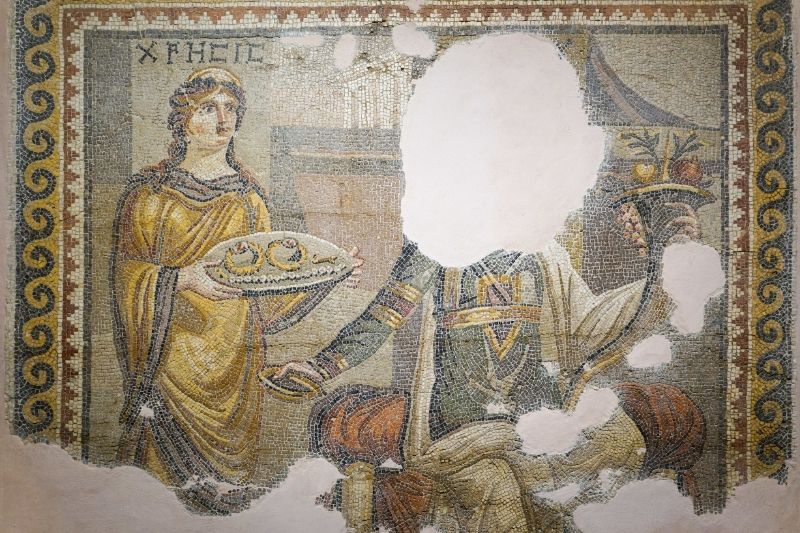
The scene depicts Khresis holding a tray filled with valuable jewelry, including gold bracelets set with large stones, a pearl necklace, and a golden clasp. She extends the tray toward a seated figure beside her. Although the face of this figure is largely damaged, it is shown holding a cornucopia filled with fruits and grape clusters, symbolizing abundance, and offering a golden bowl toward Khresis.

Above the female figure, the inscription “KRESIS” appears, emphasizing the concept of wealth gained through acquisition or conquest. Together, the two figures symbolize prosperity and the transfer of riches, reflecting the legendary wealth associated with Troy.


📣 Our WhatsApp channel is now LIVE! Stay up-to-date with the latest news and updates, just click here to follow us on WhatsApp and never miss a thing!!


The mosaic was uncovered during excavations in Hatay’s Defne district, an area known for its rich archaeological heritage. Despite partial damage, the artwork remains well-preserved and continues to provide valuable insight into the artistic traditions and symbolic storytelling of Late Antiquity.
As cultural tourism continues to grow, the Khresis Mosaic stands out as a key attraction, highlighting Hatay’s historical significance and its enduring connection to ancient civilizations.

Image Credits: Hatay Archaeology Museum

Related Articles

1,500-year-old secret underground passage uncovered in Istanbul

15 May 2023

15 May 2023

During the ongoing excavations in the ruins of Saint Polyeuktos Church in Istanbul’s Saraçhane neighborhood, which was destroyed during the...

Artifacts for sale offered at a Dutch auction house returned to Peru

9 July 2021

9 July 2021

The Dutch government announced in a press release today that the artifacts that were put up for sale at an...

Halley’s Comet Discovered 600 Years Earlier by an 11th-Century Monk, Study Finds

26 January 2026

26 January 2026

For more than three centuries, Halley’s Comet has been synonymous with the British astronomer Edmond Halley, who famously calculated its...

Oldest Recorded Gynecological Treatment

7 February 2021

7 February 2021

In their latest research, scientists have come across a treatment practice in a mummy from 4000 years ago, as written...

Lost Medieval Synagogue Unearthed: Foundations of a Major Jewish Center Rediscovered in Southern Germany

14 September 2025

14 September 2025

Archaeologists have uncovered the long-lost remains of one of the most important medieval Jewish centers in southern Germany. Excavations at...

A Jewel Worthy of a Duke: The Medieval Treasure Unearthed from the Moat

28 November 2025

28 November 2025

A remarkable archaeological discovery from the moat of Castle Kolno in Poland is offering fresh insight into medieval aristocratic culture...

Jordan’s mysterious ancient wall “Khatt Shebib”

22 October 2022

22 October 2022

The accomplishments of ancient civilizations are typically woefully underappreciated because we stereotype them as primitives who only wore loincloths, and...

Archaeologists discover a hidden Maya burial chamber in the walled enclosure of Tulum

28 December 2023

28 December 2023

Archaeologists from the National Institute of Anthropology and History (INAH) have discovered a hidden Maya burial chamber concealed within a...

Orkney dig reveals ruins of huge Neolithic tomb

21 October 2023

21 October 2023

A 5,000-year-old tomb was unearthed in Orkney, north-east Scotland. The discovery was announced by the Guardian, describing the tomb structure...

Ice Age turtle finds near Magdeburg point to canned food from the Stone Age

2 May 2024

2 May 2024

Experts have recovered around 50,000-year-old turtle shell fragments from the Barleben-Adamsee gravel pit near Magdeburg. The turtles could have been...

Artifacts found in Japan could be prototypes of ninja weapons

14 January 2022

14 January 2022

Artifacts discovered in the ruins of structures associated with warlord Toyotomi Hideyoshi’s 1590 Siege of Odawara may be prototypes of...

Tipasa’s Underwater Secrets: Algeria’s Hunt for a Lost Ancient City

1 September 2025

1 September 2025

Algeria has launched a new underwater archaeological campaign off the coast of Tipasa, a UNESCO World Heritage Site celebrated for...

Frankfurt Uncovers Its Oldest Known Roman Military Camp in Höchst Excavations

1 April 2026

1 April 2026

A remarkable archaeological discovery in Frankfurt am Main is shedding new light on the region’s earliest interaction with the Roman...

5,000-Year-Old “Küllüoba Bread” Discovered in Türkiye Reveals Ancient Baking and Fertility Rituals

30 May 2025

30 May 2025

5,000-year-old bread found in Küllüoba Höyük, Turkey reveals ancient baking methods and fertility rituals. Unique archaeological discovery with rich nutritional...

The first and largest astronomical observatory of the 6th century BC discovered in Egypt’s Kafr El-Sheikh

24 August 2024

24 August 2024

Archaeologists in Egypt unveiled the first and largest astronomical observatory from the 6th century BCE in the Buto Temple at...