
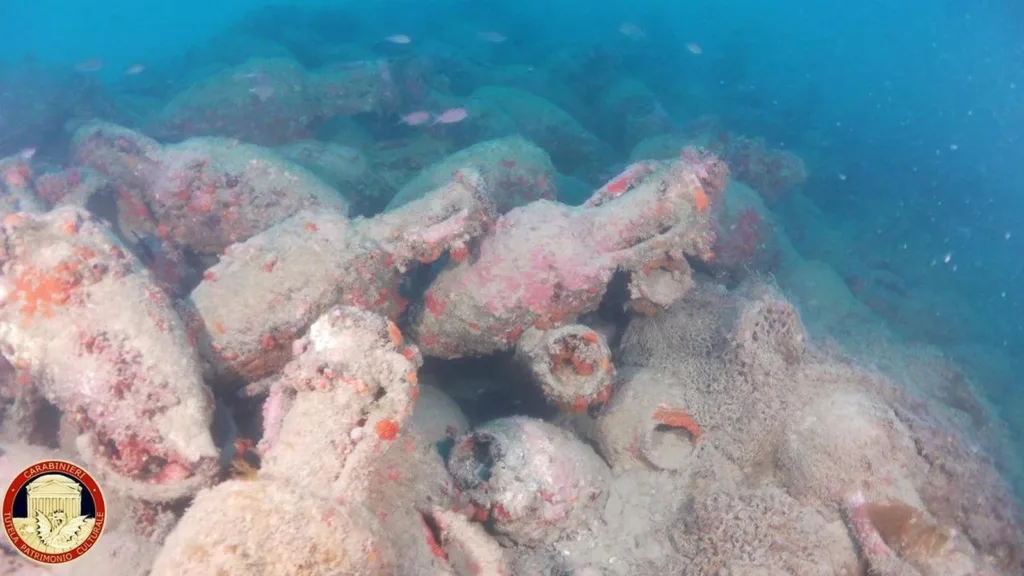
A 2,100-year-old Roman shipwreck carrying hundreds of Dressel 1A amphorae has been discovered 46 meters underwater off Mazara del Vallo, Sicily.
A Roman shipwreck carrying hundreds of amphorae has been discovered off the coast of Sicily, offering archaeologists a new glimpse into Mediterranean trade during the final centuries of the Roman Republic.
The wreck was identified about three nautical miles off Mazara del Vallo, on Sicily’s southwestern coast, at a depth of 46 meters (151 feet). Italian authorities have provisionally dated the site to between the 2nd and 1st centuries BC, making it more than 2,000 years old.
The discovery was announced on August 8 by the Carabinieri Command for the Protection of Cultural Heritage. The investigation was carried out jointly by its Palermo unit, the Soprintendenza del Mare of the Sicilian Region and the Carabinieri underwater unit based in Messina, with support from a patrol boat from Trapani.
The site was investigated after private citizens reported the remains to the authorities.
Hundreds of amphorae still lie on the seabed
The most striking feature of the wreck is its cargo. Archaeologists documented hundreds of amphorae spread across the site, most of them belonging to the Dressel 1A type.
Two lead anchor stocks were also identified, along with another structure made from lead. Authorities have not yet provided a more precise identification of that object.
The concentration of amphorae provides an important starting point for determining when the ship sailed and the commercial network in which it operated.
Dressel 1 amphorae were among the most characteristic transport containers of the late Roman Republican period. They were produced mainly along the Tyrrhenian coast of Italy, particularly between Etruria and Campania, and circulated widely through the western Mediterranean.
Archaeological evidence indicates that wine was the principal commodity transported in Dressel 1 amphorae, although researchers will need to examine the Mazara del Vallo examples before determining what this particular vessel was carrying.
The prevalence of Dressel 1A containers at the wreck is also consistent with the preliminary dating proposed by Italian archaeologists. The form was especially widespread during the 2nd and early 1st centuries BC, a period of rapidly expanding Italian maritime commerce.
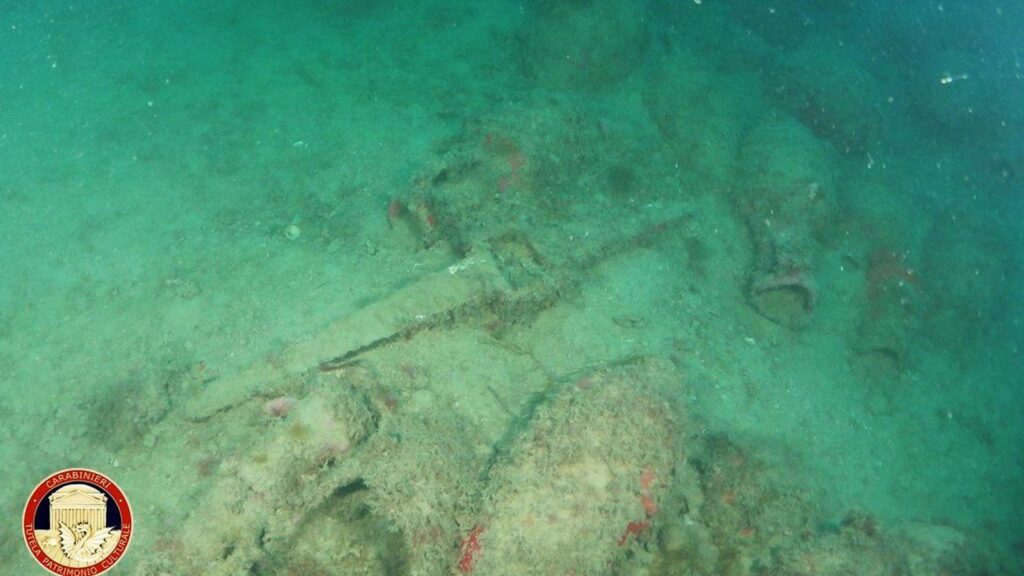
A ship from a changing Mediterranean
The proposed date places the vessel in a transformative period of Mediterranean history.
By the 2nd century BC, Rome had emerged as the dominant power across much of the Mediterranean, while merchants moved wine, agricultural products and other goods between Italy, Sicily, North Africa, Iberia and ports farther west.
Sicily occupied a strategic position within those maritime routes. The waters around the island connected the Tyrrhenian Sea with the central Mediterranean and the North African coast, making the region both a commercial crossroads and, over the centuries, a dangerous passage for shipping.
The newly identified wreck could eventually provide evidence about one of those voyages.
The amphora types, their arrangement on the seabed and any inscriptions, residues or other objects found during future investigations may help archaeologists establish where the cargo originated and possibly where the vessel was heading.
For now, however, Italian authorities have not announced the ship’s route, its precise cargo contents or the circumstances of its sinking.
Further investigation planned
Italy’s Culture Minister Alessandro Giuli described the Mazara del Vallo wreck as “one of the most important underwater archaeological discoveries of recent years.”
Giuli said the find could contribute to understanding the people, routes and exchanges that made the Mediterranean a crossroads between different civilizations.
The Soprintendenza del Mare is expected to continue documenting the wreck and its archaeological surroundings. The next phase will focus on developing a more complete picture of the site while establishing measures for its protection.
At 46 meters below the surface, the wreck also presents practical challenges for archaeological work. Rather than treating the initial discovery as a complete picture of the vessel, researchers will now have to determine how much of the ship survives beneath the cargo and sediment and whether other artifacts remain preserved within the site.
What is already visible, however, is a substantial cargo assemblage dating to the final centuries of the Roman Republic — hundreds of transport amphorae lying on the seabed off a coast that stood along some of the ancient Mediterranean’s busiest maritime corridors.
