
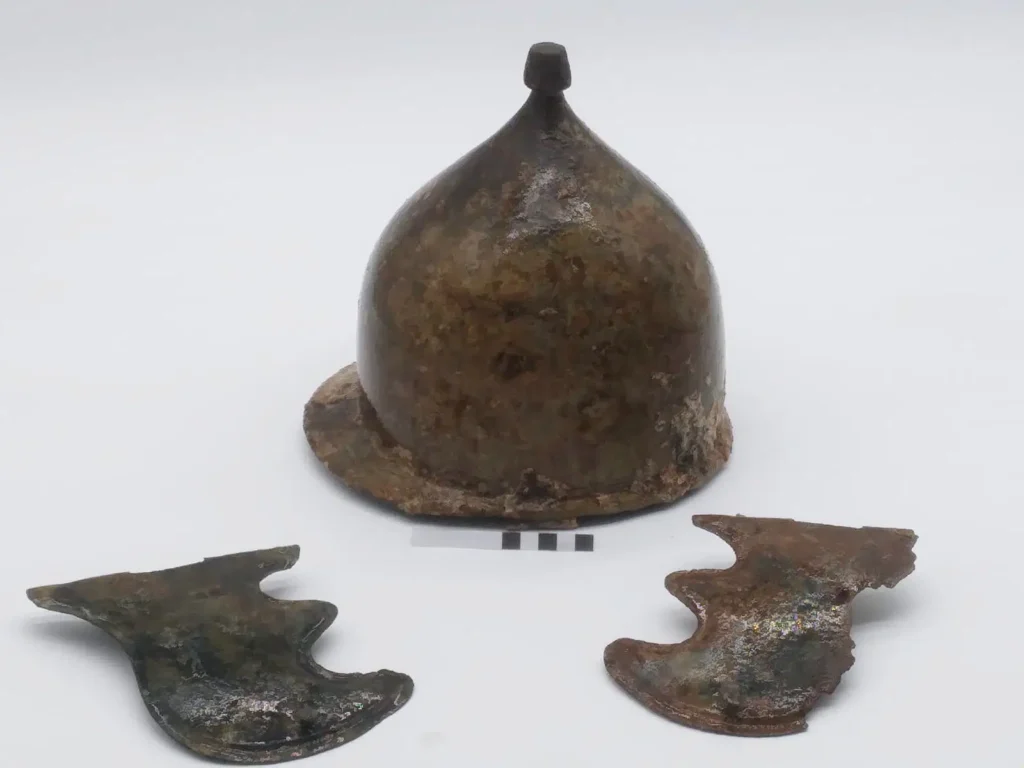
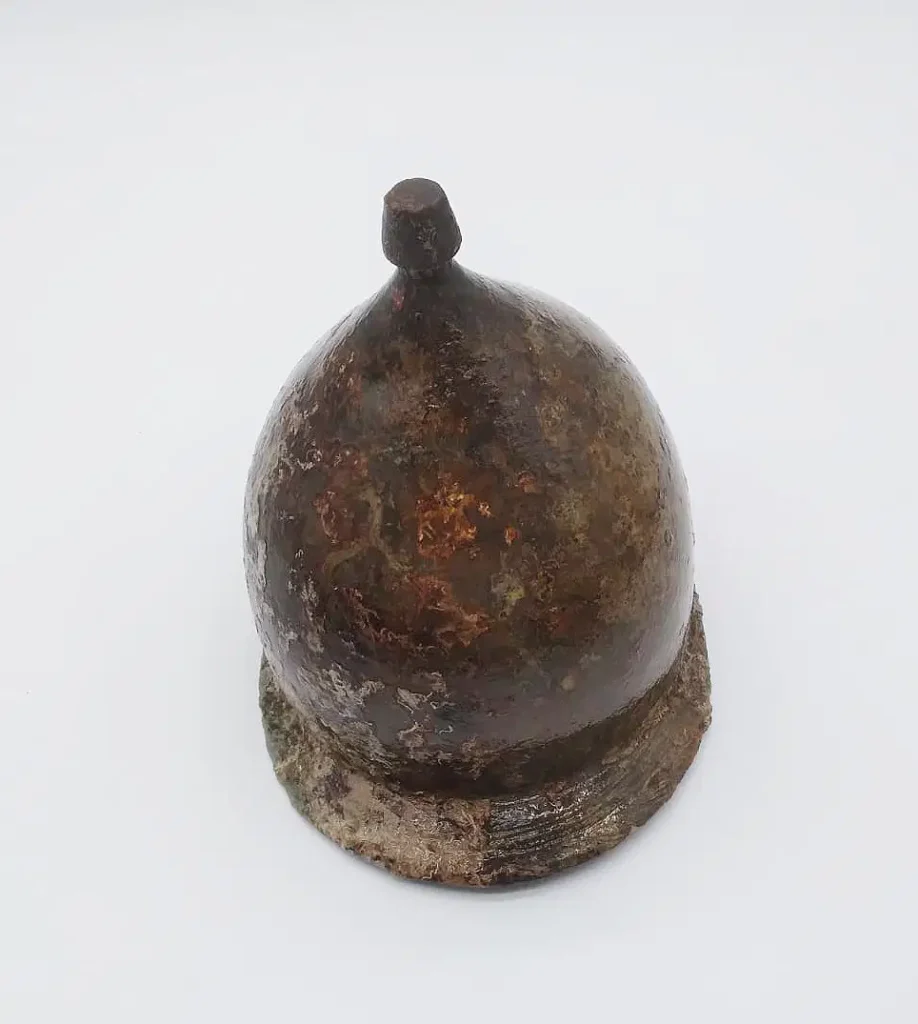
In a remarkable underwater archaeological recovery that highlights Sicily’s rich cultural heritage, a bronze Montefortino‐type helmet was retrieved from the seabed off the Egadi Islands last August. The news, released only today, gives researchers and the public alike a rare opportunity to peer into Roman military equipment of the First Punic War era.
The helmet, extraordinary in its state of preservation and complete with its cheek guards (paragances), was brought to the surface by high-water divers from the Society for the Documentation of Submerged Sites (Sdss), led by Mario Arena. Their efforts took place under the coordination of the Superintendence of the Sea, supported by the Marine Protected Area, the Municipality of Favignana, and the Harbor Master’s Office.
This find comes from a historically charged location—where, in 241 B.C., the naval Battle of the Egadi took place, concluding the First Punic War between Rome and Carthage. Montefortino helmets were used by Roman forces from roughly the 4th century BC through the 1st century AD, making this specimen not just rare, but also contextually significant.
“The Montefortino helmet is one of the most beautiful and complete ever recovered,” declared Francesco Paolo Scarpinato, Sicily’s Councilor for Cultural Heritage and Identity. This discovery not only expands our historical understanding of the Battle of the Egadi but also elevates Sicily’s standing as a guardian of unique Mediterranean heritage. The success of the operation, he noted, was made possible by a multi-institutional collaboration of international standards.
The helmet’s recovery forms part of a larger research project yielding numerous finds from different periods. Among these was a substantial bronze handle from a Late Antique wreck—known as the “fish-bank wreck,” dating to the 5th century AD—raising intriguing questions about ancient maritime commerce and shipmanship. All items have undergone preliminary conservation by Sdss restorers, funded in part by U.S. patron Michel Garcia.
Beyond recovery and preservation, advanced diagnostics were employed. At the radiology studio of Dr. Giuseppe Perricone in Trapani, CT scans of around thirty encrusted metal artifacts revealed hidden swords, spears, and javelins—likely weapons from the 241 B.C. naval clash that have rested unseen for over two millennia.
This underscores the Superintendence of the Sea’s leadership in blending archaeology, conservation, and scientific imaging in a coordinated strategy. The Sdss, with institutional backing, continues enriching the historical archive beneath the waves.
Significant support also came from the RPM Nautical Foundation, a U.S. private institution. Its oceanographic vessel and state-of-the-art survey gear helped map the seabed, document wreck zones, and pinpoint sites of archaeological interest.
The Battle of the Aegates, fought on March 10, 241 B.C., marked Rome’s decisive victory over Carthage and the beginning of its domination of the western Mediterranean. Decades of underwater discoveries—helmets, weapons, ship rostra—have helped solidify our understanding of that pivotal encounter.
The new Montefortino helmet stands out not just for its completeness but especially for its intact cheek guards—a rarity. These features provide invaluable clues to ancient Roman manufacturing techniques, materials, and military accouterments. With its exceptional condition, the artifact is a prime candidate for future museum exhibition, offering the public direct access to a relic that spans twenty-four centuries.
The discovery of the Late Antique bronze handle and the radiologically identified weapons further demonstrate the Egadi seabed as a multi-layered historical record—tracing naval conflict, commercial exchanges, and everyday vessel use across centuries.
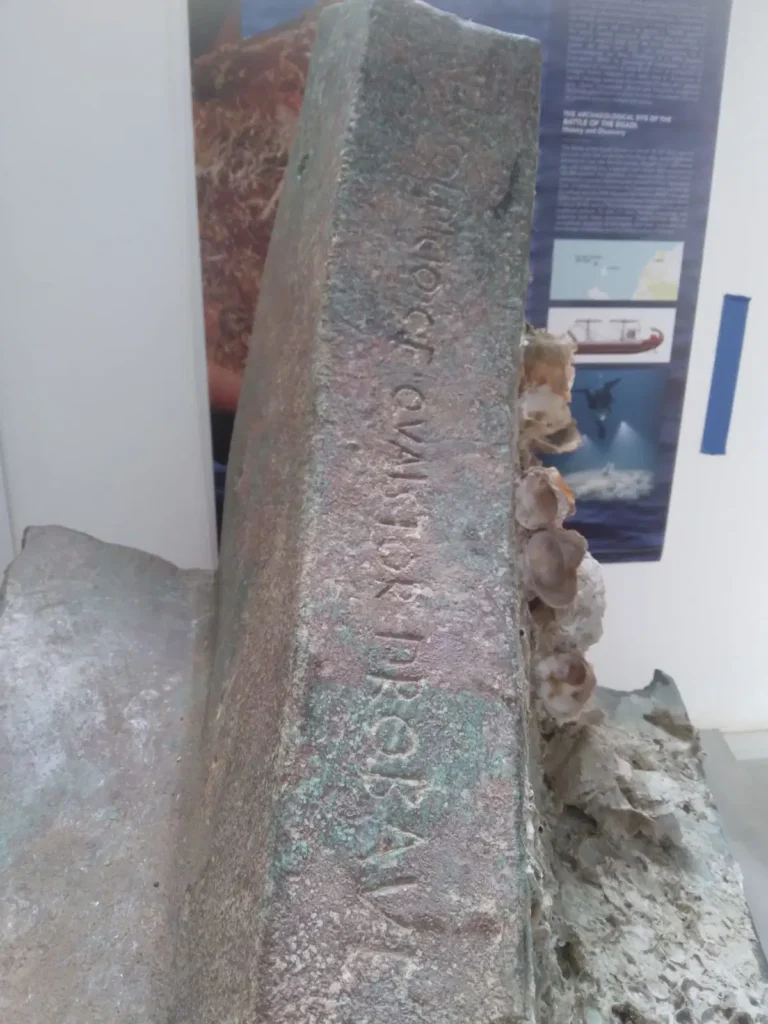
As a final note, one of the previously recovered naval rostra (number 25), inscribed “Ser. Solpicius C.F. Quaestor Probavit,” has been cleaned and analyzed. It likely references a Roman quaestor (financial official), suggesting his father was Gaius Sulpicius, possibly the consul of 243 B.C., at the height of the First Punic War.
Montefortino‐Type Helmet: Historical & Archaeological Context
Origin & Usage: The Montefortino helmet originated in the 4th century BC, influenced by Celtic and Etrusco‐Italic designs. It became a mainstay helmet in the Roman Republic and remained in use through the 1st century AD, even persisting with the Praetorian Guard after being largely replaced by the Coolus type.
Design Features: Characterized by its rounded or conical bowl, central knob (used for plume attachment), protruding neck guard, and cheek plates—these were typically attached via riveted D-rings. Decorative elements such as rope-style edging and pinecone motifs on the crest knob were common in early, more ornate examples.
Mass Production & Longevity: The Montefortino helmet was arguably the most successful helmet design of ancient times—widespread, mass-produced, and virtually unchanged for centuries. Some estimates suggest that between 3 to 4 million were made.
Subtypes: Archaeologists classify the Montefortino in several subtypes—such as Canosa, Rieti, Buggenum, and Hagenau—differing in bowl shape, neck guard size, and hollow vs. solid knobs.
Cover Image Credit: Regione Siciliana
