
Archaeologists in Denmark have uncovered two gold-decorated iron spears—the country’s earliest iron—deposited at a Bronze Age sacred spring in Boeslunde, revealing long-distance exchange networks and a major ritual center.
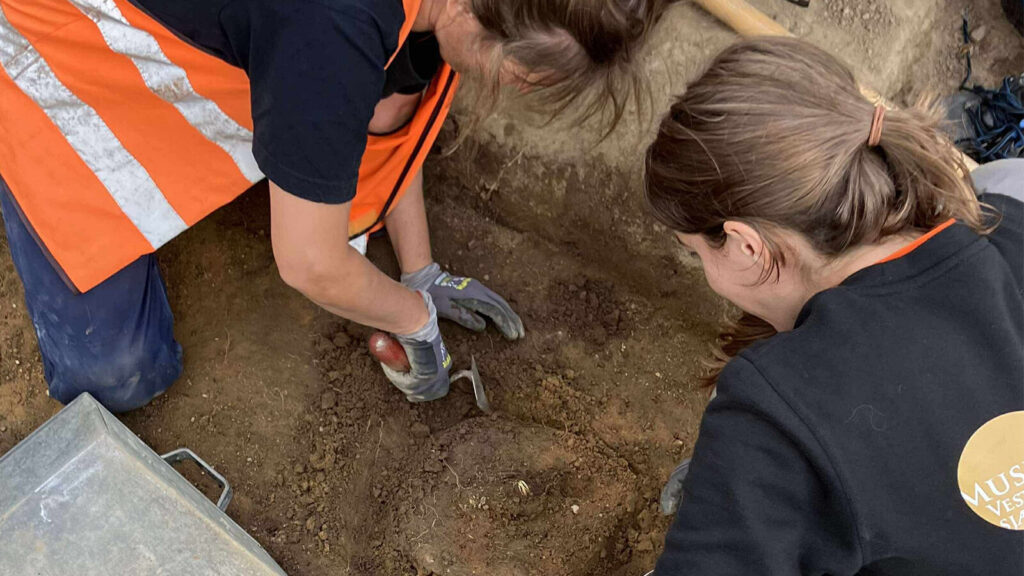
When archaeologists from Museum Vestsjælland opened a new trench at Boeslunde in August 2025, the goal was simple: understand why nearly a decade of discoveries—from gold oath rings to thousands of delicate spirals—had repeatedly emerged from the same small patch of farmland in southwest Zealand. They did not expect to rewrite the history of northern European metallurgy. Yet within days, a glimmering object caught in the soil signaled that the site had another secret to reveal.
The object was long, heavy, and undeniably out of place—a spearhead sheathed in corrosion but shimmering with gold inlay. For a moment, archaeologist Lone Claudi-Hansen could hardly process what she was holding. As she later recalled, she instinctively placed it back into the earth before turning away in shock. Bronze Age excavations do not produce iron weapons, let alone prestige arms covered in gold ornamentation. And yet here it was.
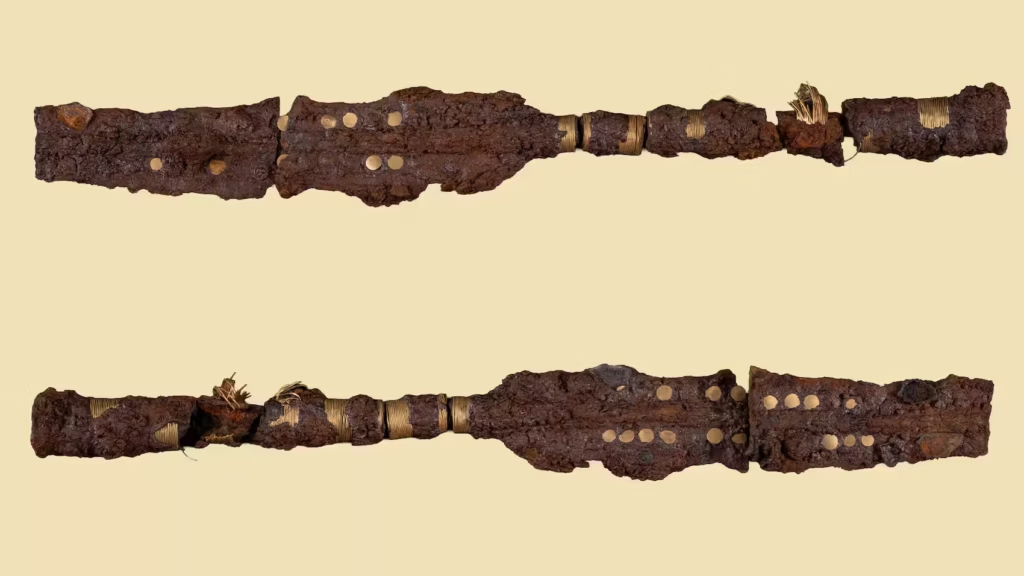
That moment of disbelief marked the beginning of one of the most significant archaeological finds in Denmark in decades. By the end of the same day, the team uncovered a second spearhead nearly identical in form and decoration. Laboratory analyses would soon confirm the extraordinary: these weapons date to approximately 900–830 BCE, representing the earliest iron yet discovered in Denmark.
A sacred spring beneath the gold
The 2025 excavation had initially focused on the question that had puzzled researchers for years: why had so many valuable ornaments—including ten heavy gold oath rings and almost 2,200 tiny spirals—been deposited here? The answer emerged when archaeologists exposed a buried spring directly beneath the earlier gold finds. The waterlogged environment had preserved organic materials with exceptional clarity, allowing an AMS sample of birch pitch from a spearhead’s protective sheath to anchor the dating with rare precision.
The spring changes everything. It reveals that the wealth scattered across the field was not random loss, accidental deposition, or the remains of a plundered settlement. It was a ritual landscape. The gold objects had been intentionally placed beside and above the flowing water, mirroring traditions documented across Europe in which springs served as powerful portals for offerings to the divine. At Boeslunde, this practice endured through centuries of the Late Bronze Age, as evidenced by nearby cooking pits that point to repeated gatherings, feasts, and ceremonies.
The newly discovered spears fit seamlessly into this ritual world. Their ornate gold decoration, revealed through detailed X-ray imaging, speaks to craftsmanship of the highest order. The best-preserved example measures 47 centimeters in its surviving portion and is estimated to have reached about 60 centimeters in full length. Nothing comparable—neither in Denmark nor in the broader Nordic region—has ever been found.
Iron before the Iron Age
The chronology is one of the most startling elements of the discovery. Denmark’s Iron Age traditionally begins several centuries after these spears were produced. Their presence signals that iron arrived not as a domestic craft but as a prized exotic material, circulating through long-distance exchange networks centuries before widespread local production took hold.
Comparable early iron weapons exist in Greece and parts of Central Europe, but none are adorned with gold inlays. The Boeslunde spears therefore expose an unexpected moment of technological and social hybridity: an elite community in Bronze Age Denmark wielding objects that combined imported iron with the local tradition of spectacular gold display.
This raises compelling questions about the people who lived here. Claudi-Hansen suggests that the surrounding landscape—already known for producing six rare gold bowls and dense clusters of luxury deposits—may reflect the domain of an influential lineage engaged in far-reaching networks of trade and ritual exchange. Their wealth was not merely accumulated; it was periodically consigned to the spring, transforming personal possessions into sacred offerings.
A window into ancient choices and beliefs
The human dimension of the discovery is evident in the archaeologist’s own reaction. Claudi-Hansen’s moment of stunned disbelief underscores how far outside expectations these objects fall. For modern researchers, the spears represent a “corner piece” of Denmark’s archaeological puzzle, illuminating the cultural transitions that accompanied Europe’s earliest iron technologies. For Bronze Age communities, however, such objects likely symbolized status, power, and spiritual commitment.
Their intentional deposition highlights how ritual practice structured relationships between people, metal, and landscape. Water, in particular, held deep symbolic weight. The newly identified Bronze Age spring at Boeslunde transforms the site from a simple field of unusual finds into a coherent sacred complex—one where cooking, gathering, and offering intertwined over generations.
The spears and the gold will soon be presented together at Museum Vestsjælland, allowing visitors to see a rare moment when distant technologies, local wealth, and ritual devotion converged. They stand as evidence that 2,800 years ago, the communities of southwest Zealand were connected to a broader world—not only economically, but spiritually.
Cover Image Credit: Museum Vestsjælland
