
15 June 2026 The Future is the Product of the Past

Hornelund Brooches: Exquisite Viking Gold Ornaments with Norse and Christian Symbolism Unearthed in Denmark

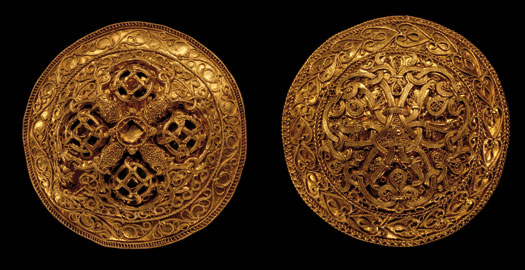
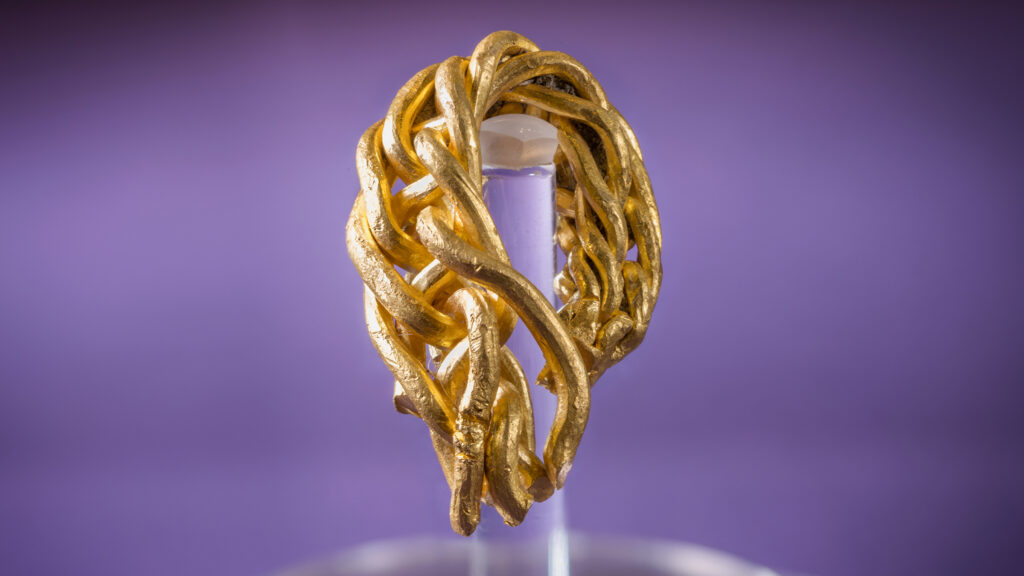
The Hornelund Brooches are rare and captivating examples of Viking Age goldsmithing, discovered in southwestern Jutland, Denmark. These two intricately crafted gold brooches, dating back to the early 11th century, were found alongside a gold arm ring, forming a mysterious hoard that continues to intrigue historians and archaeologists today.

A Unique Blend of Viking and Christian Art

Each brooch measures approximately 3.3 inches (8.5 cm) in diameter and weighs between 2.1 to 2.6 ounces (60 to 75 grams). Their designs showcase a fusion of Norse mythology and early Christian symbolism—a rare artistic combination during the Viking Age (A.D. 793–1066).

One brooch features four forward-facing animal heads, crafted in a distinctly Norse style, likely the work of a local Viking goldsmith.

The second brooch displays elegant leaves and vine motifs, echoing early Christian themes. In Christian iconography, grapevines symbolize Jesus as the “true vine”, representing life and resurrection.

Masterpieces from a Golden Age

During the Viking era, Jutland was a renowned hub for goldsmithing, producing high-quality jewelry for local elites and possibly for export. Similar brooches have been discovered in Sweden and the Slavic regions, suggesting cultural exchange or stylistic influence from countries like Estonia, where swirling decorative patterns were common in the late 10th century.


📣 Our WhatsApp channel is now LIVE! Stay up-to-date with the latest news and updates, just click here to follow us on WhatsApp and never miss a thing!!


These two intricately crafted gold brooches, dating back to the early 11th century, were found alongside a gold arm ring. Credit: National Museum of Denmark

Despite this, the Hornelund brooches remain unique in Denmark’s archaeological record. As archaeologist Władyslaw Duczko wrote in 1987, these pieces stand out in the Danish jewelry collection for their craftsmanship and hybrid artistic style.

A Mysterious Discovery

The hoard was accidentally unearthed in 1892 by a farm servant tilling fields near Varde, Denmark. Although the landowner turned the treasure over to the National Museum of Denmark (and received 295 Danish krone, equivalent to around $4,000 USD today), the site was never properly excavated.

To this day, no one knows whether the brooches were part of a Viking burial, homestead, or a hidden cache of wealth—possibly buried in haste during times of conflict or transition.

Preserved at the National Museum of Denmark

Today, the Hornelund Brooches are on display at the National Museum of Denmark, where they offer a rare glimpse into the artistic sophistication and cultural complexity of Viking society.

National Museum of Denmark

Cover Image Credit: National Museum of Denmark

Related Articles

3 mummified skeletons were found in Iznik, western Turkey

8 October 2021

8 October 2021

Archaeologists discovered mummified skeletons dating from the 2nd century A.D. within two sarcophagi at the Hisardere Necropolis in Bursa’s Iznik...

The Oldest “Book” of Europe: Derveni Papyrus

4 September 2022

4 September 2022

The Derveni papyrus is considered Europe’s oldest legible manuscript still in existence today. It is an ancient Greek papyrus roll...

A Hoard of Gold and Silver Roman Coins Dating Back to the Reign of Emperor Nero was Found in Worcestershire

7 December 2024

7 December 2024

A hoard of Roman and Iron Age silver coins dating back to Emperor Nero’s reign has been found during building...

First direct evidence of drug use as part of Bronze Age ritual ceremonies in Europe

6 April 2023

6 April 2023

An analysis of human hair strands recovered from a burial site in Menorca, Spain, reveals that ancient human civilizations used...

Lost Phrygian Inscription on Arslan Kaya Monument Deciphered

23 November 2024

23 November 2024

Professor Mark Munn of Pennsylvania State University has deciphered part of the inscription on the legendary Arslan Kaya Monument (also...

Jewel-Rich Elite Child Graves Discovered in Northern Siberia’s Upper Ob Region

13 January 2026

13 January 2026

Archaeologists working in Siberia have identified a series of early medieval child burials containing jewelry, ornate belts, and high-status dress...

Newly Reinterpreted Old Bulgarian Inscription Reveals Deep Cultural Links Between Byzantium, Slavs, and Altaic Traditions

9 March 2026

9 March 2026

A newly analyzed medieval inscription from Preslav sheds light on the cultural and linguistic crossroads of the early Bulgarian state,...

Fire Preserves Rare Bronze Age Loom in Alicante, Revealing 3,500-Year-Old Textile Technology

23 March 2026

23 March 2026

Archaeologists uncover an exceptionally preserved warp-weighted loom at Cabezo Redondo, shedding new light on Bronze Age textile production and early...

Ancient Talayotic Ceramics and Islamic-Era Structures Unearthed in Island of Cabrera

28 March 2026

28 March 2026

A remarkable archaeological discovery on the island of Cabrera, located just south of Mallorca in the Mediterranean Sea, is shedding...

2,300-year-old Punic tomb complex found during works on car park for staff

26 October 2024

26 October 2024

A 2,300-year-old Punic tomb was discovered during work in a car park near Mater Dei Hospital in Msida, Malta. The...

Rare Funeral Pyre at Sizewell C Reveals a Prehistoric Cremation Ritual on England’s Suffolk Coast

13 May 2026

13 May 2026

A rare funeral pyre at Sizewell C is giving archaeologists an unusual glimpse into how ancient communities on England’s Suffolk...

Rare gold gifts 2300 years old discovered in the famous Phoenician city of Carthage

17 August 2023

17 August 2023

Archaeologists excavating the sanctuary of Tophet, Carthage uncovered a collection of offerings, Tunisia’s Ministry of Cultural Affairs announced in a...

Gürcütepe’s 9,000-Year-Old Figurines Offer Rare Clues to Life After Taş Tepeler’s Monumental Age

11 December 2025

11 December 2025

Just southeast of Şanlıurfa, on the northwestern edge of the vast Harran Plain, a small but exceptionally informative archaeological site...

Skeleton Of “Spanish Monk” in Palace of Cortés Turns Out To Be An Aztec Woman

26 January 2024

26 January 2024

Recent research at the Palace of Cortés in Cuernavaca, Mexico, has revealed a grave historical error. For 50 years, it...

Iconic 2,500-Year-Old Coțofenești Helmet and Dacian Treasures Stolen from Dutch Museum

26 January 2025

26 January 2025

A heist at the Drents Museum in Assen, Netherlands, has resulted in the theft of several invaluable artifacts from the...