
Archaeologists in Denmark are testing mysterious 2,500-year-old Iron Age hole belts to understand whether they served as defenses, storage pits, boundary markers, or controlled movement barriers.
A puzzle cut into the Danish landscape
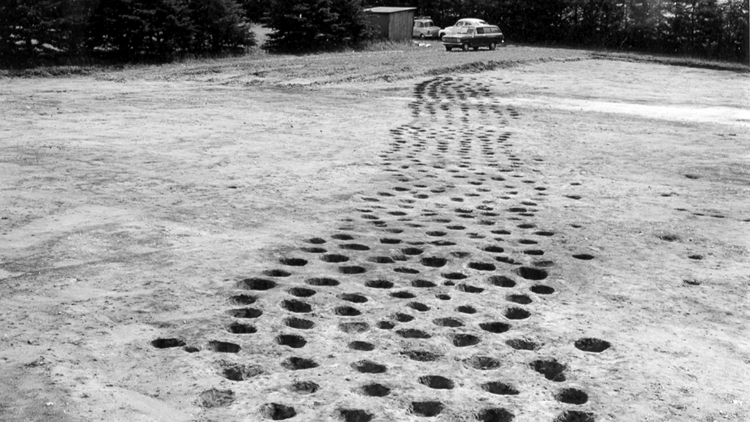
Across Denmark, rows of shallow holes cut through the landscape like traces of a forgotten plan. They are not graves, not ordinary postholes, and not simple refuse pits. Known in Danish as hulbælter, or “hole belts,” these long bands of spaced pits have puzzled archaeologists for decades. Now, a new experimental archaeology project is trying to answer a basic question: what did these thousands of Iron Age holes actually do?
The phenomenon dates to the early Pre-Roman Iron Age, around 500–300 BC. The features can run for hundreds of meters and sometimes for several kilometers. Individual pits are usually only about 30 to 40 centimeters deep, but together they form belts three to six meters wide. Nearly 50 examples have been identified across Denmark, especially in central and western Jutland, with others known on Funen and Lolland. Earlier research has noted that these pit-zone alignments are unusually concentrated in Denmark, although isolated parallels are known in Sweden and the Netherlands.
Rebuilding the holes from scratch
At the Saxo Institute at the University of Copenhagen, associate professor Henriette Lyngstrøm has gathered 30 archaeology students to move the debate from theory into the soil. Instead of asking only why the holes were dug, the team is rebuilding a hole belt from scratch: shaping tools, digging with reconstructed wooden spades, comparing them with modern spades, recording labor, and testing how the feature behaves.
The work is taking place in front of the Iron Age village at Sagnlandet Lejre, where ancient techniques can be tested at full scale. Some aspects of the past are not visible in a plan drawing. They emerge only when bodies, tools, soil, time, weather, and coordination are forced into the same experiment.
Could the pits have kept food cool?
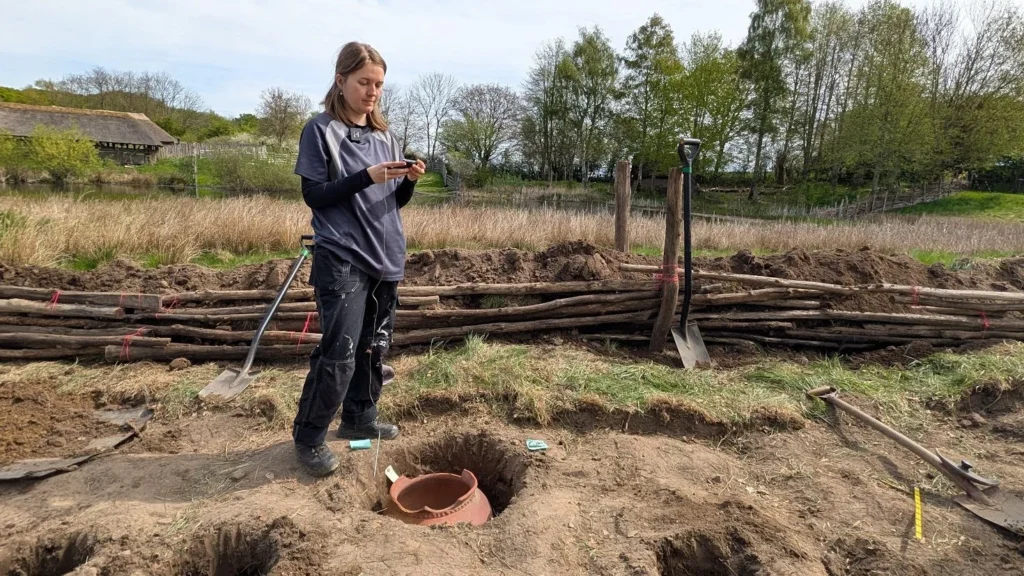
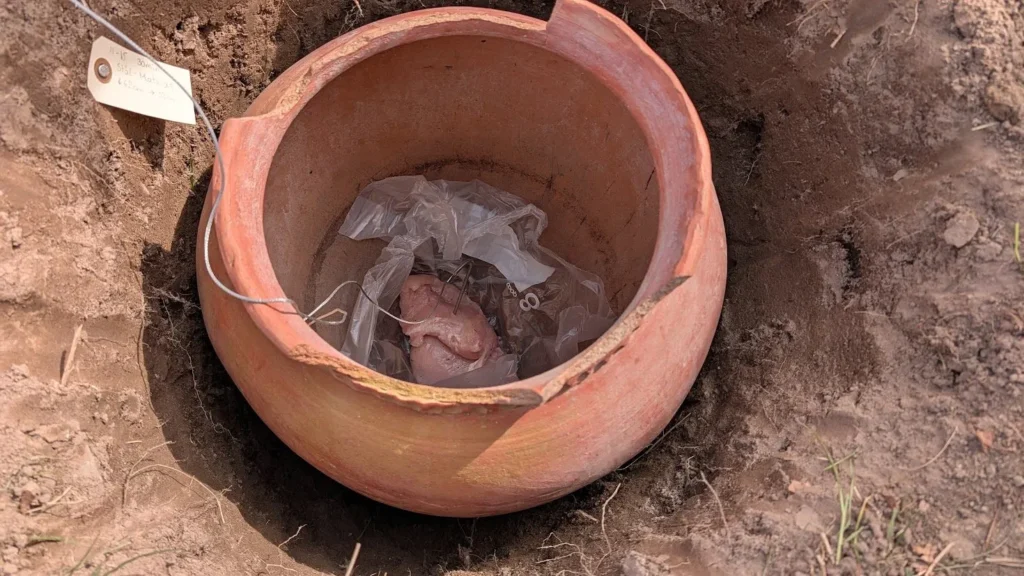
One of the more unusual tests concerns food storage. At Lystbækgård in western Jutland, archaeologists previously found pottery fragments and the bottom of a clay vessel in a hole belt. That evidence does not prove a storage function, but it has kept the idea alive. Graduate student Angelyn Sørensen tested the possibility by placing a piece of chicken, initially about 10 degrees Celsius, inside a ceramic jar in one of the pits and monitoring its temperature through the day.
On a warm May day, with outdoor temperatures reaching about 20 degrees Celsius, the meat rose only to around 12 degrees. That is still not a safe storage temperature for chicken by modern standards, but archaeologically the result matters for a different reason. It suggests that a covered pit could moderate temperature and may have helped keep food cooler in colder seasons, especially in autumn. The same pottery fragments also proved useful as digging tools.
Wooden spades and organized labor
The wooden spades are another central part of the experiment. Archaeologists have found many Iron Age wooden implements with flat ends and a central grip. Because they resemble paddles, they were once sometimes interpreted as oars. But their asymmetrical ends, together with traces of soil and small stones in the damaged wood, point instead toward digging. Graduate student Clara Thejls and her colleagues tested reconstructed versions, while another group worked with modern metal spades.
The difference was clear. Wooden spades worked, but they were slower, harder to use, and had to be resharpened with an axe during the work. That does not rule them out. It makes the Iron Age labor more visible. Digging a hole belt was not a casual task. It required planning, repeated effort, and people who knew how to organize a group.
This may be one of the project’s most important findings. Lyngstrøm has argued that too many diggers can slow the process. A hole belt required discipline, spacing, and leadership. If communities built these features across long distances, they also needed a social structure capable of directing labor. The holes may therefore reveal hierarchy and collective organization in Iron Age Denmark.
A defensive barrier, or something more complex?
The defensive theory remains especially compelling. Earlier experimental work suggested that sheep and cattle could cross such belts without hesitation, weakening the idea that they were built mainly as livestock barriers. But when the Lejre team staged a mock fight with sticks and plastic weapons, the feature worked better for defenders than attackers. Moving, balancing, and fighting at the same time became difficult for those trying to cross the uneven belt.
That result does not close the debate. Hole belts may have served different functions in different places: defense, controlled movement, boundary marking, seasonal storage, or ritual activity. The strength of the Lejre project is that it does not force one answer too early. Instead, it tests what was possible.
For now, Denmark’s mysterious 2,500-year-old hole belts remain partly unresolved. But the experiments are narrowing the field. They show that these shallow pits were not random marks in the soil, but engineered features that demanded labor, leadership, and intention.
The experiment was reported by the Danish science outlet Videnskab.dk.
Cover Image Credit: The Grønbæk hole belt in Ringkøbing-Skjern was among the first to be found in the 1960s, when archaeologists first noticed this phenomenon. Ringkøbing-Skjern Museum
