
12 December 2025 The Future is the Product of the Past

New Study Disproves Roman Massacre at Maiden Castle, Revealing Complex Iron Age Conflicts

Bournemouth University Archaeologists Challenge 90-Year-Old Roman Conquest Narrative at Maiden Castle with Fresh Forensic and Radiocarbon Analysis

A landmark study by Bournemouth University (BU) archaeologists has upended a widely accepted version of ancient British history, revealing that the infamous “Roman massacre” at Maiden Castle never happened. Instead, researchers discovered that the individuals buried at the Iron Age hillfort in Dorset died during multiple episodes of localized violence spanning several generations—long before any Roman legions set foot on the site.

The study, recently published in the Oxford Journal of Archaeology, reexamines one of Britain’s most iconic archaeological discoveries using modern forensic techniques and a comprehensive radiocarbon dating program. Human remains previously interpreted as victims of a single dramatic Roman attack were actually deposited over a timeline stretching from the late 1st century BC into the early 1st century AD.

Dr. Martin Smith, Associate Professor in Forensic and Biological Anthropology at BU, explained:

“The find of dozens of human skeletons displaying lethal weapon injuries was never in doubt. However, our systematic radiocarbon analysis shows these deaths occurred across decades, rather than a single event.”


📣 Our WhatsApp channel is now LIVE! Stay up-to-date with the latest news and updates, just click here to follow us on WhatsApp and never miss a thing!!


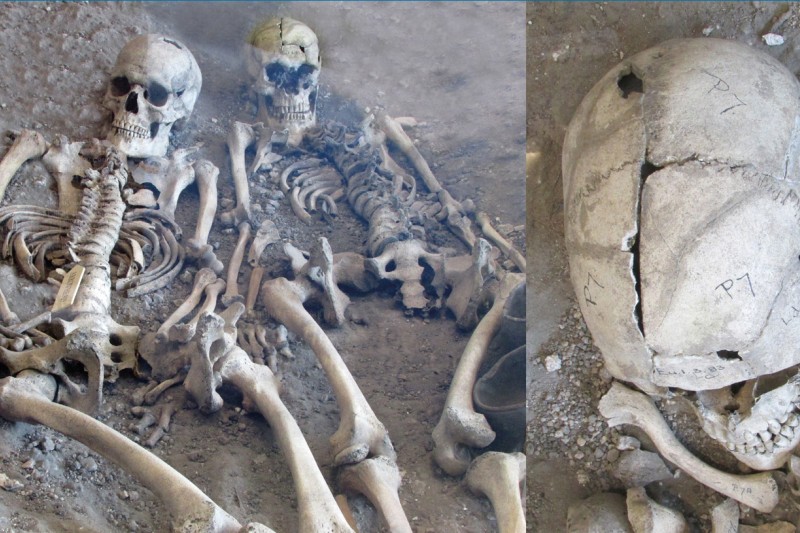
Two skeletons excavated by Mortimer Wheeler in the 1930s, dating back to the 1st century AD, both show injuries caused by bladed weapons. One of these individuals even has a spearhead embedded in his spine, which was previously (and incorrectly) identified as a Roman ballista bolt. Credit: Martin Smith

Originally excavated in 1936 by famed archaeologist Sir Mortimer Wheeler, Maiden Castle became a cultural symbol of resistance, allegedly representing the violent clash between the native Durotriges tribe and invading Roman forces. Wheeler’s vivid account of a Roman siege, complete with “marks of battle” and a tale of noble but futile resistance, helped etch the site into the national narrative as the setting of a tragic massacre.

But modern science tells a different story.

Dr. Miles Russell, Principal Academic in Prehistoric and Roman Archaeology at BU and co-author of the study, remarked:

“Since the 1930s, this story of a doomed native last stand has permeated books, articles, and documentaries. But our findings show it simply doesn’t hold up under scrutiny. The injuries are real, but the pattern, spread over decades, points not to Roman soldiers—but to inter-tribal violence or ritual killings by fellow Britons.”

Injuries observed on the skeletons include blunt force trauma and sharp-force lesions, but lack the consistency and concentration expected from organized Roman military tactics. Moreover, variations in burial practices suggest complex social dynamics at play. According to Visiting Fellow and archaeological scientist Paul Cheetham,

“The burial diversity suggests either co-existing cultures or intricate social stratification within Iron Age society. It’s no longer valid to impose simplistic interpretations on such complex archaeological contexts.”

The research also raises compelling questions about what remains hidden beneath the site. Wheeler’s initial excavation, though groundbreaking for its time, only covered a fraction of the expansive hillfort. Cheetham added,

“It’s likely that many more burials remain undiscovered around the vast ramparts of Maiden Castle.”
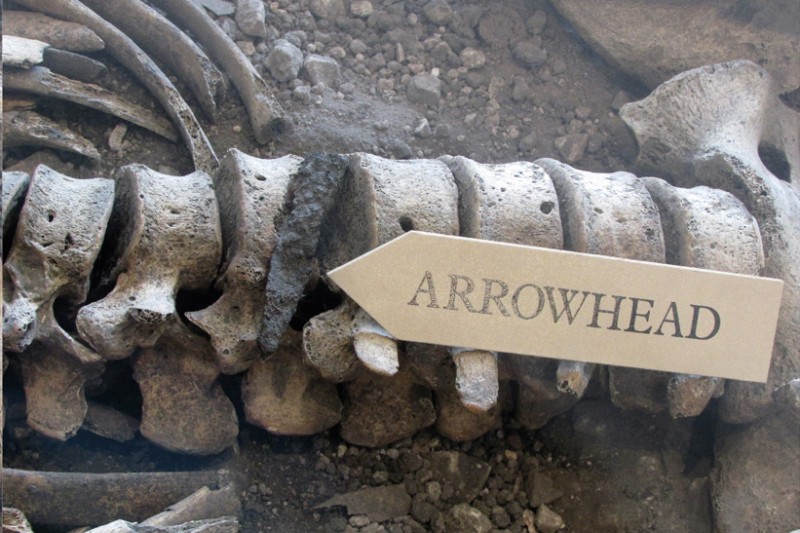
A skeleton with a spearhead lodged in the spine, previously (and mistakenly) identified as a bolt or arrowhead from a Roman ballista. Credit: Martin Smith

Dr. Smith noted how contemporary influences may have shaped earlier interpretations:

“Wheeler was working on the eve of WWII, with Britain fearing another foreign invasion. That kind of anxiety might have made the idea of a heroic stand against the Romans resonate more deeply.”

This new study calls for a reevaluation not only of Maiden Castle but of how historical narratives are constructed—and how they persist, even in the face of contradictory evidence.

By employing modern archaeological science, Bournemouth University researchers have not only dismantled a myth but replaced it with a richer, more human story—one that acknowledges the complexities of Iron Age life, social conflict, and the long shadow of impending conquest.

Smith, M. J., Russell, M., & Cheetham, P. (2025). Fraught with high tragedy: A contextual and chronological reconsideration of the Maiden Castle Iron Age ‘war cemetery’ (England). Oxford Journal of Archaeology, 44(2), 123–140. https://doi.org/10.1111/ojoa.12324

Bournemouth University

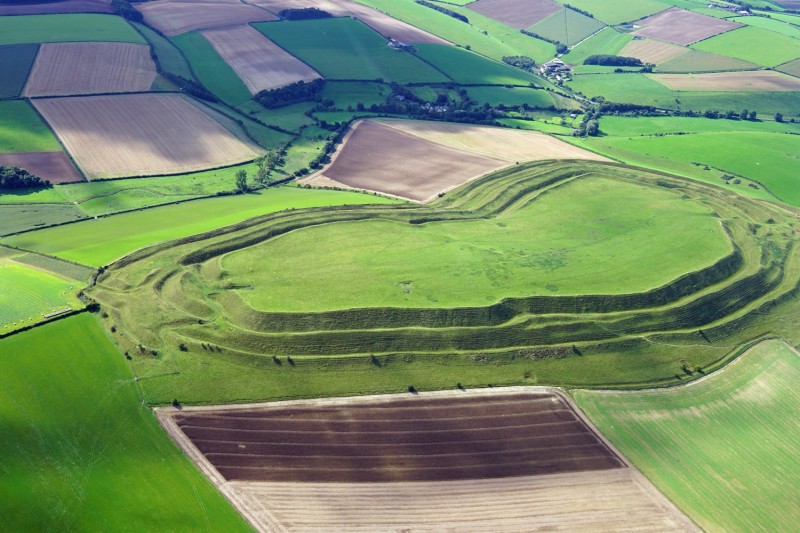
Cover Image Credit: Aerial view of Maiden Castle, Dorset, the largest Iron Age hillfort in Britain. Credit: Jo and Sue Crane

Related Articles

Wasabi Isn’t Just For Sushi: It is an Innovative Solution for Preserving Ancient Papyrus

28 February 2024

28 February 2024

A new natural technique for cleaning and preserving priceless ancient Egyptian papyrus that are in danger from bacteria and fungi...

Researchers Suggest That the 5,000-Year-Old Boat-Shaped Mound May Be Fossilized Remains of Noah’s Ark

16 March 2025

16 March 2025

A recent discovery in Türkiye has ignited interest among experts who believe they may have found the fossilized remains of...

Before the Hittites: 8,000-Year-Old Rock Art Discovered in Kayseri, Türkiye

6 November 2025

6 November 2025

An extraordinary archaeological discovery in Kayseri’s Develi district has revealed 8,000-year-old rock art engravings, offering new insight into how early...

Polish archaeologists have uncovered nine crocodile heads within ancient Egyptian tombs of nobles

25 December 2022

25 December 2022

Polish archaeologists excavating the Theban Necropolis in Egypt discovered nine crocodile heads hidden inside two tombs belonging to high-ranking nobles....

7,000-year-old Ritual Complex Found In Jordan Desert

23 February 2022

23 February 2022

The team of French and Jordanian archaeologists has discovered a 7,000-year-old ritualistic complex near what is thought to be the...

The Jinn of Girnavaz Mound

6 February 2021

6 February 2021

Girnavaz mound is in the north of Nusaybin district of Mardin province and Nusaybin 4 km is away. It is...

Archaeologists discover ‘exceptional’ ancient Roman sanctuary in near intact condition in Netherlands

23 June 2022

23 June 2022

Archaeologists have unearthed a relatively intact 1st-century Roman sanctuary in the town of Herwen-Hemeling in the province of Gelderland in...

Face of the Picts? Rare Carved Stone Discovered at Scottish Hillfort

19 September 2025

19 September 2025

A remarkable discovery at a hillfort in Fife has brought archaeologists face-to-face with Scotland’s enigmatic Pictish past. A carved stone,...

2,000-year-old Roman Military Sandal with Nails Found in Germany

25 June 2024

25 June 2024

Archaeologists have discovered the remains of a 2,000-year-old Roman Military Sandal near an auxiliary Roman camp in Germany. Archaeologists from...

Recent excavations reveal the complete water conservancy system of the nearly 5000-year-old Liangzhu Ruins

26 November 2024

26 November 2024

In recent excavations around the Liangzhu Ruins in east China’s Zhejiang Province, researchers have discovered about 20 ancient dams. Seven...

The Bronze Sacred Sanxingdui Tree Number 3 is Being Restored

9 April 2021

9 April 2021

According to the announcement of the Sanxingdui Museum, archaeologists have begun to assemble and restore the No. 3 bronze sacred...

7,000-year-old discovery in Umm Jirsan Cave

28 June 2021

28 June 2021

Archaeologists have made new discoveries in the Umm Jirsan cave in the Harrat Khaybar lava field in northern Saudi Arabia....

700-Year-Old Church Becomes a Museum

31 January 2021

31 January 2021

It was learned that the 7-century-old church in Akçaabat, Trabzon will serve as a museum from now on. St. The...

Jordan’s mysterious ancient wall “Khatt Shebib”

22 October 2022

22 October 2022

The accomplishments of ancient civilizations are typically woefully underappreciated because we stereotype them as primitives who only wore loincloths, and...

New study reveals the Milky Way’s hidden role in ancient Egyptian mythology

11 April 2024

11 April 2024

The ancient Egyptians were keen observers of the night sky. They incorporated their astronomical observations into their religion, mythology, and...