
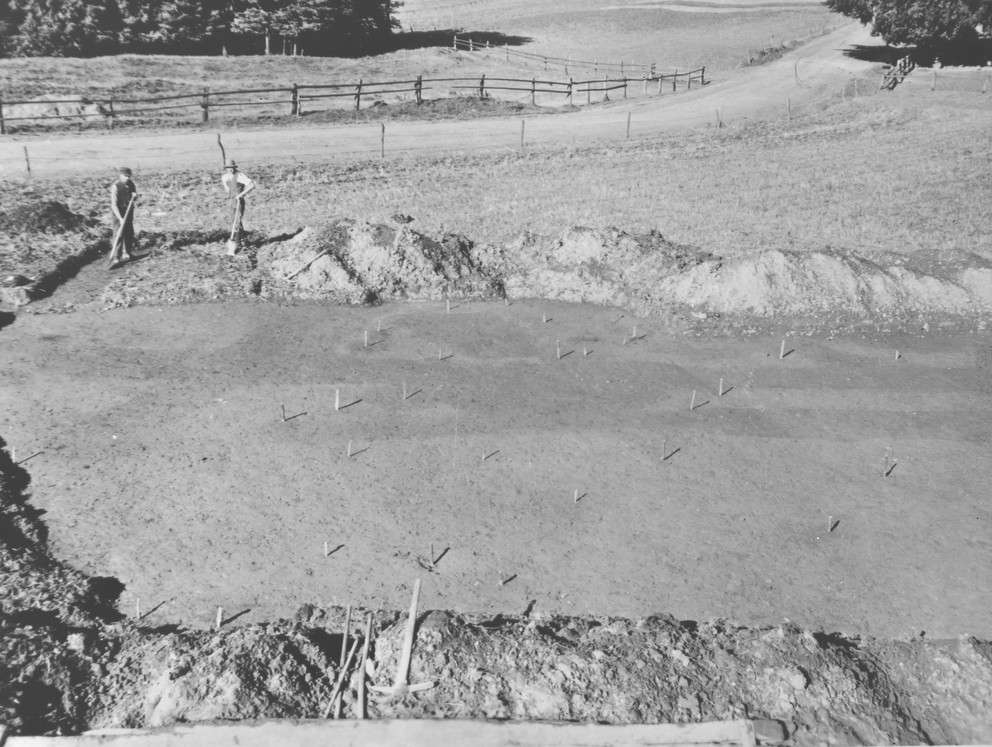
The Roman camp at Kneblinghausen, in Germany’s Soest district, is one of the most puzzling Roman-era sites in Westphalia. Excavations there began back in 1901. Between 1934 and 1951, local schoolmaster Eberhard Henneböle led several digging campaigns of his own.
Even so, the site has given up almost nothing that can be firmly dated. What’s confirmed is a Germanic settlement, later overlaid by a Roman fortification. Why the Romans were there, and for how long, remains unknown.
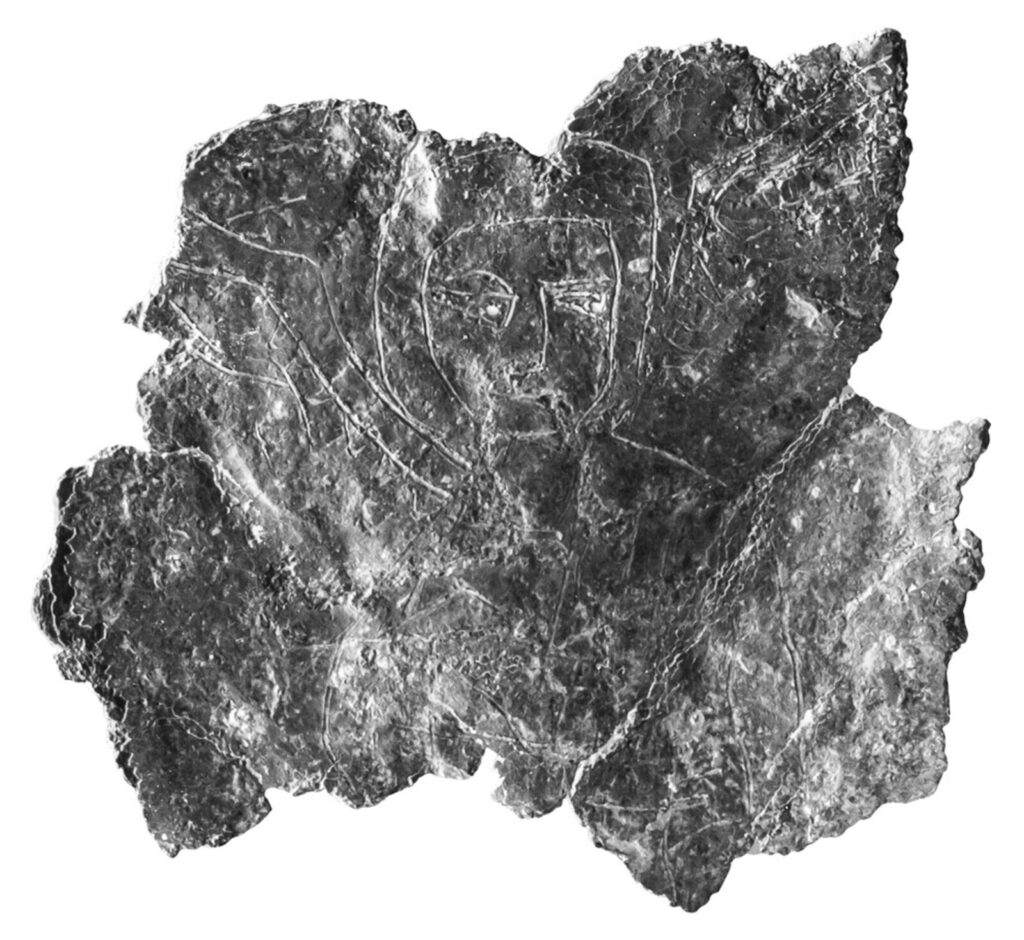
Now a rediscovered photograph adds a new twist. It shows a Roman lead artifact from Kneblinghausen engraved with a winged, god-like figure — a piece photographed once, in 1938, and never seen since. No excavation report explains it. No one recorded where it went. All that survives is a single negative, and a question that historians still can’t settle: is the figure Mercury, or is it Victoria?
A Lost Object, Rediscovered on Film
Until recently, only two objects at Kneblinghausen could be called Roman with real confidence: an iron adze used for woodworking, and a fragment of a bronze cloak brooch. That short list has just grown by one — not through new digging, but through an old photograph.
While digitizing Henneböle’s photographic archive, researchers found a small negative, just 12 by 9 centimeters, in an envelope with a handwritten label. Translated, it reads: “Roman camp, lead plate from IV/38 Na with an engraved drawing of a head, found 19 Aug. 38.” A later inventory from 1965/66 lists it as find number 704.
The object itself is missing. Its current location, if it still exists, is unknown. All that remains is the photograph.
Converted from negative to positive, the image shows a thin, irregular sheet of metal, chipped, creased, and worn at the edges. Judging by the scale of other finds in the same collection, the piece was likely under ten centimeters across. The shallow, delicate scratches suggest a soft material — lead is the most likely candidate, which is why researchers now refer to it as a Roman lead artifact from Kneblinghausen.
A Face, a Halo, and a Pair of Wings
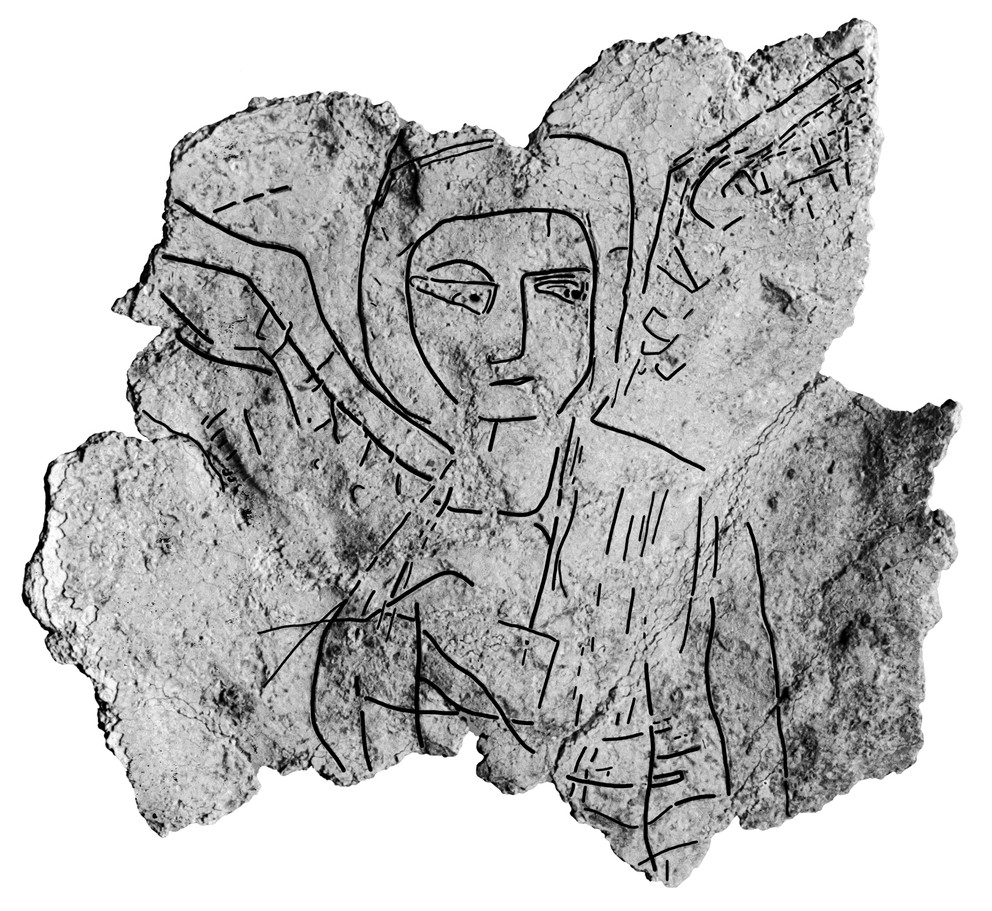
The mystery lies in what’s scratched onto the metal. The engraving shows a stylized human figure, seen from the front, head and shoulders, with its gaze cast down and to the right.
An extra line circles the head, almost like a halo. Curved lines sweep outward from either side of it, rising up and out. Fainter, harder-to-read marks cover the torso. The style suggests a talented amateur rather than a professional engraver.
Interpreting the image is difficult without the original object in hand. Still, a few details stand out. The figure seems to wear some kind of head covering. The curling lines beside it look distinctly like wings.
The Case for Mercury
A halo and wings might suggest a Christian angel, but that reading doesn’t fit a Roman military context roughly two thousand years old. A more fitting match is the Roman god Mercury, often shown wearing a winged helmet or a winged petasos, his broad-brimmed traveler’s hat. Mercury’s usual attributes, a staff and a purse, aren’t visible in the engraving, but their absence doesn’t rule him out.
The Case for Victoria
There’s a second candidate, and she may fit even better. The figure’s features read as feminine, and the wings appear to sit on the back rather than on the head, which points more toward Victoria, the Roman goddess of victory, than toward Mercury’s headgear. Under that reading, the “head covering” becomes a hairstyle or a laurel wreath, both closely tied to how Victoria was traditionally shown.
Neither god can be confirmed, and neither can be ruled out. The relic that could settle the argument is gone.
Everyday Label or Something More Charged
Engraved lead served very different purposes across the Roman world. Simple lead tags, called pittacia, worked as commercial labels, recording quantities, prices, or a trader’s name.
At the more dramatic end were curse tablets, or defixiones. These thin lead sheets carried short inscriptions and sometimes small images, scratched in with a stylus. They usually turn up near graves, temples, or sacred springs. Their writers called on a god to bring harm to a rival, whether in business, love, or a legal dispute.
Whether the Kneblinghausen lead artifact once carried that kind of weight, or was simply idle scratching by a soldier with time to kill, can’t be answered without more context.
There’s another complication. Roman pottery sherds are known to have been secretly planted at the 1938 excavation by workers on site. That means an origin from somewhere else entirely, possibly even an early medieval, Christian-era object, can’t be ruled out. It may even explain why Henneböle, otherwise a careful record-keeper, never published this find.
An Open Question at an Already Mysterious Site
For now, the engraved lead artifact from Kneblinghausen exists only as a decades-old photograph. The object itself is gone, and its meaning sits somewhere between two competing gods and one far more ordinary explanation.
Rather than clearing up what the Roman camp was for, the find adds one more layer of mystery to a site that, more than a century after the first excavation, still hasn’t given up its secrets.
