
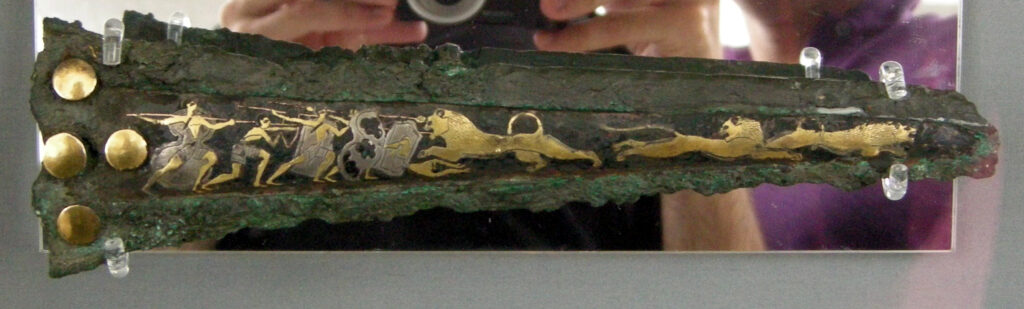
Long before blacksmiths learned to smelt iron ore, the rulers of Bronze Age Greece were already wearing iron: just not the kind that came out of a furnace. It came out of the sky.
A five-year investigation by a French-Greek research team has confirmed that Mycenaean and Minoan elites deliberately sought out meteorite iron to craft their most prestigious jewelry, while ordinary terrestrial iron remained rare and crude for centuries longer. The findings, led by Matthieu Gounelle of the French National Museum of Natural History and Eleni Mantzourani of the National and Kapodistrian University of Athens, were published in the “Journal of Archaeological Science”.
A Five-Year Hunt Across Nineteen Museums
The scale of the project is part of what makes it convincing. Researchers combed through nineteen museums and thirty-three archaeological sites, chemically testing a total of 105 Bronze Age and Early Iron Age artifacts. Of those, 91 were iron objects — the core dataset used to answer a question that had lingered unresolved for decades: did the Aegean’s palatial elite use celestial metal the way other Bronze Age cultures did, and when did local iron smelting actually begin?
The chemistry gave a clear answer. Thirteen of the 91 objects — roughly 14 percent — contained significant traces of nickel, the telltale fingerprint of extraterrestrial origin that terrestrial iron ore simply doesn’t carry. Every single one of those thirteen nickel-rich objects was a ring.
Rings Fit for Kings
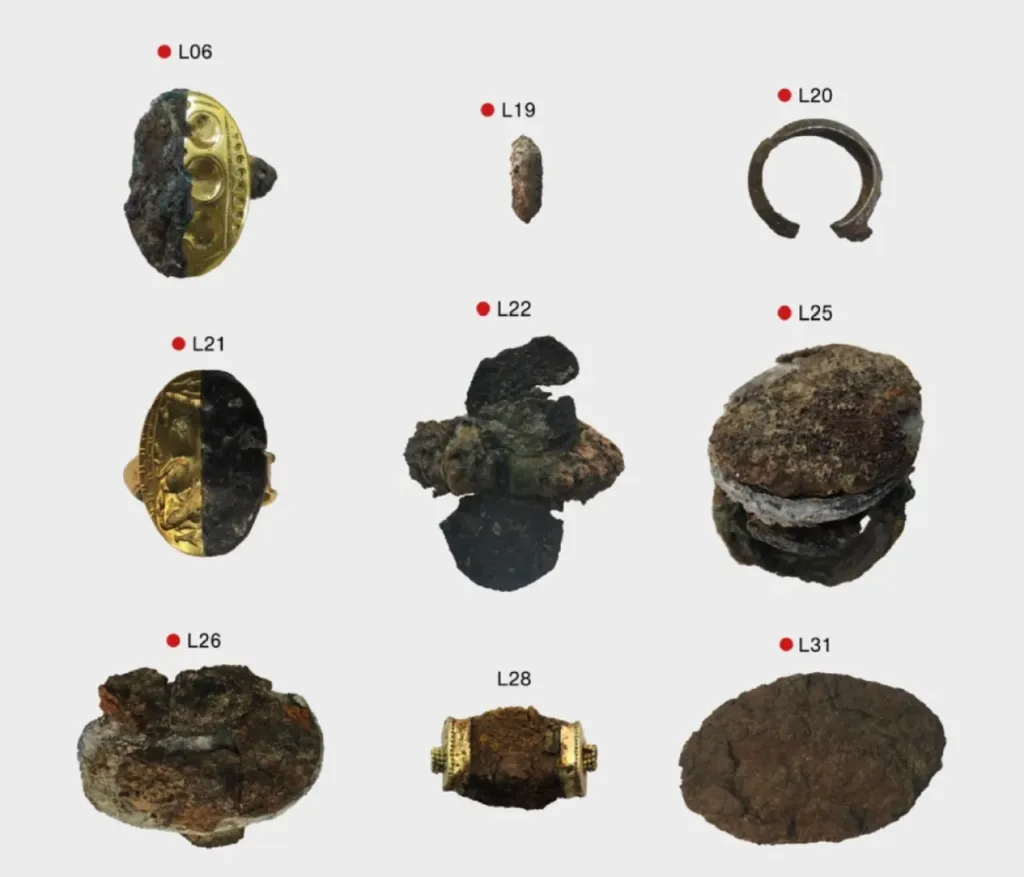
Eleven of the thirteen meteoritic rings came out of the Peloponnese, unearthed in richly furnished tholos and chamber tombs at Mycenae, Vapheio, Kakovatos, Aidonia, and Dendra — burials stocked with gold vessels, agate seals, and amber jewelry that mark them as belonging to the palatial elite. The twelfth ring turned up somewhere very different: on the finger of a man at the Minoan sanctuary of Anemospilia, in Crete, whom archaeologists believe was a high-ranking priest.
Most of the rings are signets — flat-bezeled rings used to stamp and seal documents — and many are polymetallic, combining meteoritic iron with gold, silver, or bronze. Two examples, from Mycenae and Phaistos, even have bezels split cleanly in half: one side gold, the other iron-nickel, engraved by clearly skilled hands. As the study’s authors put it, the pattern suggests these objects functioned as emblems of power among the Minoan and Mycenaean elite, not simple ornaments.
Gounelle addressed exactly this pattern in the MNHN’s announcement of the findings. He explained that the funerary context of the rings suggests they belonged to prominent individuals or members of an elite, likely because the sky-borne origin of the material was already recognized at the time — a detail that helps explain why every nickel-bearing object in the entire sample turned out to be a ring, and never a blade or a tool.
Why Egypt, Not Greece, Was Probably the Source
Greece itself is a poor place to find meteorites. Only one confirmed meteorite fall has ever been recorded on Greek soil — at Serres in 1818 — and the country lacks the arid deserts that let meteorites survive for millennia elsewhere. That scarcity pushed the researchers toward a trade-based explanation: the raw material likely arrived from Egypt, where desert conditions preserve meteorites in far greater numbers.
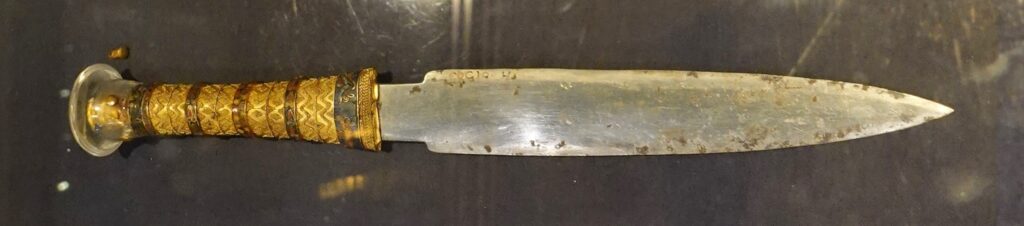
Egypt already has a track record here. The Gerzeh beads, dated to around 3200 BCE, and Tutankhamun’s famous meteoritic dagger from roughly 1350 BCE are established examples of Egyptian meteoritic ironwork. Colombia One frames the new Greek findings as another data point in a growing body of evidence that ancient societies around the Mediterranean and Near East prized iron that literally fell from the sky. Curiously, very few meteoritic objects have actually been found within Egypt itself — but the researchers argue that’s not a contradiction. In ancient trade networks, valuable raw materials routinely moved long distances without the exporting region keeping much for itself.
Two Kinds of Iron, Two Very Different Jobs
The other 78 objects in the sample — 86 percent of the total — showed no nickel at all, meaning they were smelted from terrestrial ore. And their story runs almost in reverse to the meteoritic rings.
Before the 12th century BCE, only two reliably dated pieces of smelted iron exist in the record: a pendant from Dendra and a ring from Skoura, both from the 14th or 13th century BCE. Everything else made from terrestrial iron dates to the Submycenaean and Protogeometric periods: from around 1075 BCE onward, after the Mycenaean palaces had already collapsed. That timeline places Greece notably behind Anatolia, where smelted iron objects were already circulating in the Early and Middle Bronze Age.
The two materials weren’t just chronologically separate — they were used for entirely different purposes. Meteoritic iron went into elaborate, polymetallic jewelry with decorated bezels. Smelted iron, once it did appear, went mostly into knives, daggers, and swords, or turned up as unworked fragments rarely paired with other metals. GreekReporter notes that smelted iron tended to show up in cruder, everyday items, while meteorite iron went into finer, more valuable pieces: a distinction the study’s authors say shows artisans and their clients understood these as fundamentally different materials, not interchangeable versions of “iron.”
A Fashion That Faded With the Palaces
The meteoritic ring tradition didn’t just decline — it stopped. Every ring from the Submycenaean and Protogeometric periods examined in the study (36 in total) was made of ordinary smelted iron, with no nickel whatsoever. The celestial-ring fashion, which began in Crete around the 17th century BCE and reached the Peloponnese by the 16th, ran out almost exactly when the Mycenaean palaces fell in the early 12th century BCE.
It’s worth being precise about that collapse, because it wasn’t a single event. Minoan civilization on Crete had already declined well before the Mycenaean palaces fell on the mainland, and Science News points out that the Minoan collapse may have been driven by a volcanic eruption rather than the same upheavals that later toppled the Mycenaean palatial system. The two civilizations’ declines were related but not identical — and the meteoritic ring fashion spanned both.
The researchers offer several possible explanations for why the trend ended, and they’re careful not to present them as mutually exclusive. Demand could have collapsed along with the elite class that valued these rings. Supply chains could have broken down — Egyptian meteorite expeditions interrupted, or Mediterranean trade networks disrupted, both plausible during the same turbulent period. Or, as the authors put it with disarming honesty, it’s entirely possible the meteoritic-ring fashion simply faded out the way any fashion eventually does.
Meanwhile, terrestrial iron use moved in the opposite direction, expanding after the palaces fell — mirroring, with a delay of a century or two, a shift that had already happened further east.
Rewriting the Map
Beyond the chronology, the study substantially expands the known geography of meteoritic ironwork. Before this project, only seven sites with confirmed meteoritic iron finds were known in the eastern Mediterranean, spread across Egypt, Syria, Lebanon, and Türkiye. This research adds seven entirely new sites — all in Greece: Phaistos, Anemospilia, Mycenae, Vapheio, Kakovatos, Aidonia, and Dendra. In the authors’ own words, the number of Bronze Age iron rings identified as probably meteoritic has increased roughly tenfold.
Some questions remain open. The team isn’t certain exactly how ancient smiths extracted usable fragments from meteorites, though they draw a comparison to techniques used by Inuit metalworkers in Greenland, who historically detached small pieces from large iron masses using basalt rocks. Nickel content across the thirteen rings also varies wildly — from 1 percent to 50 percent — which hints that several distinct meteorites, not just one source rock, were worked into jewelry over the centuries. It’s also worth noting that, as with much single-study archaeological science reporting, independent outside commentary on the findings has been limited so far in available coverage — a normal early stage for a paper that published only recently.
What the evidence does make clear is that iron in Bronze Age Greece was never one material. There was iron from the sky, reserved for the fingers of kings and priests, and iron from the earth, which only began arming soldiers and equipping households as the palatial world was already coming apart. One arrived as a rare, imported luxury; the other emerged as a practical technology. And when the palaces fell, only one of them survived the transition.
France’s National Museum of Natural History (Muséum national d’Histoire naturelle, MNHN)
Matthieu Gounelle, Eleni Mantzourani, Iron in Greece in the second millennium B.C.E. Journal of Archaeological Science, vol.192, August 2026. doi.org/10.1016/j.jas.2026.106622
