
Sparta’s origins may be far older and more complicated than the familiar story of a warrior society founded by conquering Dorians in southern Greece.
A new archaeological and historical study suggests that the people later known as Spartans did not simply impose themselves on an empty or passive landscape. Instead, they appear to have entered a region already shaped by an older Lakedaimonian community, one whose memory was anchored in a Mycenaean palace, a hilltop sanctuary, and centuries of ritual life in the Eurotas Valley.
The study, published by historian Hans Beck of the University of Münster in The Annual of the British School at Athens, shifts attention away from Sparta itself and toward two places south of the classical city: the Mycenaean palace at Aghios Vasileios near Xirokambi and the Sanctuary of Apollo Amyklaios at Amykles.
Together, these sites suggest that Lakedaimonian identity did not begin with Sparta. It had deeper Bronze Age roots.
Linear B tablets point to an older Lakedaimonian identity
The earliest traces of the Lakedaimonians come from Linear B, the script used by Mycenaean palace administrations during the Late Bronze Age. Tablets found at Thebes mention forms of the word “Lakedaimonian,” indicating that the name or identity was already known in palatial records around the end of the Bronze Age.
That matters because Lakedaimonians are often treated as almost interchangeable with Spartans in later Greek history. Beck’s study argues that the relationship was more fluid. The Lakedaimonians were not a fixed “nation” in the modern sense. They were a changing community, held together by shared places, rituals, memories, and political centers.
Aghios Vasileios now gives that early world a physical anchor.
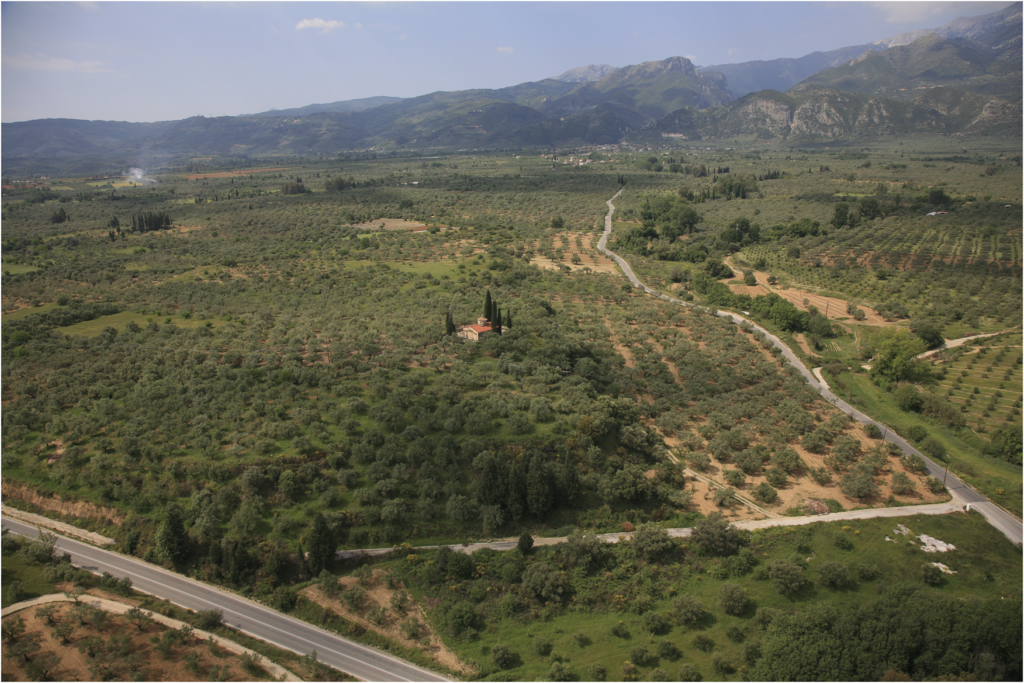
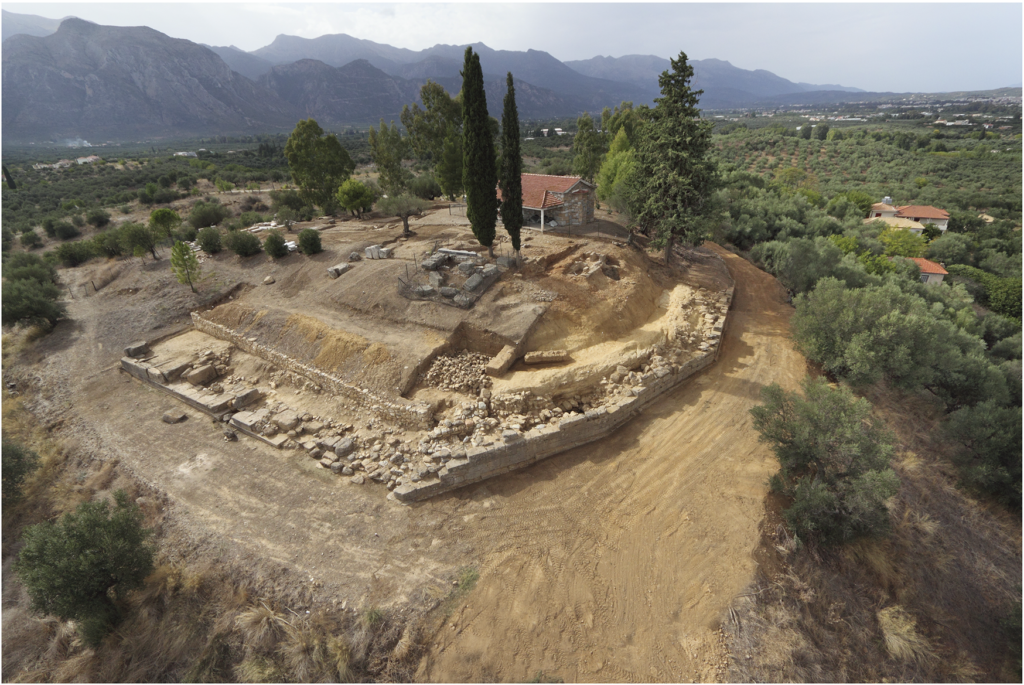
Located about 12 kilometers south of modern Sparta, the site has produced monumental Mycenaean buildings, a large court, fresco fragments, bronze swords, and more than 200 Linear B archival components. Among them is a nodule bearing the sign group wa-na-ko-to, linked to the Mycenaean wanax, or king.
This was not a small village. The evidence places Aghios Vasileios among the major palatial centers of the Mycenaean world. Its archive ranks behind only Knossos, Pylos, and Thebes in the quantity of Linear B records known from Aegean sites.
For Beck, the implication is striking: the wanax of the Lakedaimonians now has a plausible home.
A palace that gathered people and power
A Mycenaean palace was more than a royal residence. It was an administrative machine, a ritual center, and a point of gravity for farmers, craftspeople, scribes, officials, and local elites.
At Aghios Vasileios, the written records refer to livestock, oil, wool, textiles, aromatic substances, animal products, and other goods. Such records show a palace embedded in the economic life of the Eurotas Valley and beyond. The palace likely drew scattered communities into repeated contact, creating what Beck describes as a sense of belonging.
That belonging was not rigid. A farmer living far from the hilltop may not have thought of himself as “Lakedaimonian” every day. But during ceremonies, obligations, exchanges, and gatherings around the palace, a shared identity could become real.
Then the Mycenaean palatial system collapsed.
Aghios Vasileios appears to have been destroyed or abandoned around the transition from the 13th to the 12th century BCE. Across the Greek world, palaces fell, archives burned, and political systems vanished. Yet in the Eurotas Valley, one sacred place continued to draw people.
Amyklai became a sanctuary of memory
About six to seven kilometers north of Aghios Vasileios, the hill of Aghia Kyriaki at Amykles had already become an important ritual site during the Late Bronze Age. Archaeology has revealed female figurines, animal figurines, rhytons, drinking vessels, and evidence of banqueting.
During the palace period, Amyklai may have acted as a ceremonial outpost tied to the world of Aghios Vasileios. After the palace disappeared, it did not fade. Its role seems to have grown.
Pottery and votive finds suggest that people continued to gather at the sanctuary through the Submycenaean, Protogeometric, and Geometric periods. The offerings changed over time. Drinking vessels, bronze pins, spearheads, iron swords, spindle whorls, and other objects point to feasting, textile dedication, elite display, and ritual performance.
In a landscape where royal power had collapsed, Amyklai preserved continuity. It became a place where memory survived without a palace.
Sparta’s rise may have been integration, not erasure
The older model imagined the arrival of Dorian Spartans as a sharp conquest of Laconia. Beck does not deny movement, tension, or conflict. But the archaeological picture does not support a simple story of violent replacement at Amyklai.
There is no clear cultural rupture at the sanctuary. Ritual practices continued. Offerings evolved gradually. The sacred hill remained active.
This suggests a slower process in which early Spartans entered a region already shaped by Lakedaimonian traditions and gradually became part of that world. Rather than erasing the older community, they may have adopted its places of memory and reframed them under Spartan leadership.
Amyklai became the crucial meeting ground.
The Hyakinthia, one of the most important festivals in the region, brought Spartans and Lakedaimonians together through processions, sacrifices, music, athletic contests, feasting, singing, and dance. Ancient testimony suggests that local songs from different places formed part of the festival. This was not a purely Spartan performance. It carried regional memory.
For Spartans, the journey to Amyklai meant moving beyond their urban center. For Lakedaimonians from the Eurotas plain and surrounding regions, the sanctuary was an ancestral place.
A bronze Apollo over an ancient hero
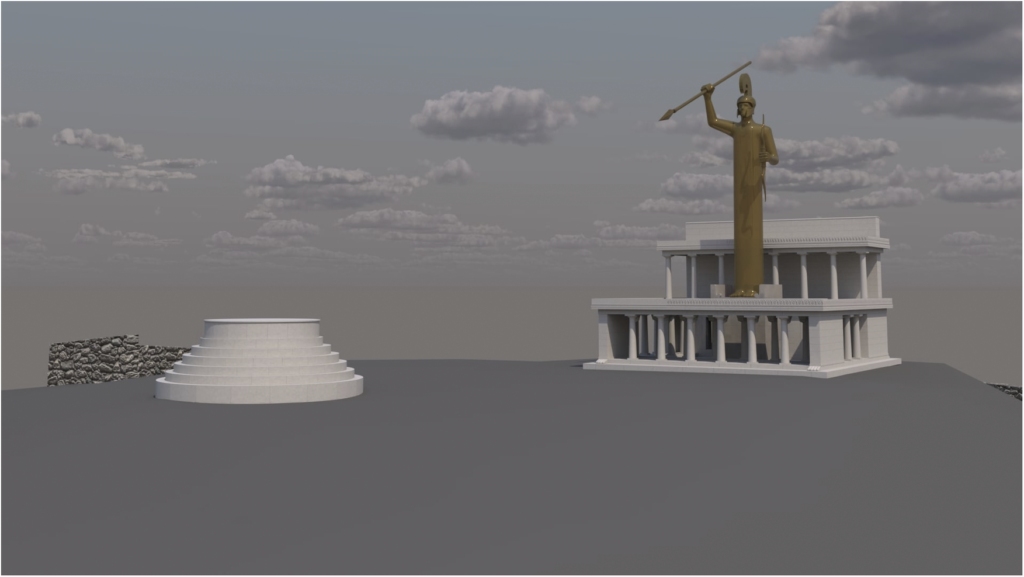
By the sixth century BCE, Amyklai had become one of the great sacred landmarks of Laconia. A colossal statue of Apollo Amyklaios, about 14 meters high, stood on the hilltop. Sheathed in bronze, with helmet, spear, and bow, it would have been visible across parts of the Eurotas Valley.
Beneath the statue lay another layer of meaning: the tomb or altar of Hyakinthos, a local hero whose name appears to preserve very ancient traditions. The combination of Apollo and Hyakinthos linked an Olympian god with a deep local past.
That pairing may be the clearest symbol of what happened in Laconia. Sparta did not simply replace the Lakedaimonian world. It stood on top of it, absorbed it, and gave it a new political shape.
The result was not the clean birth of a warrior state, but a long negotiation between newcomers, older communities, sacred hills, ruined palaces, and inherited memories.
Before Sparta became Sparta, Laconia already had a story.
Beck, H. (2026). PLACES OF BELONGING: ARCHAEOHISTORICAL ENCOUNTERS WITH THE LAKEDAIMONIANS AT THE MYCENAEAN PALACE OF AGHIOS VASILEIOS AND THE SANCTUARY OF APOLLO AT AMYKLES. The Annual of the British School at Athens, 1–27. doi:10.1017/S0068245426100343
Cover Image Credit: Aerial view of the Aghios Vasileios hilltop from the west. Photograph by V. Georgiadis, from Wiersma et al. Reference Wiersma, 2022, 124. © Corien Wiersma, Aghios Vasileios Survey Project (printed with permission). Credit: Beck, H., 2026
