
14 June 2026 The Future is the Product of the Past

3,500-Year-Old Mycenaean Boar Tusk Helmets Unearthed in Ancient Greece

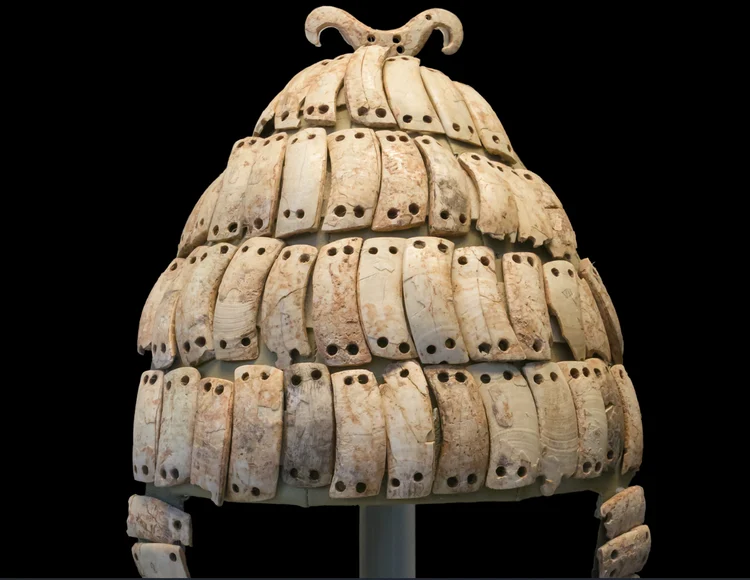
A remarkable boar tusk helmet discovered in a vaulted tomb near Pylos, Greece, is shedding new light on Mycenaean warrior culture and elite craftsmanship dating back to around 1500 BC. The artifact, made from dozens of carefully shaped wild boar tusks sewn onto a conical leather cap, represents one of the most distinctive forms of head protection in Bronze Age Greece.

Archaeologists explain that the helmet was constructed by stitching polished boar tusks onto fabric or leather strips arranged around a felt-lined cap. The design provided coverage for the wearer’s jaw and neck, though it offered less impact resistance than later bronze helmets. Despite this, its symbolic value appears to have far outweighed its practical limitations.

The significance of these helmets is reinforced by literary evidence. In Book Ten of Homer’s Iliad, the hero Odysseus is equipped with a helmet adorned with rows of gleaming white tusks, arranged in alternating directions. The detailed description closely matches archaeological finds from Mycenaean sites such as Dendra, where ivory fragments and bronze armor have been uncovered.
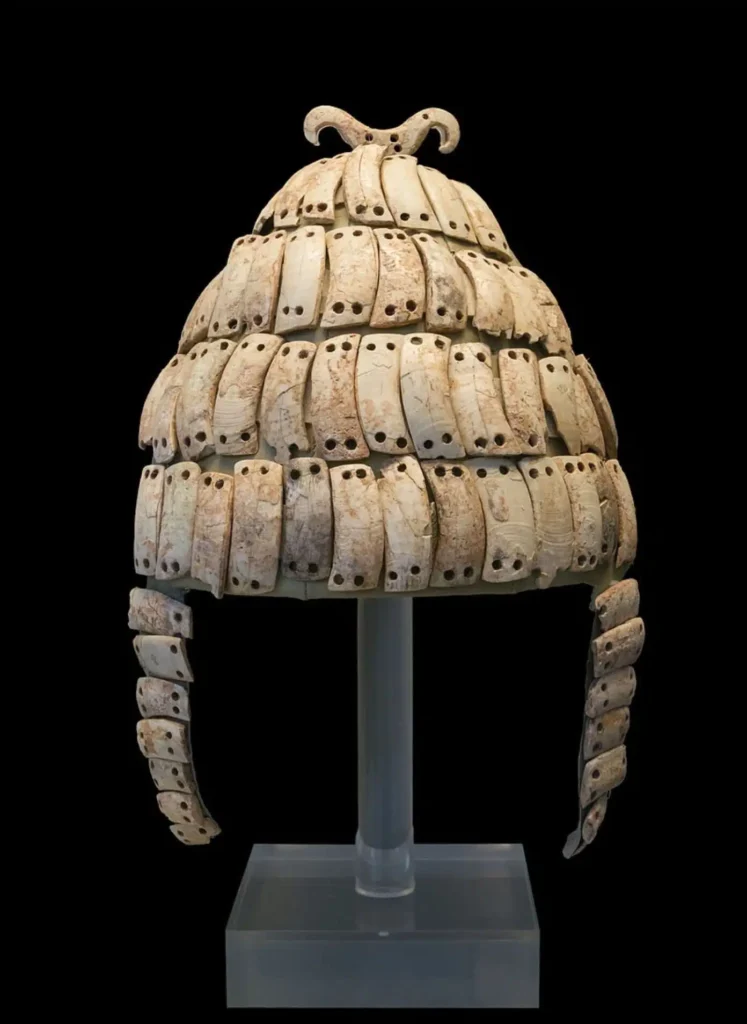
Mycenaean Greek boar tusk helmet from Mycenae, 14th century BC. On display at the National Archaeological Museum, Athens. Public Domain
Mycenaean boar tusk helmet from Mycenae, 14th century BC. On display at the National Archaeological Museum, Athens. Credit: Public Domain

Crafting a single boar tusk helmet required the tusks of up to 40 or 50 wild boars, highlighting its exclusivity. Such investment suggests these helmets functioned as prestige symbols—likely worn by elite warriors or leaders. Homer even describes them as heirlooms passed down through generations, reinforcing their cultural importance.

Today, examples and related artifacts are displayed at the Archaeological Museum of Pylos, alongside gold jewelry, vases, and weapons recovered from monumental tombs in the region. These discoveries not only illuminate ancient Greek warfare but also reveal a society where craftsmanship, status, and myth were deeply intertwined.


📣 Our WhatsApp channel is now LIVE! Stay up-to-date with the latest news and updates, just click here to follow us on WhatsApp and never miss a thing!!


Cover Image Credit: Public Domain

Related Articles

Archaeologists Uncover a 2,500-Year-Old Monumental Solstice Sanctuary in Spain

24 September 2025

24 September 2025

In the hills near the Andalusian town of Jódar, Spain, archaeologists have uncovered a monumental solstice sanctuary where the sun...

Discovery of 1,500-Year-Old Mosaic at Ancient City of Dara in Mardin, Türkiye

7 July 2025

7 July 2025

According to information provided by Anadolu Agency, archaeologists have recently uncovered a remarkably well-preserved 1,500-year-old mosaic decorated with drop and...

Ancient Water Pipeline Unearthed on 65-Meter Hill in Tajikistan Reveals Engineering Marvel of the Past

19 August 2025

19 August 2025

Archaeologists in Tajikistan have made a groundbreaking discovery at the Mugtepa settlement in Istaravshan: an ancient water pipeline system, constructed...

Possible Oldest Handgun in Germany Discovered Near Kletzke

10 March 2026

10 March 2026

A small bronze fragment discovered in northeastern Germany could represent the oldest known handheld firearm in the country, potentially reshaping...

Oldest footprints of pre-humans identified in Crete

11 October 2021

11 October 2021

Six million-year-old fossilized footprints on the island show the human foot had begun to develop. The oldest known footprints of...

Archeologists discover 2000-year-old Roman coins on the deserted Swedish island of Gotska Sandön

14 April 2023

14 April 2023

Archaeologists found 2,000-year-old Roman coins on the Swedish deserted island of Gotska Sandön. Previously, ancient Roman coins were discovered on...

1400-year-old artifacts discovered in the ancient city of Uzuncaburç (Diocaesarea)

26 January 2022

26 January 2022

During the excavations carried out in a tower in the ancient city of Uzuncaburç (Diocaesarea) in Mersin province in the...

A Monumental 3,800-Year-Old Warrior Kurgan Discovered in Azerbaijan

16 July 2025

16 July 2025

A monumental discovery has emerged from the windswept plains of Ceyranchol in western Azerbaijan: a 3,800-year-old Middle Bronze Age kurgan,...

Evidence of textile manufacture dating back millennia was found in an area famous for the Witney Blanket

12 June 2023

12 June 2023

Archaeological excavations at the site of Oxfordshire County Council’s project to build the A40 Science Transit Park and Ride at...

The easternmost Roman aqueduct in Armenia was discovered

19 November 2021

19 November 2021

Archaeologists from the University of Münster and the National Academy of Sciences of the Republic of Armenia have discovered remains...

Archaeologists discovered the earliest Iron Age house in Athens and Attica

26 May 2023

26 May 2023

A research team from the University of Göttingen discovered the earliest  Iron Age house in Athens and Attica. Archaeologists from...

Archaeologists have found seven pairs of Anglo-Saxon brooches in seven graves during an excavation in Gloucestershire

5 April 2022

5 April 2022

Archaeologists have found seven pairs of Anglo-Saxon saucer brooches, one pair in each of seven burials unearthed in an excavation...

Medieval gold ‘lynx’ earrings from Ani Ruins

29 December 2022

29 December 2022

A pair of lynx-shaped gold earrings have been unearthed near the ruins of Ani, the once great metropolis known as...

Could Therasia’s 4,500-Year-Old Seals Be the Missing Link in Aegean Writing?

3 June 2025

3 June 2025

Therasia’s archaeological discovery offers significant insights, influencing our understanding of Early Bronze Age communication and the emergence of writing in...

New Samnite Necropolis Sector Discovered in Pontecagnano: 34 Tombs and Unusual Child Burials with Bronze Warrior Belts

11 March 2026

11 March 2026

Archaeologists working in southern Italy have uncovered 34 Samnite-period tombs in the municipality of Pontecagnano Faiano, offering new insights into...