
10 February 2026 The Future is the Product of the Past

Archaeologists Uncover a 2,500-Year-Old Monumental Solstice Sanctuary in Spain

In the hills near the Andalusian town of Jódar, Spain, archaeologists have uncovered a monumental solstice sanctuary where the sun itself played a role in ancient Iberian rituals. The discovery, published in the journal Complutum, reveals a 2,500-year-old stone complex that may have served as a temple of the cosmos, designed to capture the drama of the winter solstice.

A Monument to the Sun

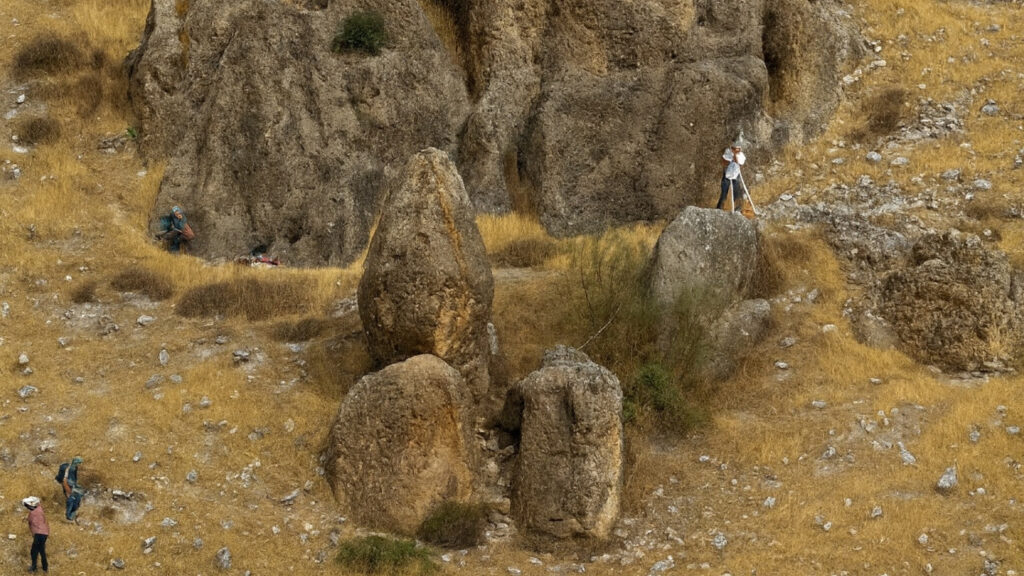
The centerpiece of the site, known as El Fontanar, is a towering monolith more than five meters high. Its elongated, upright form faces the point where the sun rises on the shortest day of the year. At dawn on the winter solstice, a ray of sunlight pierces the tip of the stone and projects toward a nearby rock shelter.

This shelter, nearly seven meters tall, has a V-shaped entrance that archaeologists interpret as a powerful symbol of femininity. A massive boulder above the opening resembles fallopian tubes, while the lower stones mark the contours of female anatomy. At the moment of the solstice sunrise, the shadow of the “male” stone stretches across the ground and touches the lower recess of the shelter, where the rock surface evokes a vulva-like form.

Researchers describe the scene as a deliberate recreation of hierogamy—a sacred union between male and female forces. It represents not only a cosmic marriage but also a mythic ritual of fertility and rebirth, connecting the solar hero to a goddess of the earth.

Linking Myth and Stone

Lead archaeologist Arturo Ruiz explains that such imagery echoes religious traditions across the Mediterranean, from Egypt to Greece. Yet in Iberian culture, these were not abstract symbols. They were carved into the landscape itself, timed with the movements of the sun and experienced through ritual.


📣 Our WhatsApp channel is now LIVE! Stay up-to-date with the latest news and updates, just click here to follow us on WhatsApp and never miss a thing!!


The sanctuary’s construction is dated to the 5th–4th centuries BCE, predating many of the region’s major Iberian settlements. This suggests that the site was a focal point of religious life long before urban centers flourished.
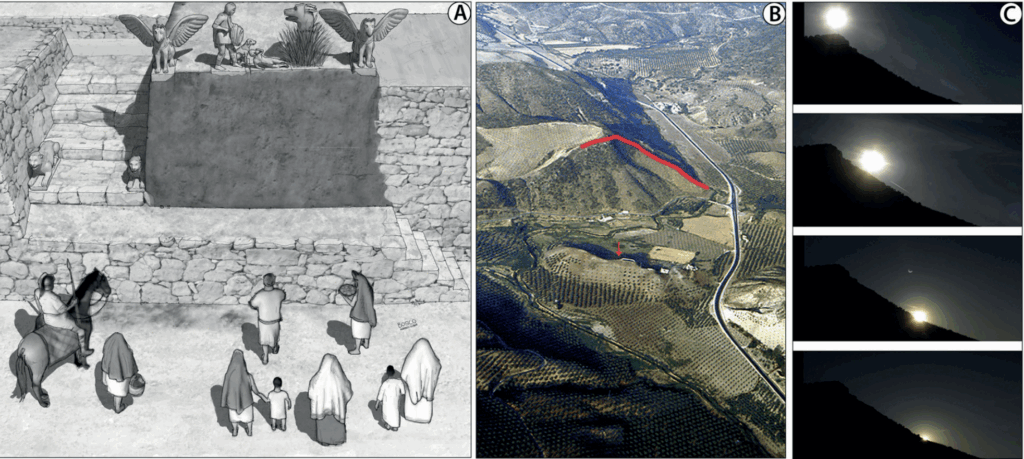
Idealized reconstruction of the El Pajarillo monument (Alberto Luque); B. Aerial view of the western visual basin (the arrow indicates El Pajarillo hill and the red line marks the eastern slope of Las Canteras hill); C. Photographic sequence of the sun-rolling effect on Las Canteras hill (observed from the heroon of El Pajarillo) (José Manuel Pedrosa

The Hero’s Journey and the Goddess

The discovery ties into broader Iberian mythology centered on Iltiraka (ancient Úbeda la Vieja) and Puente Tablas. In these traditions, a solar deity or hero descends into the underworld in autumn, only to be reborn by the winter solstice. The alignment of El Fontanar’s stones appears to dramatize this myth: the death of light, the sacred union, and the promise of renewal.

“This monument is extraordinary for its scale and intention,” notes Ruiz. “It was designed to unite heaven and earth, to affirm the sacred connection between masculine and feminine principles.”

A Cosmic Theater

The findings also align with earlier studies at El Pajarillo, another Iberian site in the Jandulilla valley. There, sculpted scenes depict a hero battling a wolf, a symbolic passage to the underworld. Together, El Pajarillo and El Fontanar form a ritual landscape—a sacred path where myth, astronomy, and territory converge.

For the Iberians, the land itself became a stage for the hero’s journey. The cycle of descent, union, and resurrection was not merely told in stories but played out in the shifting light of the solstice sun.

Global Significance

The sanctuary of El Fontanar underscores how ancient peoples integrated astronomy, architecture, and spirituality. Across cultures, the solstice marked a turning point, a triumph of light over darkness. In Iberia, this moment was immortalized in stone, blending myth with cosmic reality.

For modern archaeology, the discovery highlights the sophistication of Iberian ritual and the depth of their symbolic connection to the natural world. More than a ruin, El Fontanar is a timeless reminder that humanity has always sought to bridge earth and sky, body and cosmos.

Journal Complutum

Ruiz, A., Molinos, M., Esteban, C., Yanes, M., & Lechuga, M. Á. (2025). Paisaje, camino y liturgia en el mito del héroe de Iltiraka. Complutum, 36(1), Estudios en Homenaje a Teresa Chapa Brunet. https://doi.org/10.5209/cmpl.102416

Cover Image Credit: Institute for Iberian Archaeology (IAI)

Related Articles

Oldest known arrowheads uncovered in the Americas

24 December 2022

24 December 2022

Archaeologists from Oregon State University have discovered projectile points in Idaho that are thousands of years older than any that...

Archaeologists Uncover Little-Known Rare Knife Collection Spanning from the Xiongnu Era to the Middle Ages

21 January 2026

21 January 2026

Archaeologists have uncovered a little-known knife collection revealing that Xiongnu-era blacksmithing traditions survived along the Yenisei River for more than...

INAH Archaeologists recover the coyote-man of Tacámbaro

26 January 2022

26 January 2022

Archaeologists win the coyote-man trial that lasted 30 years in Mexico. The litigation regarding the coyote-man of Tacámbaro, an important...

From Arnhem to Oldenburg: Nazi-Looted Artifacts Found in Oldenburg Museum Colection

30 August 2025

30 August 2025

A remarkable discovery at the Landesmuseum Natur und Mensch in Oldenburg has shed new light on the dark history of...

Ancient Roman Theatre Seat Reveals Name of Prominent Priestess

12 November 2025

12 November 2025

Archaeologists working at the ancient city of Apollonia ad Rhyndacum in Gölyazı, Türkiye, have uncovered a remarkable piece of history:...

Bronze belt of Urartian warrior found in the ancient city Satala

29 May 2022

29 May 2022

During the excavations in the ancient city of Satala, located in the Kelkit district of Gümüşhane province in Turkey, a...

“Human evolution” Migration out of Africa was affected by climate constraints.

25 August 2021

25 August 2021

The story of modern man’s migration from Africa still remains unclear in many aspects. Why did people migrate? Is it...

460-Year-Old Wooden Hunting Bow Found in Alaska’s Lake Clark

11 March 2022

11 March 2022

In late September 2021, National Park Service employees made an unlikely discovery in Lake Clark National Park and Preserve in...

In western Turkey, inscriptions and 2,500-year-old sculptures were found

11 July 2021

11 July 2021

Two 2,500-year-old marble statues and an inscription have been found during excavations at the ancient city of Euromos, in Turkey’s...

Ancient Curse Tablets Reveal Dark Spiritual Practices in the Roman Empire – and Their Echo in the Bible

17 June 2025

17 June 2025

New Research Connects Ritual Cursing to the Book of Revelation From jealous lovers to petty thieves, people in the ancient...

‘Roman numerals’ discovered on Stone of Destiny ahead of King Charles III coronation

8 April 2023

8 April 2023

New research has revealed previously unrecorded markings that appear to be Roman numerals on the Stone of Destiny, considered one...

4th Century BC Greek Shipwreck Discovered Near Croatian Island of Vis – One of the Adriatic’s Oldest

10 July 2025

10 July 2025

A significant archaeological find has been confirmed off the coast of Komiža, near the Croatian island of Vis, where researchers...

Altar site for Greek goddess Demeter unearthed in Turkey’s ancient city of Blaundus

21 December 2021

21 December 2021

An altar site for the Greek goddess Demeter was unearthed during the ongoing excavations in the ancient city of Blaundus,...

Unique Iron & Viking-Age Mortuary Houses Found in Norway

28 August 2024

28 August 2024

While building a road in the village of Vinjeøra in central Norway, three ancient mortuary houses dating back to the...