
A collection of 3,400-year-old gold diadems discovered in elite tombs in Cyprus includes one found still resting on the forehead of a child who died at the age of four or five.
The ornaments were recovered from the Late Bronze Age cemetery of Hala Sultan Tekke, an important port city near modern Larnaca. A new study identifies nine gold diadems and two smaller gold mouth coverings from seven chamber tombs and one shaft tomb dating between the 15th and 13th centuries BCE.
The objects combine artistic traditions associated with Egypt, Minoan Crete, Mycenaean Greece and the Near East. Despite these international influences, the study concludes that the diadems were probably produced by Cypriot craftspeople who developed their own regional style.
A child buried with a gold diadem
One of the most striking discoveries came from Chamber Tomb RR, a multi-generational burial containing the remains of at least 34 people.
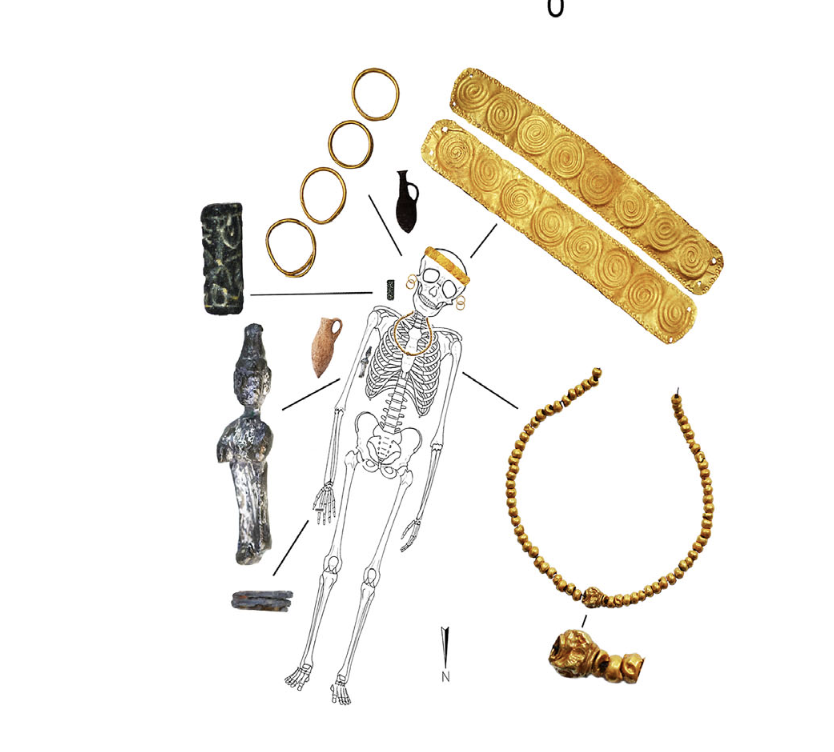
In its earliest layer, dated to around 1350 BCE, archaeologists uncovered the poorly preserved but articulated skeleton of a child aged between four and five. The gold diadem remained in its original position across the child’s forehead.
The child had also been buried with a necklace made from 68 gold beads and four gold earrings positioned near the skull. Other objects included a silver pendant depicting an Anatolian deity, a silver ring decorated with a triple spiral and a carved cylinder seal.
The unusually rich burial assemblage suggests that high social standing was not limited to adults and may have been inherited through family connections. The diadem also provides direct archaeological evidence that the longer gold bands were worn on the forehead rather than placed across the mouth.
Gold headwear worn in life and death
The study distinguishes the nine diadems from two smaller objects described as mouthpieces.
The diadems were long gold bands with holes at their ends, allowing them to be secured around the head with cords or attached to another support. Several were found beside skulls, while the child’s example remained directly on the forehead.
Wear marks on some of the heavier diadems suggest that they were not made solely for burial. Researchers propose that they may have been worn during ceremonial occasions before being placed in tombs for continued use in the afterlife.
The smaller and lighter examples show fewer signs of wear and may have been manufactured specifically as burial objects. The two plain mouthpieces, by contrast, appear to have been used exclusively in funerary ceremonies and were placed over the mouths of the dead.
The ornaments were associated with adults of both sexes, a possible teenage girl and the young child. This indicates that gold diadems were not restricted to a single age group or gender.
Egyptian bulls and Mycenaean rosettes
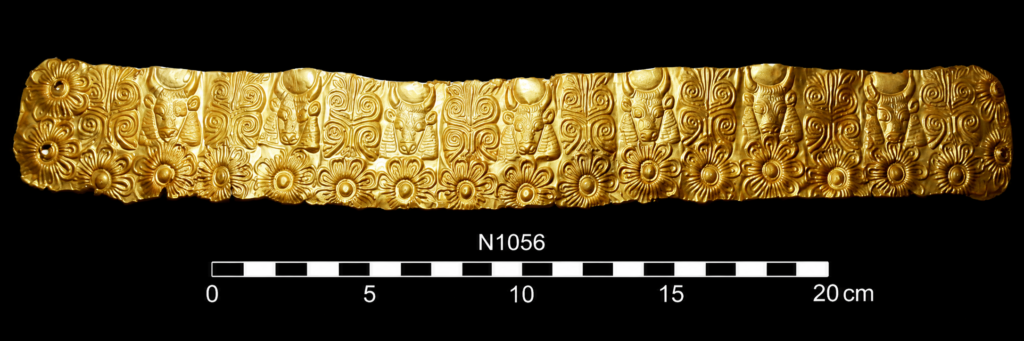
The largest example is a 34.2-centimeter-long diadem found in Chamber Tomb XX. It was associated with a woman aged between 35 and 40.
The band is decorated with seven frontal bull heads. A sun-disk-like form appears between their curved horns, while striped hair or wig-like elements beside the faces reflect Egyptian artistic conventions.
The bulls are surrounded by palm-based floral designs and eight-petalled rosettes similar to motifs known from Mycenaean pottery and elite graves in Greece. The combination brings Egyptian and Aegean imagery together on a single object.
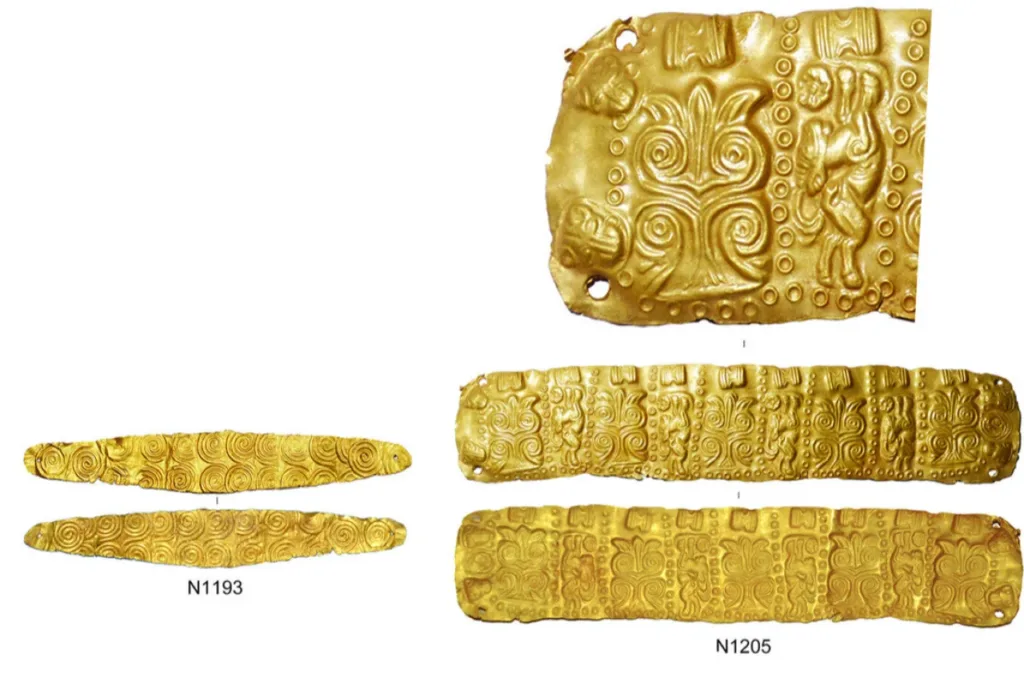
Another ornament, known as the Ibex-feline diadem, is the heaviest in the collection at 23.14 grams. Its design includes four running ibexes, floral elements, rosettes, hourglass-shaped symbols and feline heads—possibly lions—positioned at both ends.
Since lions were not native to Cyprus, their presence further supports the influence of artistic traditions from Egypt, Greece and the Near East.
Made by Cypriot goldworkers
The researchers argue that the diadems represent local Cypriot production rather than finished objects imported from another region.
Their decoration was created by pressing thin gold sheets against carved matrices, probably made from stone, bronze or bone. Differences between apparently similar rosettes and plant designs suggest that several matrices were used, possibly by different craftspeople or workshops.
No matching moulds or stamps have yet been found at Hala Sultan Tekke. Although fragments of gold sheet have been discovered at the settlement, there is still no direct evidence identifying the workshop where the diadems were produced.
The precise origin of the gold is also unresolved. Possible sources include recycled objects, the gold-producing regions of Nubia in Egypt and the Bronze Age mine at Ada Tepe in present-day Bulgaria. The study stresses that compositional and trace-element analyses will be required before any source can be confirmed.
A Bronze Age center of international trade
Hala Sultan Tekke flourished between approximately 1630 and 1150 BCE. During the Bronze Age, the modern Larnaca Salt Lake was connected to the Mediterranean and formed a sheltered natural harbor.
The city covered at least 25 hectares and supported large-scale copper working, pottery production and the manufacture of purple-dyed textiles. Its trading networks extended far beyond Cyprus.
Objects found at the site include pottery from mainland Greece and Crete, Egyptian faience and glass, Anatolian ceramics, Mesopotamian seals and goods produced from materials that travelled enormous distances. Lapis lazuli came from Afghanistan, carnelian from India and amber from the Baltic region.
The gold diadems reflect this connected world. Rather than copying one foreign tradition, Cypriot craftspeople selected and combined imagery from several regions, producing jewelry that remained distinctly local.
The study, written by archaeologist Peter M. Fischer, was published in the Oxford Journal of Archaeology.
Fischer, P. M. (2026) CULTURAL FUSION IN LATE BRONZE AGE GOLDWORK: DIADEMS AND MOUTH-PIECES FROM HALA SULTAN TEKKE, CYPRUS. Oxford Journal of Archaeology, 45: 151–179. https://doi.org/10.1111/ojoa.70012.
Cover Image Credit: Fischer, P. M. (2026)
