
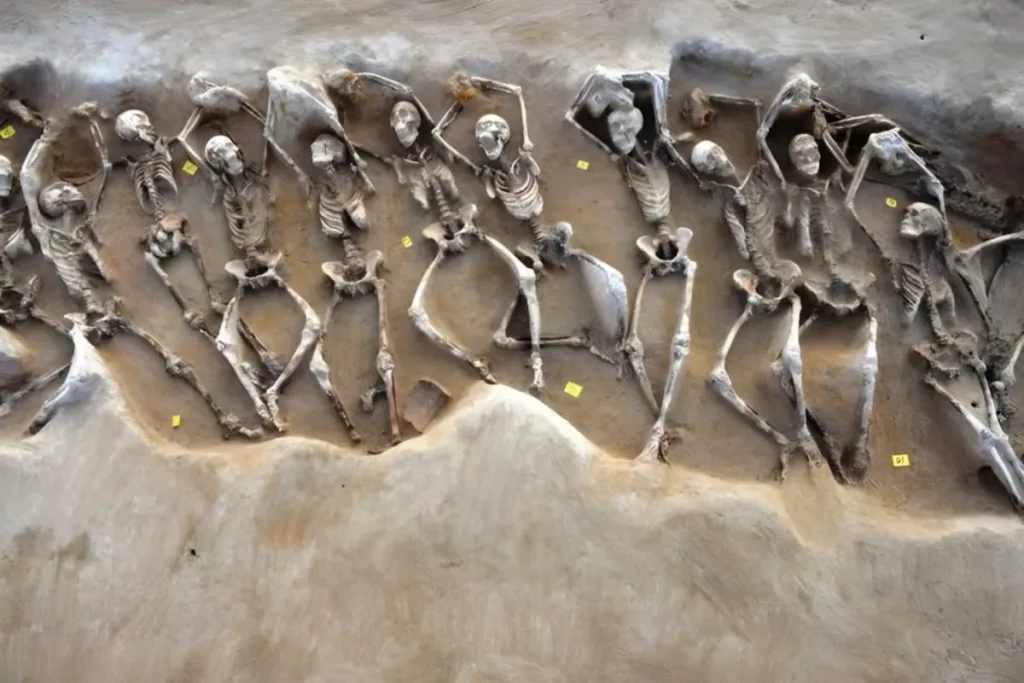
New strontium isotope research shows the shackled men in ancient Athens’ Phaleron mass grave were locals, not foreign invaders, reshaping theories about their violent deaths.
For nearly a decade, one of ancient Athens’ most haunting archaeological discoveries has fueled debate among historians and archaeologists alike. Now, a new scientific study is finally offering answers about who these men really were.
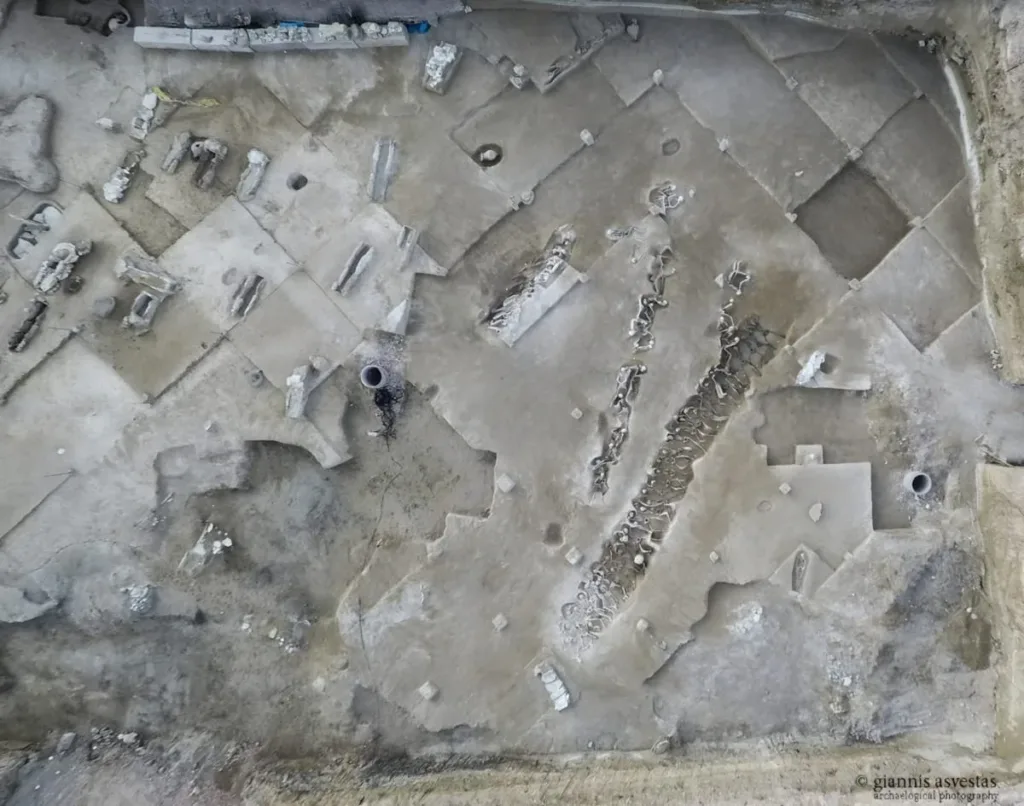
The site in question is the “Esplanada,” a set of mass graves within the larger Phaleron Burial Ground on the coast near Athens, first uncovered by archaeologists in 2016. Inside, researchers found 79 adult men laid out in three orderly rows — many of them still bound with corroded metal shackles at the wrists. The unusual, public nature of the burial has long suggested it was meant to send a message, but to whom, and about what, has remained a mystery.
Competing Theories About the Grave
Since its discovery, scholars have proposed several explanations for the Esplanada. Some argued the mass grave reflected elite political rivalries during Athens’ formative Archaic period.
Others suggested it was tied to the emergence of centralized state power, as the young city-state began punishing offenses collectively rather than leaving justice to individual families or clans. A third theory held that the men might have been foreign invaders or captives, executed and buried together as outsiders.
Determining which theory holds up required a different kind of evidence — one written into the men’s own bones and teeth.
What the Teeth Reveal
A research team led by Julianne R. Stamer of Arizona State University’s Center for Bioarchaeological Research turned to strontium isotope analysis, a technique that traces where a person spent their early childhood based on the chemical signature locked into tooth enamel.
Strontium is a naturally occurring element found in local rock and soil. It moves through groundwater and food chains, entering the human body through what people eat and drink. Because tooth enamel forms during childhood and doesn’t change afterward, it preserves a permanent chemical “fingerprint” of where a person grew up — one that can be compared against the geology of a specific region to determine whether someone was raised locally or came from elsewhere.
The team analyzed enamel samples from 66 of the Esplanada’s shackled men, along with 97 additional individuals buried elsewhere at the wider Phaleron cemetery, bringing the total study population to 163 people.
Overwhelmingly Local Origins
The results were strikingly consistent. Roughly 97 percent of the Esplanada men — 64 out of 66 — showed strontium values matching a local origin in Attica, the region surrounding Athens. Across the broader Phaleron cemetery population, the local rate was nearly identical, at about 96 percent (156 of 163 individuals total).
Statistically, the shackled men in the mass grave were no different from the general population buried at Phaleron. If they had been foreign fighters, captured enemies, or invaders from outside Attica, researchers would have expected to see a much higher proportion of non-local isotope signatures. Instead, only a small handful of individuals across the entire sample — seven in total — showed evidence of childhoods spent elsewhere.
Rewriting the Story of the Esplanada
The findings don’t reveal exactly why these men were shackled and killed, since strontium isotopes trace geographic origin, not cause of death or political affiliation. But they do rule out one of the leading theories: these were not outsiders brought into Attica during a foreign conflict.
Instead, the evidence points to violence that originated within the community itself — a grim reflection of the political instability that gripped early Athens before the rise of the classical city-state. The research also reinforces broader historical evidence suggesting that migration into Attica remained limited during the Archaic period, even as trade and travel expanded across the wider Aegean world.
For the men of the Esplanada, the discovery adds a deeply human dimension to a site that has captured public fascination for years. Rather than nameless foreign captives, they now emerge as members of the very community that ultimately turned against them — a sobering reminder that political violence in ancient Athens, much like elsewhere, often came from within.
Stamer, J. R., Rothwell, J. E., Simonton, M., Chryssoulaki, S., Knudson, K. J., & Buikstra, J. E. (2026). Investigating the residential history of the Esplanada mass graves at Phaleron, Greece. Journal of Archaeological Science: Reports, 74(105952), 105952. doi:10.1016/j.jasrep.2026.105952
Cover Image Credit: The Esplanada mass grave at the Phaleron Burial Ground, where researchers uncovered the remains of 79 men, many still bound at the wrists with iron shackles. Credit: Giannis Asvestas, Hellenic Ministry of Culture, via Bérard, R.-M., & Castex, D., Athens Journal of History (2021)
