
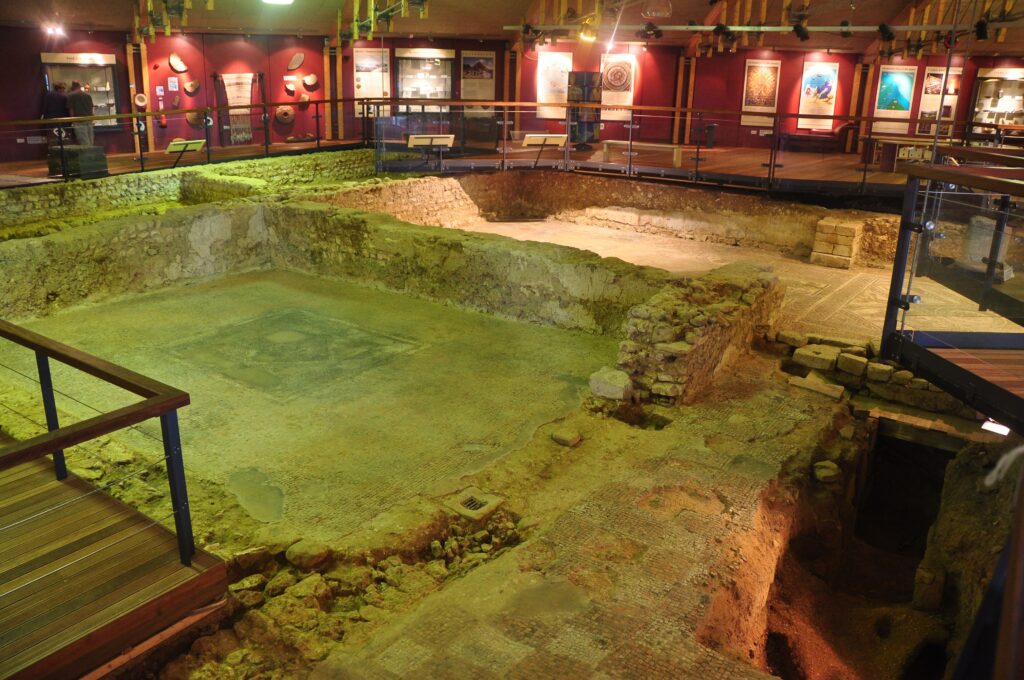
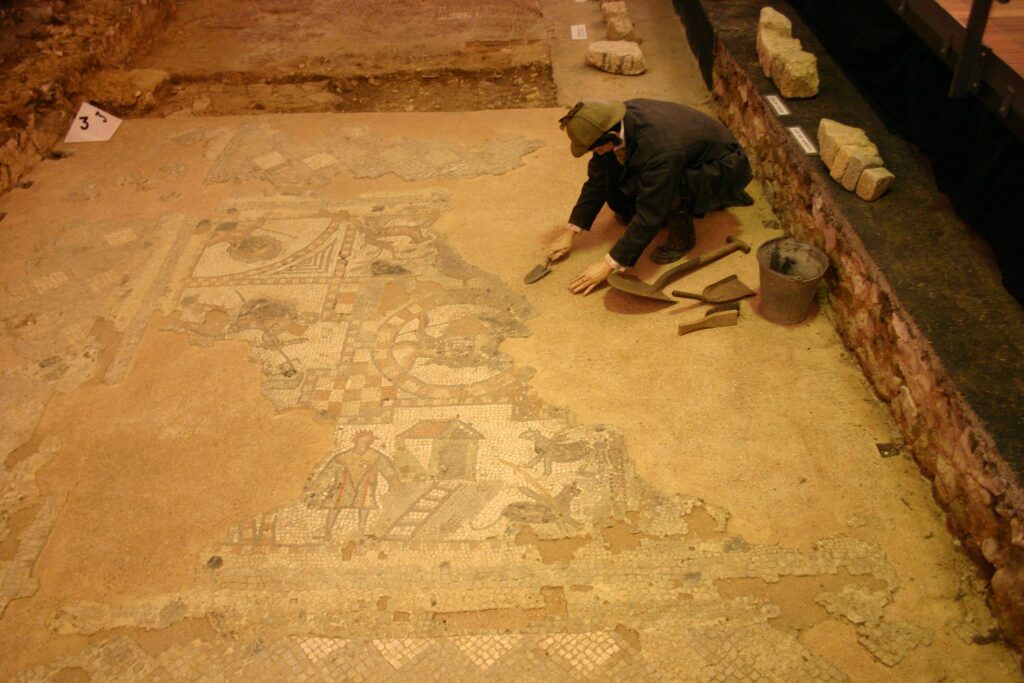
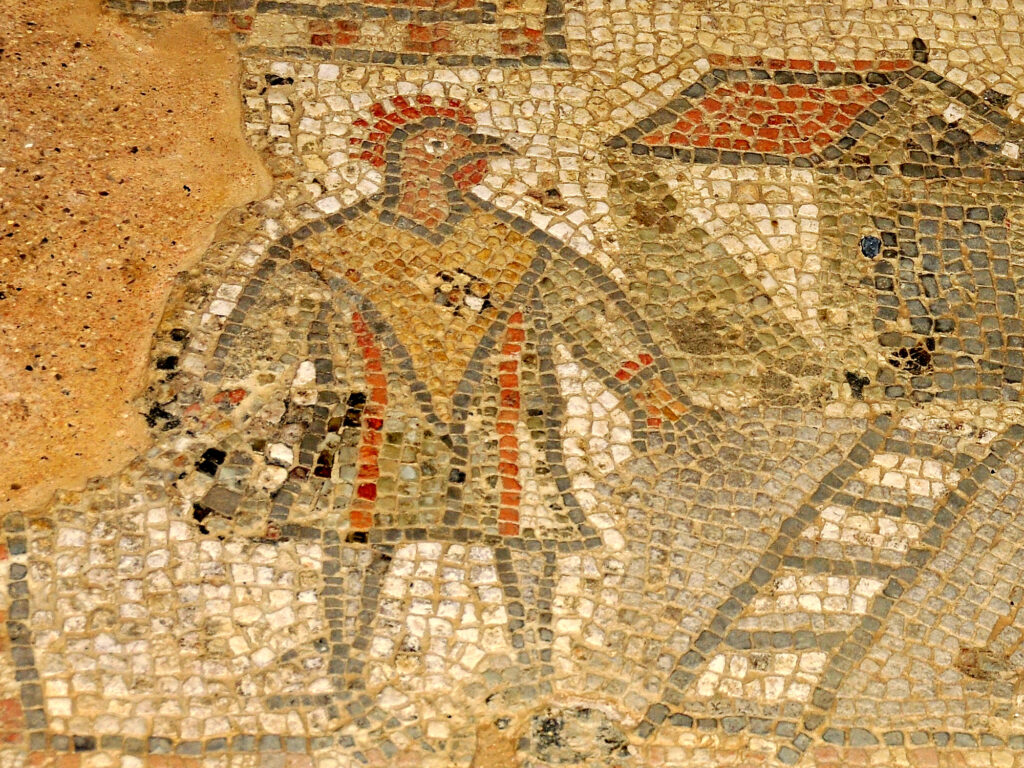
For more than 140 years, the mosaic floors of Brading Roman Villa on the Isle of Wight have drawn visitors eager to admire scenes of Bacchus, Medusa, and the everyday luxury of Roman Britain. But beneath the beauty of those tile floors lies a much darker story: one that a new scientific study is only now beginning to piece together.
Human bones, scattered across the villa’s rooms and grounds, may be the last physical evidence of a violent purge that swept through Roman Britain in the mid-fourth century CE. According to new radiocarbon dating research, these remains likely belong to victims of a single catastrophic event, or a tightly clustered series of deadly incidents, rather than to ordinary burials spread out over generations.
A Discovery Overshadowed by Mosaics
When Victorian excavators first uncovered Brading Villa in 1880 and 1881, they were captivated by its stunning mosaic pavements: among the finest ever found in Britain. Human bone fragments turned up alongside these treasures, tucked into several rooms of the villa, but they barely made it into the historical record. Nineteenth-century archaeologists jotted down vague notes about “portions of a human skull” or “fragments of human bones,” without recording precisely where each piece came from.
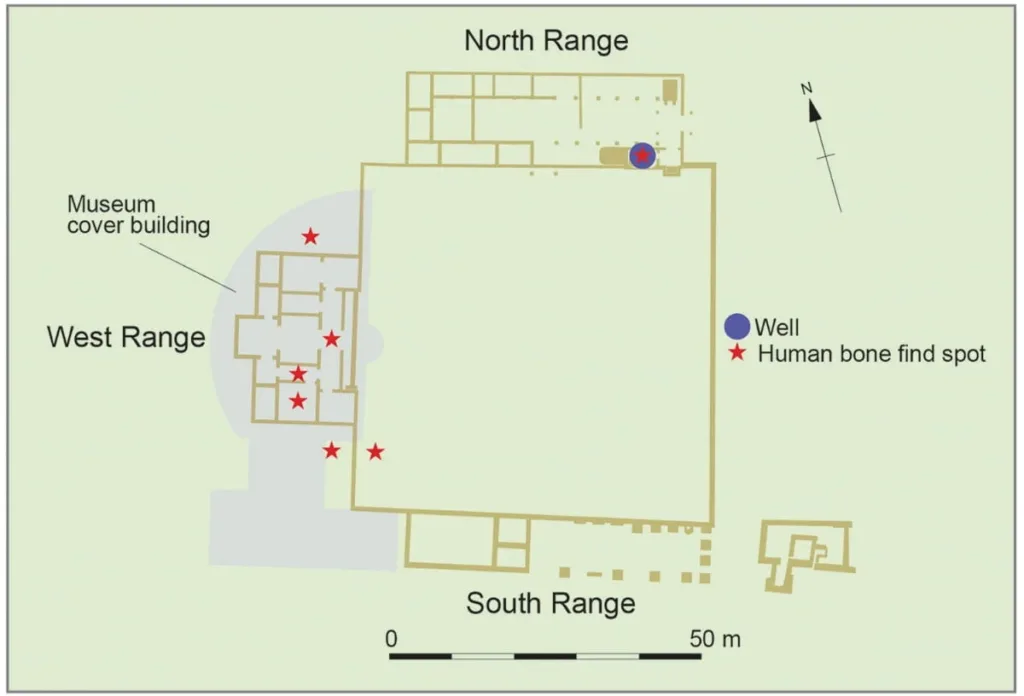
That changed with more careful excavations in the 1990s and 2000s. Archaeologists working at the site recovered additional disarticulated remains, both inside the villa’s walls and scattered across the surrounding grounds. One especially eerie find came from the bottom of a well beneath the villa’s northern range: the skeleton of a teenager, resting alongside the bones of three young dogs.
Taken together, the collection of remains represents at least four adults, one adolescent, and an infant: a strikingly large number of individuals for a single rural estate, and one that doesn’t fit the pattern of typical Roman burial practices.
What the Bones Reveal
Modern science has finally given researchers a way to interrogate these silent witnesses. By radiocarbon dating four bone samples, scientists narrowed the timeframe of death to somewhere between roughly CE 220 and 400: solidly within the late Roman period, and well before the traditional end of Roman rule in Britain. Statistical analysis suggests the dated bones are consistent with a single event, or several closely spaced events, rather than remains accumulated gradually over centuries.
The physical evidence adds a chilling layer of detail. Some bones bear fine cut marks, seemingly made before burial or shortly after death. One rib from the teenager found in the well shows a telltale knife mark. Other bones carry bite marks: signs that scavenging animals like dogs or foxes disturbed shallow graves, dragging bones across the site long after the bodies were first laid to rest. This would help explain why remains ended up scattered so widely, both within the villa’s rooms and out in the open ground beyond its walls.
A Suspicious Gap in the Coins
Perhaps the most intriguing clue doesn’t come from bone at all: it comes from coins. Brading Villa has yielded around 90 Roman coins spanning centuries of occupation, and researchers compared this coin sequence against typical patterns found at other Romano-British sites.
Almost every Roman rural site in Britain shows a coin peak corresponding to the period between CE 330 and 348. Brading’s collection is missing that peak entirely. Such an unusual gap in coin loss can be a signature of a disruption: perhaps a period when the villa stood abandoned, its economic activity interrupted by violence or upheaval. Interestingly, this same window lines up with signs that parts of the villa, especially its western wing, were significantly reorganized, including the abandonment of what had been a grand reception suite.
Echoes of a Roman Purge
Why might a rural villa on a quiet island have suffered such violence? Historians point to a documented episode of real political terror in Roman Britain: the aftermath of the usurper Magnentius’s defeat and suicide in CE 353. Once Emperor Constantius II secured victory, he unleashed his agent Paulus on Britain to hunt down Magnentius’s real and suspected supporters. The Roman historian Ammianus Marcellinus recorded the brutal fallout: arrests, torture, executions, and the confiscation of property, sweeping up innocent people along with genuine conspirators.
Researchers now suggest Brading Villa may have been swept into this very crackdown, its owner possibly killed or dispossessed, with the estate later placed under a lower-status caretaker rather than restored to its former grandeur.
What Other “Massacre” Sites Teach Us
Brading is not the first Romano-British site to be linked to a mass-death event — and past cases show just how carefully such interpretations need to be handled.
Caistor-by-Norwich (Venta Icenorum) was long cited as a textbook example of Saxon raiders putting the town’s Romano-British inhabitants to the sword in the early fifth century, with a burnt building, unburied bodies, and associated coins seemingly supporting the story. But in 1987, archaeologist M.J. Darling pointed out that the original 1930 excavation had never been published, and argued the evidence was far shakier than the dramatic narrative suggested.
Maiden Castle’s famous “war cemetery” offers the opposite lesson. Mortimer Wheeler, who excavated the site in the 1930s, attributed the trauma on the skeletons to a single Roman assault around the time of the AD 43 conquest. A 2025 study using a new radiocarbon dating programme and Bayesian modelling overturned that reading: the burials actually cluster into separate episodes of violence spread from the early first century AD to around AD 80–85, with several individuals from the surrounding ramparts dating even earlier, to the mid-first century BC. The pattern points to recurring, generations-apart outbreaks of lethal violence among local Durotrigian communities in the decades before the Roman conquest — not a single massacre carried out by Rome.
Together, these cases explain why Brading’s researchers are so careful with their conclusions. Radiocarbon dating has both dismantled once-accepted massacre narratives and, as at Brading, supplied new evidence to support one. Fulford and Hamilton’s data currently align with the Magnentius-era purge, but Caistor-by-Norwich is a reminder that new excavation data or previously unpublished archival records could still reshape the picture.
A Mystery Still Unsolved
The scientists behind the study are careful to note that their theory remains circumstantial. The radiocarbon dates and coin evidence align neatly with the historical timeline of the Magnentius purge, but they cannot definitively prove who died at Brading, or exactly how. Incomplete Victorian records make it nearly impossible to match many of the surviving bones to their original findspots with certainty.
Still, the sheer volume and distribution of human remains at Brading sets it apart from other Roman villas in Britain, where scattered human bone is far less common. Combined with signs of trauma, animal scavenging, and a sudden reshaping of the villa’s layout, the evidence points toward a genuinely violent and unusual episode in the site’s history.
Whether the victims of Brading Villa perished in a targeted massacre tied to imperial revenge, or in some other deadly upheaval lost to history, their bones remain one of the most compelling physical traces yet uncovered of the turbulent final century of Roman rule in Britain.
Fulford, M., & Hamilton, D. (2026). Brading Roman Villa: Evidence of a Late Roman Massacre? Britannia, 1–8. doi:10.1017/S0068113X26100816
