
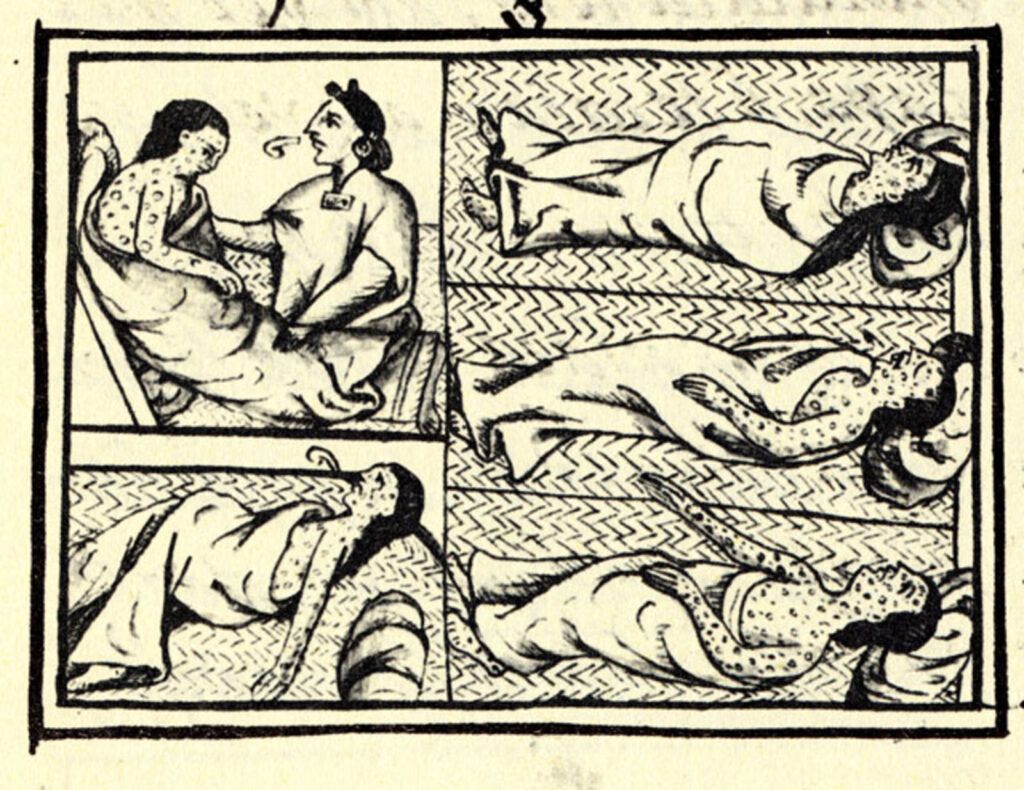
Historical records describe smallpox wiping out entire Native American communities within weeks. So why have archaeologists found evidence for fewer than 20 victims across the whole of the Americas?
For centuries, the story of European colonization in the Americas has carried a grim subplot: smallpox, arriving with conquistadors and settlers, tore through Indigenous populations with almost no resistance, killing by some estimates tens of millions of people. Yet a new study published in the Journal of Anthropological Archaeology reveals a striking contradiction: the mass graves that such catastrophic mortality should have left behind are, for the most part, simply not there.
The research, led by Alex Garcia-Putnam of the University of New Hampshire alongside colleagues from New York University, the Smithsonian Tropical Research Institute, and the University of Kansas, pulls together ethnohistoric accounts, epidemiological data, and bioarchaeological evidence from across North and South America. Their conclusion: published physical evidence for smallpox in the archaeological record is limited to fewer than 20 individuals: a staggering gap when set against population estimates suggesting smallpox alone may have killed anywhere from roughly 480,000 to nearly 64 million people.
“They Had Ceased to Bury Their Dead”
Some of the most haunting evidence in the study comes not from a dig site, but from a letter. In October 1831, Indian Agent John Dougherty wrote to his superiors describing the aftermath of a smallpox outbreak among the Pawnee in the Central Great Plains. He reported villages in a “most deplorable condition,” where the dead were “dying so fast… that they had ceased to bury their dead.” Bodies lay along riverbanks, in cornfield storage pits, and were dragged off by dogs and torn apart by wolves and vultures.
Dougherty’s account is far from isolated. The researchers gathered similar testimony from British Columbia, where survivors reportedly burned entire homes with the dead still inside; from Manitoba, where Hudson’s Bay Company employees described bodies “lying Dead about the Barren Ground like rotten sheep”; and from Northern California, where Yurok elders recalled abandoning their dead and fleeing into the mountains rather than face “complete devastation.”
Three Theories for the Missing Dead
Faced with this gap between written history and the physical record, the study’s authors propose three possible — and not mutually exclusive — explanations:
Death outpaced burial traditions. In the worst outbreaks, so few people survived that there was simply no one left to dig graves. Bodies were left exposed to scavengers and the elements, leaving little or nothing for archaeologists to find generations later.
The graves exist: they just haven’t been found. Given the sheer size of the Americas compared to Europe, mass burial sites may still be sitting undiscovered, destroyed by development, or lost to time and shifting rivers.
Nature erased the evidence. Acidic tropical soils in places like Panama and Mexico are notoriously hostile to preserving bone, while looting and poorly documented excavations over the past two centuries may have destroyed or obscured evidence without anyone realizing what it represented.
Notably, the few confirmed or suspected mass burial sites that do exist — in Peru, Washington State, and a single well-documented case tied to an 1853 smallpox epidemic in Honolulu — remain the exception rather than the rule, even in regions with excellent conditions for preserving human remains.
A New Checklist for Finding Smallpox in the Ground
To move the field forward, the authors propose four criteria future researchers can use to evaluate whether a burial site might be linked to a historic smallpox outbreak: tightly dated, concurrent burials from a known epidemic period; skeletal signs of physiological stress; demographic patterns suggesting the disease didn’t strike randomly; and, most conclusively, ancient DNA evidence of the virus itself preserved in bone or tissue.
The authors stress this isn’t an attempt to cast doubt on the devastation colonization brought to Native communities — the historical record on that point, they argue, is overwhelming. Instead, they’re asking a different question: what does the archaeological silence itself reveal about how those communities experienced, and were destroyed by, disease, violence, and colonial upheaval together?
As one researcher cited in the study puts it, absence of evidence is not evidence of absence — but understanding why the evidence is missing may be just as important as finding it.
Garcia-Putnam, A., Snyder, T.J., Tasa, G.L., Smith-Guzmán, N.E., & Shield Chief Gover, C. (2026). “Exploring archaeological evidence for historic smallpox epidemics in the Americas.” Journal of Anthropological Archaeology, 83, 101778.
