
A groundbreaking study reveals that Pecos River style murals in Texas and northern Mexico form the oldest securely dated rock paintings in the Americas, preserving a continuous 4,000-year spiritual and artistic tradition that may have influenced later Mesoamerican cosmologies.
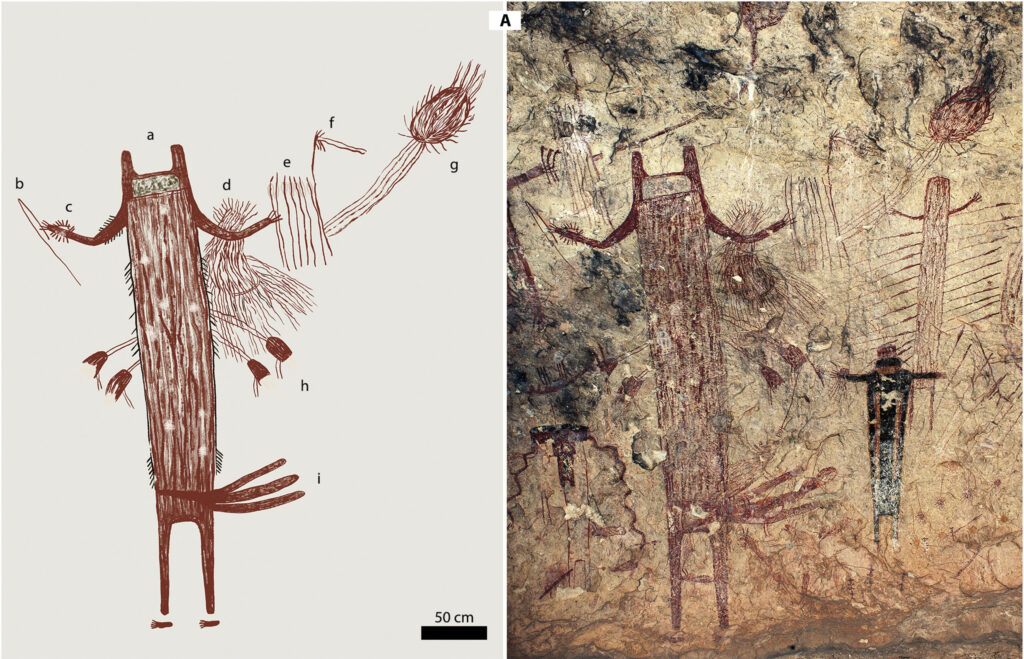
Across the rugged limestone canyons of southwest Texas and northern Mexico, a silent archive of ancient thought stretches across rock shelter walls. Layered in reds, blacks, yellows, oranges, and whites—some panels more than 150 meters long—these are the Pecos River style murals, one of the most intricate and information-dense rock art traditions in the world. For decades, researchers struggled to situate them in time. Now, a landmark study has finally traced their origins and temporal arc, revealing a cultural tradition so enduring that it may have shaped the cosmologies of later Mesoamerican civilizations.
Published in Science Advances, the study presents the largest and most precise dating effort ever undertaken for a rock art region in the Americas, combining 57 direct radiocarbon dates from the paint itself and 25 additional dates from calcium oxalate crusts deposited above and below the images. The results demonstrate that this artistic tradition began between 5,760 and 5,385 years ago—and continued, uninterrupted, for over 4,000 years, ending sometime between 1,370 and 1,035 years ago.
These dates make the Pecos River murals not only the oldest securely dated rock paintings in the Americas, but also the longest-running visual tradition on the continent.
A Painted Landscape Occupied for 12,500 Years
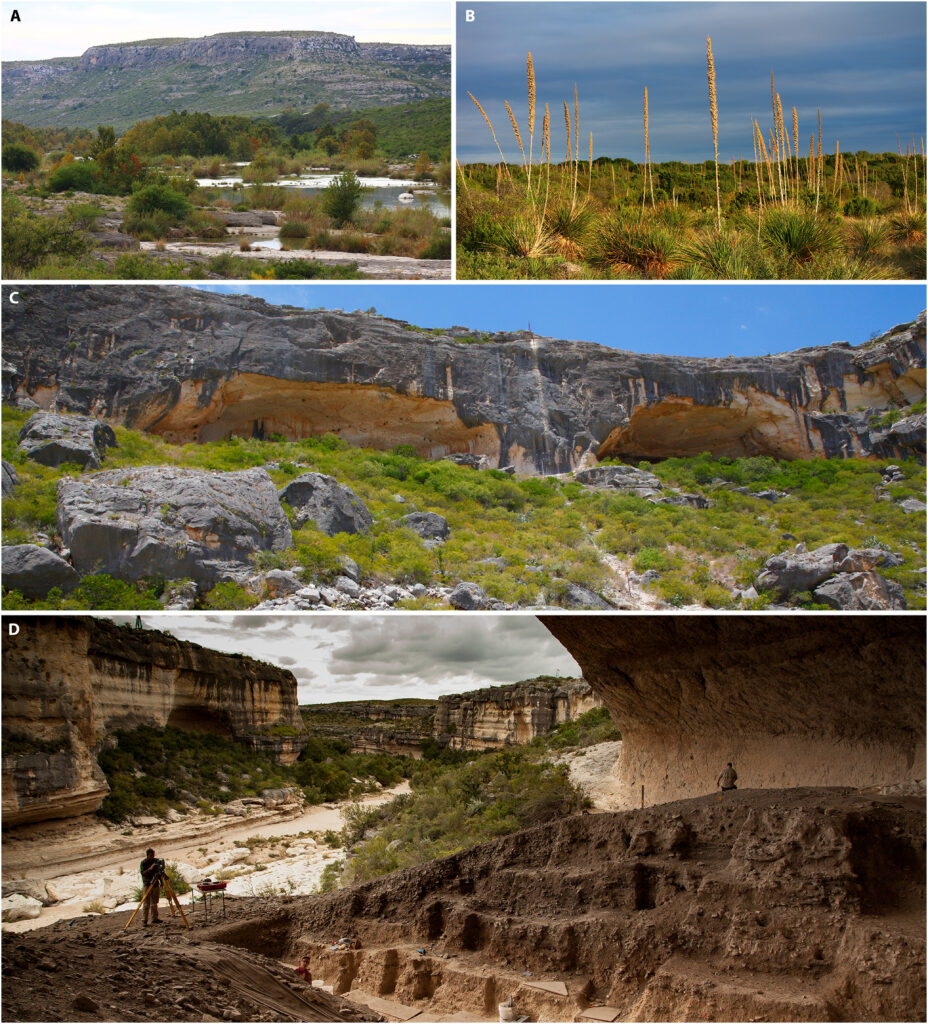
The study area—known as the Lower Pecos Canyonlands—is a cultural and ecological crossroads where three biomes meet: the Edwards Plateau, the Chihuahuan Desert, and the Tamaulipan thorn scrub. Archaeological deposits show that hunter-gatherer groups lived here for more than 12,500 years, adapting to fluctuating climates, changing river regimes, and shifting resource availability.
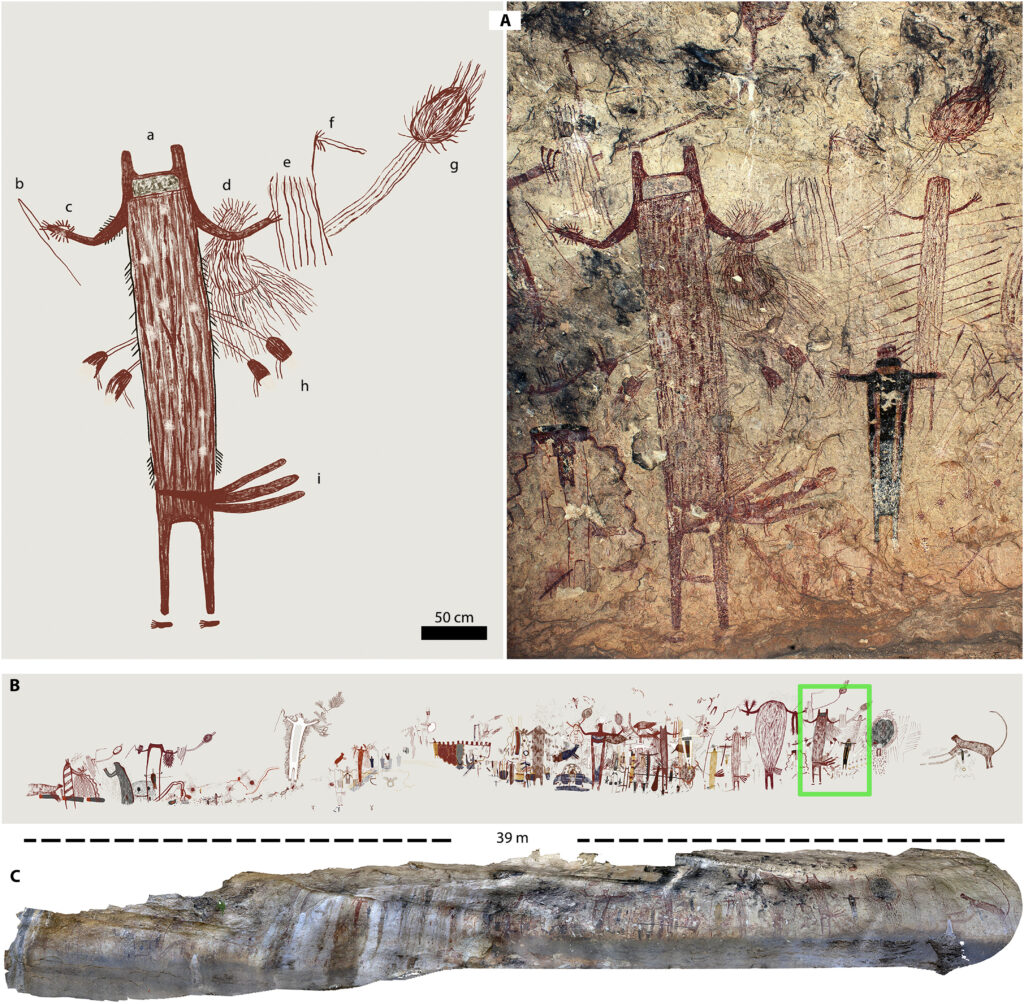
But their most spectacular legacy is the rock art. More than 150 rock shelters north of the Rio Grande (and likely as many in Coahuila, Mexico) are covered with Pecos River style pictographs. Some murals rise 8 meters high; others span the length of a football field. Many required scaffolding or ladders, indicating coordinated labor and ceremonial planning.
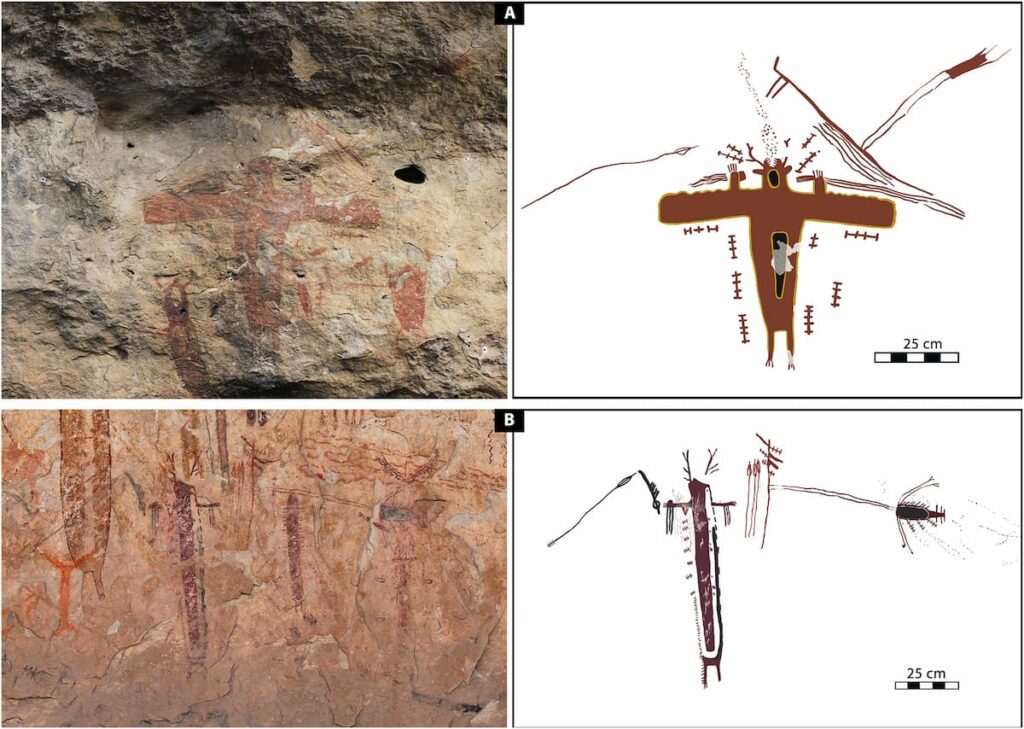
The paintings are visually complex. Human figures—some only a few centimeters tall, others towering above life size—appear with distinctive headdresses resembling rabbit ears or antlers. They hold atlatls, darts, staffs, and a mysterious object known as the “power bundle”: an ovoid shape attached to long, parallel lines extending from the non-dominant arm. Animal imagery includes deer, felines, birds, snakes, and occasional insect-like figures.
These elements form a visual vocabulary that experts now believe encoded myths, ritual instructions, and cosmological narratives.
Dating the “Undatable”: A Breakthrough in Rock Art Chronology
Rock art is notoriously difficult to date, especially when the pigments are mineral-based. But the Pecos River artists mixed their pigments with organic binders—likely deer bone marrow fat and sap from plants such as yucca. This organic fraction allowed researchers to directly date paint fragments as small as 1–2 square centimeters.
Using a specialized method known as plasma oxidation, the team extracted carbon from the organic binders without damaging the mineral pigments. The resulting samples were measured using accelerator mass spectrometry (AMS), producing the most comprehensive direct dating dataset for any rock art province in the Americas.
To strengthen confidence in their results, the team also dated calcium oxalate crusts naturally formed on the rock surfaces. Crusts beneath the paint provided maximum ages; crusts above the paint provided minimum ages—each confirming the direct dates. In every case, the stratigraphy aligned perfectly.
A Message Preserved for Millennia
One of the study’s most surprising revelations came from analyzing how the murals were constructed. Researchers examined 588 points of paint-layer intersection using digital microscopy. In 535 cases, artists followed the same rule: black paint first, red next, then yellow, and finally white.
This strict sequence meant that figures were often woven together: one figure’s black layer might lie beneath another figure’s red layer, while its own yellow highlights overlapped a third figure. Such interlacing shows that many murals—sometimes comprising hundreds of figures—were created as single, deliberate compositions, not accretions built up over centuries.
Radiocarbon dates within each mural were statistically indistinguishable, reinforcing the conclusion: these were large-scale narrative events, executed in orchestrated painting sessions.
Persistence Through Climate Change and Cultural Shifts
The new chronological model shows that the Pecos River tradition endured through dramatic ecological and technological transformations. Middle Holocene aridity between roughly 6000 and 4000 years ago, widespread flooding along the Pecos River, shifts from broad-bladed to lanceolate and then contracting-stem projectile points, intermittent incursions of bison-hunting groups, and the introduction of new ritual motifs such as winged anthropomorphs all occurred while the Pecos River tradition remained intact.
Despite these upheavals, the rock art’s core attributes—motifs, composition rules, and color sequences—remained consistent.
“It persisted for roughly 175 generations,” the authors note, with remarkable fidelity.
A Cultural Keystone Landscape
The Lower Pecos Canyonlands is filled with deep canyons, sinkholes, caves, springs, and river bends—features that, in many Indigenous worldviews, are portals to the spirit realm. The authors propose that these locations were perceived as “cultural keystone places”: powerful sites where supernatural entities dwelled and ancestral knowledge could be accessed.
From this perspective, the murals were not simply paintings. They were living beings, embodiments of cosmological forces, and tools for transmitting sacred knowledge.
Echoes in Mesoamerican Cosmologies
Perhaps the most provocative implication of the study is the connection between Pecos River symbolism and later Mesoamerican belief systems. Scholars have long noted parallels between Pecos River imagery and the cosmologies of the Aztec (Nahua) and Huichol (Wixárika). These include concepts of emergence from sacred caves, the structuring of the cosmos into layered, interconnected realms, ritualized interactions between humans and divine forces, and the presence of sacred bundles as containers of power.
The new chronology suggests that these similarities may not be coincidental. Instead, the Pecos River tradition may represent one of the earliest graphic expressions of a pan-American philosophical system—what Mexican anthropologist Alfredo López Austin famously called el núcleo duro, the “hard core” of Mesoamerican cosmovision.
“Our chronological model places Pecos River murals within a timeframe that supports this hypothesis,” the authors write.
The Longest-Lived Visual Tradition in the Americas
The Pecos River style murals now stand as the best-dated, longest-lasting rock art tradition in the Western Hemisphere. They offer a rare, unbroken line of insight into how ancient hunter-gatherers understood their universe—and how those ideas may have shaped the spiritual landscapes of later civilizations.
Spanning a time depth greater than the period between the building of the Egyptian pyramids and the present day, these works are a monumental testament to cultural resilience, artistic sophistication, and the human drive to encode meaning onto the world.
They remind us that long before the rise of cities, pyramids, or empires, the canyon walls of the Lower Pecos already carried a story—painted stroke by stroke, generation after generation, for nearly five millennia.
Steelman, K. L., Boyd, C. E., & Dering, J. P. (2025). Mapping the chronology of an ancient cosmovision: 4000 years of continuity in Pecos River style mural painting and symbolism. Science Advances, 11(adx7205), 1–18. DOI: 10.1126/sciadv.adx7205
Cover Image Credit: Steelman et al. 2025, Science Advances
