
Archaeologists in Mexico have uncovered a mysterious 200-foot-long earthen mound carved in the shape of a scorpion — a remarkable discovery that may rewrite what we know about how ancient Mesoamerican farmers watched the skies.
Located in the arid Tehuacán Valley of Puebla, about 160 miles southeast of Mexico City, the so-called Scorpion Mound Complex appears to have served both as a ceremonial center and an astronomical observatory used to track the sun’s movement during the summer and winter solstices. The site, first documented by researchers from the University of Texas at Austin and Mexico’s INAH (National Institute of Anthropology and History), dates to between A.D. 600 and 1100 — a time of intense agricultural innovation across central Mexico.
A Giant Scorpion Etched in Earth
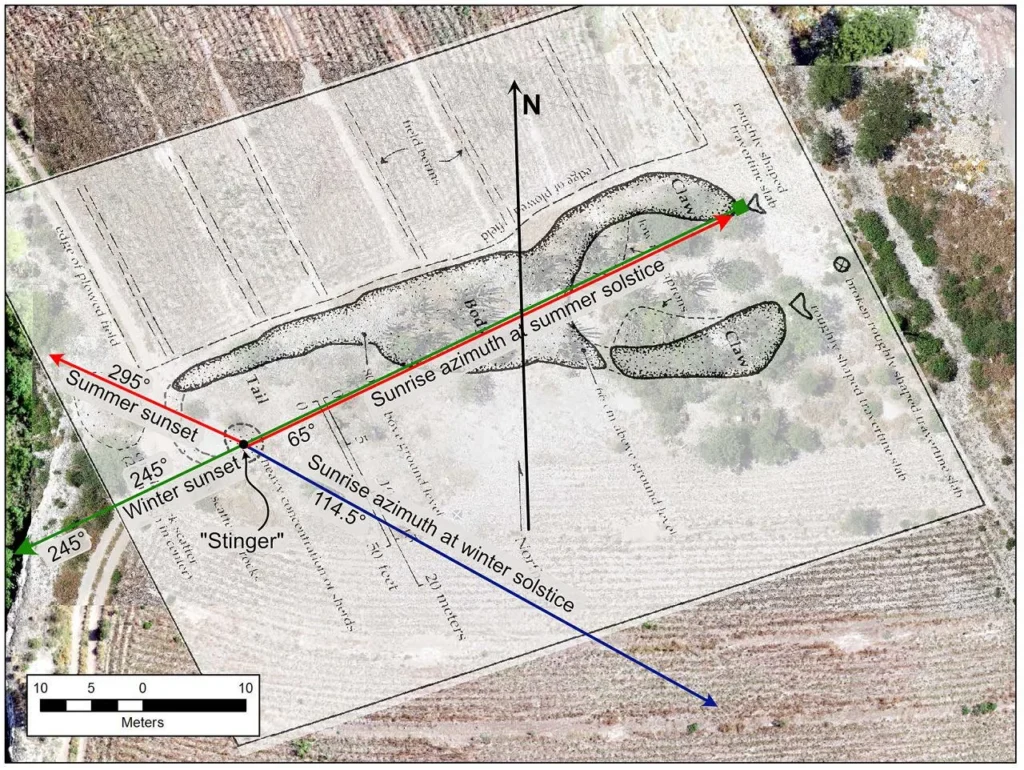
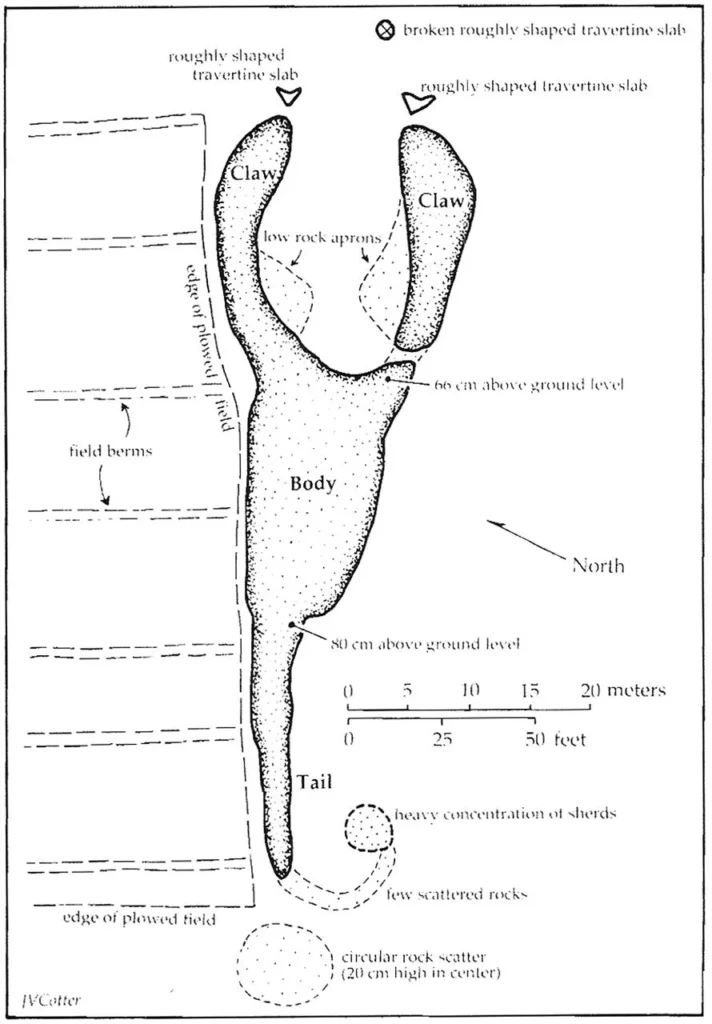
When viewed from above, the mound’s distinctive shape is unmistakable: a broad body, two outstretched claws, and a curved tail that ends in a raised “stinger.” Stretching roughly 205 feet (62.5 meters) in length and built from stones and soil up to 31 inches (80 centimeters) high, the structure has remained remarkably intact for more than a millennium.
Drone photography and GPS mapping confirmed that the mound was not a random pile of field stones, as early observers once thought, but a carefully constructed effigy mound — a symbolic representation of the scorpion deity Tlāhuizcalpantēcuhtli, associated with Venus, rain, and agricultural fertility in Mesoamerican cosmology.
“The Scorpion Mound stands out as a rare example of intentional effigy construction in Mesoamerica,” explains archaeologist James A. Neely, lead author of the 2025 study published in Ancient Mesoamerica. “Effigy mounds are common in North America, but extremely uncommon here. This one may represent a unique fusion of astronomical knowledge, ritual practice, and local farming traditions.”
A Solar Calendar in the Shape of a Scorpion
The mound’s orientation appears to have been deliberate. When researchers plotted its alignment, they found that the direction from the “stinger” to the left claw faces 65 degrees east-northeast — exactly where the sun rises during the summer solstice. Conversely, during the winter solstice, the sunset aligns with the scorpion’s tail when viewed from the left claw.
Such precise geometry suggests that the builders used the mound as a solar calendar to mark the changing seasons — vital information in a semi-arid valley where rainfall dictated agricultural success. “For ancient farmers, observing the solstices wasn’t a luxury,” Neely notes. “It was essential to survival.”
The summer solstice in particular marked the onset of the rainy season, signaling the right time to sow maize and other crops. The winter solstice, conversely, would have marked the season’s end — a moment for ritual offerings and thanksgiving ceremonies.
Rituals, Offerings, and Everyday Life
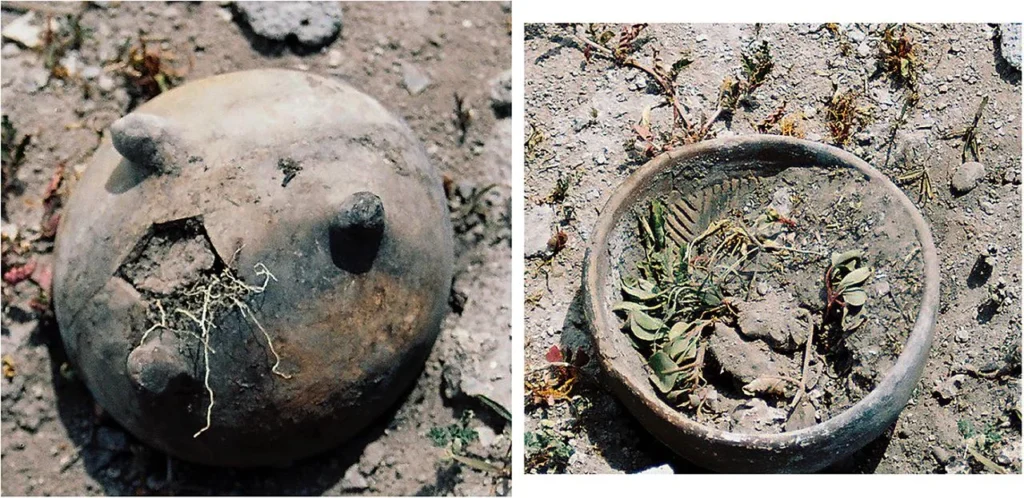
Excavations at the site revealed ceramic jars, tripod molcajetes (grinding bowls), incense burners, and fragments of hollow figurines, all pointing to ritual activities tied to seasonal change. A particularly striking find was a set of “killed” tripod bowls — intentionally broken vessels discovered near the scorpion’s head and containing a modern offering of tobacco and chilies, evidence that the site may have continued to hold spiritual significance long after its construction.
The Scorpion Mound is part of a larger 9-hectare (22-acre) ceremonial and civic complex containing at least 12 other mounds connected by a network of prehistoric irrigation canals. These canals formed part of one of the largest and best-preserved ancient water-management systems in Mesoamerica, covering nearly 100 square kilometers of farmland. Such infrastructure allowed local communities to thrive in an environment where irrigation was essential for agriculture.
Cosmic Connections and Cultural Links
Beyond its practical function, the scorpion symbol held deep cosmic meaning across ancient Mexico. In Aztec mythology, the scorpion was linked to Venus as the Morning Star — a celestial force tied to water, fertility, and renewal. The same imagery appears in Cacaxtla, a nearby ceremonial center famous for its vibrant murals depicting Venus and scorpion motifs. Ceramic styles found at the Scorpion Mound mirror those from Cacaxtla and Cholula, hinting at cultural and possibly political connections between these regions during the Epi-Classic period.
“These shared symbols suggest that people across central Mexico were united by a worldview in which astronomy, agriculture, and ritual were inseparable,” says co-author Blas Castellón Huerta of INAH. “The Scorpion Mound may have been a local expression of that broader cosmic belief system.”
A Window into Everyday Astronomy
Unlike the monumental observatories at cities such as Chichén Itzá or Monte Albán, the Scorpion Mound reflects the astronomical awareness of rural farmers, not elites. Its builders were likely villagers whose daily lives depended on the land and the sky. The mound’s modest scale and community context suggest a more egalitarian form of celestial observation, one grounded in practical farming and communal ritual rather than imperial power.
Archaeologists plan further excavations to confirm the mound’s construction phases and test its solstice alignments using precision instruments. If confirmed, the Scorpion Mound could become one of the most important examples of community-based astronomical architecture in ancient Mesoamerica.
“This discovery reminds us that sky-watching wasn’t confined to temples and kings,” Neely concludes. “Even small farming communities were looking to the heavens — and shaping the earth — to understand their place in the cosmos.”
Neely, J., Castellon-Huerta, B., Wilson, S., Willis, M., & Walker, C. (2025). The Scorpion Mound Complex: An Effigy Mound Site with Possible Functional/Ceremonial Significance in the Tehuacán Valley of Puebla, México. Ancient Mesoamerica, 1–16. doi:10.1017/S0956536125000070
Cover Image Credit: J. Neely et al., Ancient Mesoamerica (2025)
