
13 June 2026 The Future is the Product of the Past

Ancient Warrior Vessel Discovered at Chankillo, The Oldest Solar Observatory in the Americas

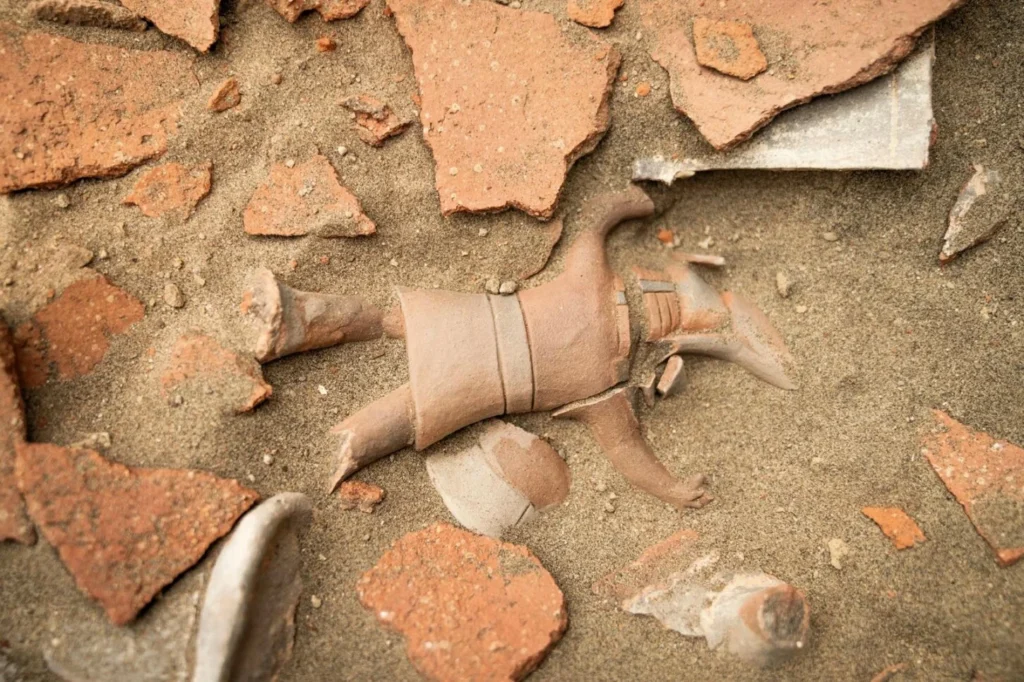
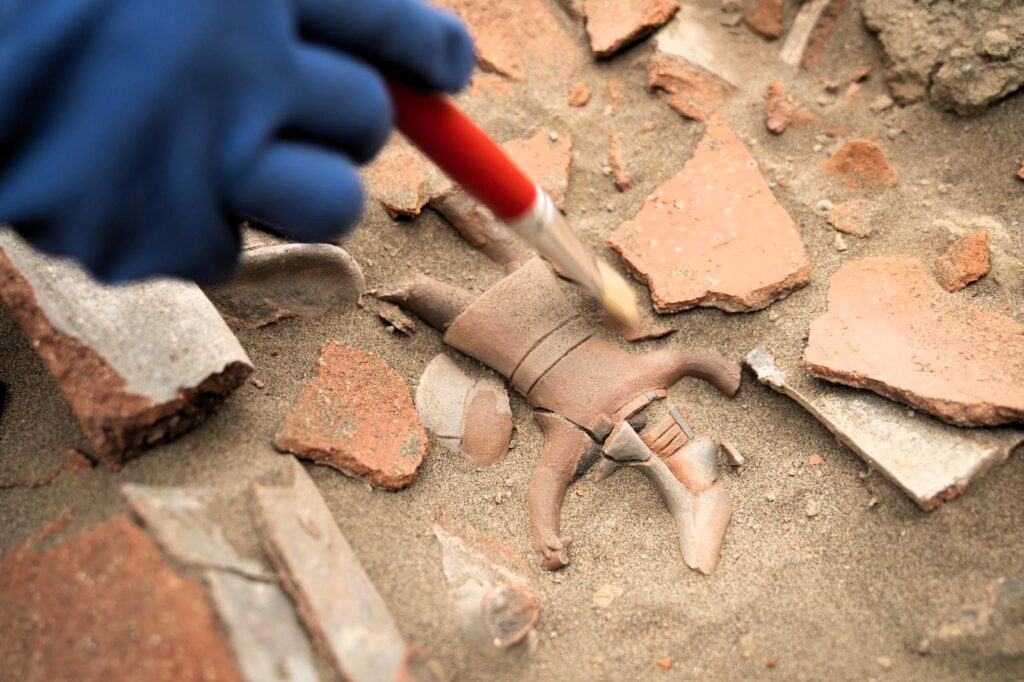
Archaeologists have uncovered a fragmented vessel depicting a warrior at Chankillo, the oldest solar observatory in the Americas, located in Peru’s Casma Valley.

This rare find links ancient solar ceremonies to the military and political power of elite groups over 2,300 years ago, offering new insights into the ceremonial and societal practices of the Casma culture.

Discovery of the Patazca-Style Warrior Vessel

The vessel, crafted in the Patazca style, was deliberately broken, likely as part of a ritual offering or during a conflict-related event. Patazca ceramics, produced in the northern coastal Andes around 500 BCE–200 CE, are characterized by highly detailed figurative designs, often depicting humans, animals, and scenes of combat or ritual.

These vessels frequently show expressive figures in dynamic poses, reflecting both daily life and ceremonial practices. The style is associated with the Casma culture, known for its complex society, monumental architecture, and sophisticated ceremonial traditions.

Located near the entrance to the Chankillo Solar Observatory, the vessel emphasizes the ceremonial role of such objects in religious practices tied to solar observation. Researchers link the warrior imagery to the Fortified Temple, a central hub for political, military, and ritual activities of the elite.


📣 Our WhatsApp channel is now LIVE! Stay up-to-date with the latest news and updates, just click here to follow us on WhatsApp and never miss a thing!!


This discovery confirms that ritual objects were not only ceremonial but also conveyed messages of identity and authority. Credit: Ministry of Culture of Peru

Ritual Significance and Elite Power

The Peruvian Ministry of Culture explains that the discovery confirms ritual objects were not purely decorative; they communicated identity, authority, and social status. The intentional smashing of the vessel likely played a role in ceremonies that reinforced elite dominance.

“This vessel shows how ancient elites combined ritual and imagery to assert control and maintain societal order,” ministry officials stated.

Chankillo: The Oldest Solar Observatory in the Americas

Chankillo, a UNESCO World Heritage Site since 2021, is celebrated for its Thirteen Towers, recognized as the oldest solar observatory in the Americas. Constructed over 2,300 years ago by the Casma culture, the towers are precisely aligned to mark the positions of the sunrise and sunset throughout the year, creating a full horizon calendar. This advanced astronomical knowledge allowed ancient inhabitants to accurately predict seasonal changes, optimize agricultural cycles, and schedule ceremonial events, reflecting a sophisticated understanding of the solar calendar.

The observatory’s design also demonstrates the interplay between science, religion, and political authority. By controlling knowledge of solar cycles, the elites of Chankillo could organize ritual events that reinforced their social and political dominance, linking celestial observation directly to power and ceremonial authority. The site’s combination of monumental architecture, ritual spaces, and astronomical precision makes Chankillo a unique testament to the ingenuity and organizational complexity of early Andean civilizations.
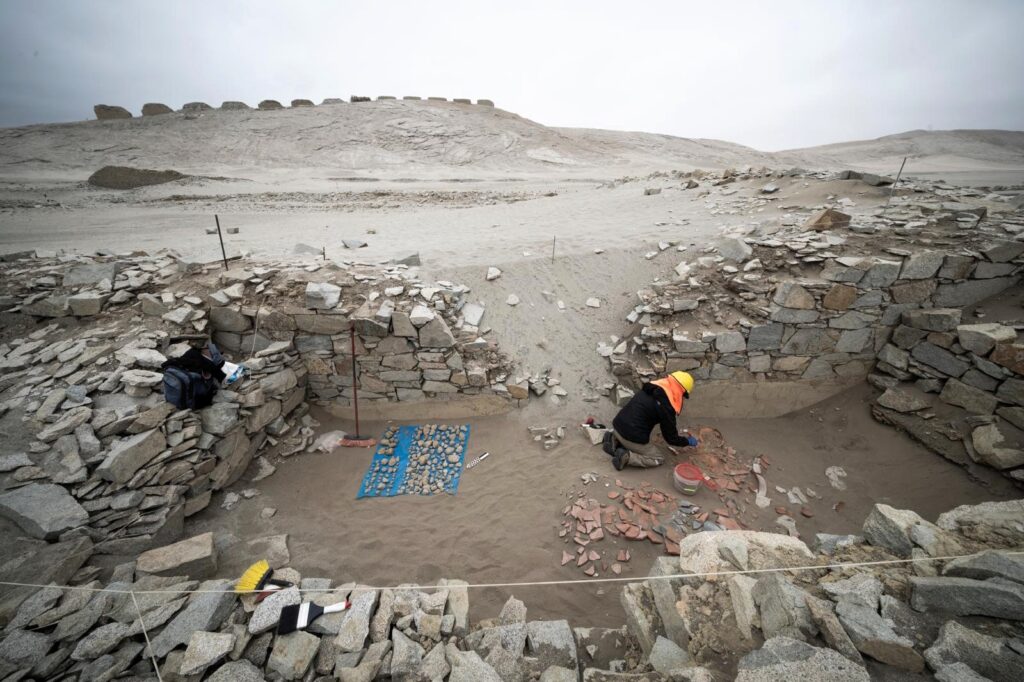
Credit: Ministry of Culture of Peru

Linking Military Authority to Ceremonial Practices

The warrior vessel strengthens the interpretation that Chankillo was more than a solar observatory. It served as a ceremonial and military stage where elites asserted power through ritual, astronomy, and force.

The Fortified Temple, stretching over 300 meters, highlights Chankillo’s dual function as a sacred and strategic location. Warrior depictions on the vessel provide evidence of militaristic aspects of elite identity, linking rituals to the assertion of authority.
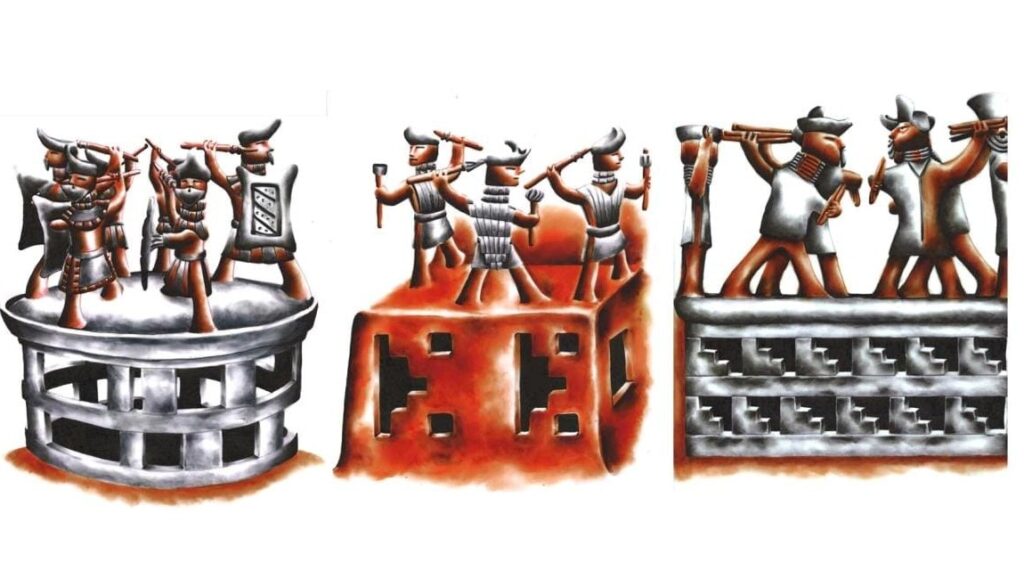
Credit: Ministry of Culture of Peru

Continuing Research and Cultural Insights

The Ministry of Culture continues excavations to uncover more about Chankillo’s social, political, and religious structures. The discovery of the warrior vessel illustrates the sophistication of Andean societies centuries before the Inca Empire.

Chankillo remains unique for combining astronomical, ritual, and defensive features. The Thirteen Towers form one of the most precise ancient horizon calendars, while the Fortified Temple and ceremonial spaces reveal the Casma culture’s complex hierarchy. Artifacts like this warrior vessel offer a window into how elites communicated power, identity, and connection to the cosmos.

Ongoing research at Chankillo will likely reveal more evidence of how early Andean civilizations used astronomy, ritual, and military organization to maintain control. This discovery adds a compelling layer to the story of Chankillo, highlighting the central role of strength and authority in elite rituals.

Ministry of Culture of Peru

Cover Image Credit: Ministry of Culture of Peru

Related Articles

A Scientific Surprise: Bering Land Bridge formed surprisingly late during last ice age

1 January 2023

1 January 2023

A new study shows that the Bering Land Bridge, the strip of land that once connected Asia to Alaska, emerged...

A 2,500-year-old Slate Tablet Containing Paleo-Hispanic Alphabet Found

15 June 2024

15 June 2024

Experts analyzing the symbols on a 2,500-year-old tablet recently discovered in Spain have uncovered a mysterious ancient alphabet. According to...

Ancient Funerary Stones Looted from Yemen Will Be Exhibited at the Victoria & Albert Museum

14 September 2023

14 September 2023

The Victoria & Albert Museum (V&A) has signed a historic agreement with the Yemeni government to temporarily keep and display...

A 2,500-Year-Old Mysterious Idol Discovered in the Ancient Urartian Fortress in Armenia

13 October 2025

13 October 2025

Archaeologists in Armenia have discovered a 2,500-year-old mysterious idol carved from volcanic tuff inside the ancient Urartian fortress of Argishtikhinili,...

Gold coin hoard discovered in a cup beneath a North Yorkshire kitchen floor is being auctioned off

7 September 2022

7 September 2022

A couple in North Yorkshire found an early 18th-century gold coin hoard buried under the floorboards of their kitchen. The...

Archaeologists Discovered a Mysterious Ancient Bone Floor in Alkmaar, the Netherlands

16 December 2024

16 December 2024

Archaeologists found a part of a floor made of animal bones in Alkmaar, North Holland, the Netherlands. Experts are intrigued...

Archaeologists Uncover Roman London’s First Basilica Beneath an Office Basement

13 February 2025

13 February 2025

Archaeologists have made a groundbreaking discovery beneath an office building in London, unearthing a substantial section of the ancient city’s...

Tomb of an Urartian buried with his dog, cattle, sheep, and 4 horses unearthed

6 September 2021

6 September 2021

In ancient times, the dead were buried with their living and non-living things. The offerings placed as dead gifts varied...

Medieval Cannonballs Found Beneath Future Administrative Centre in Belgium’s Nieuwpoort

28 April 2026

28 April 2026

A future civic building in Nieuwpoort has unexpectedly opened a window onto the Belgian city’s defensive past. Archaeologists working on...

1700 years ago the Korean peninsula had more genetic diversity than in our time, “Facial reconstruction possible through DNA analyses”

22 June 2022

22 June 2022

An international team led by The University of Vienna and the Ulsan National Institute of Science and Technology in collaboration...

Olmec reliefs show Ancient Olmec Leaders In Trance-Like State Roaring Like Jaguars

14 August 2022

14 August 2022

Archaeologists in Mexico have discovered two carved reliefs from the late Olmec period (900-400 B.C.) in Villahermosa, Tabasco, southeastern Mexico...

8,000-year-old Musical Instrument found in northwest Turkey

4 July 2021

4 July 2021

Archaeologists in northwestern Turkey’s Bilecik on Tuesday discovered a musical instrument that dates back to an estimated 8,000 years. During...

Ancient Japanese Armor Reveals Strong Links to Korea’s Baekje Kingdom

10 April 2026

10 April 2026

Recent archaeological findings in Japan are shedding new light on the deep cultural and technological exchanges between ancient Japan and...

Homo Sapiens are older than we previously thought

16 January 2022

16 January 2022

Researchers have discovered that Omo I skeletons, previously thought to be less than 200,000 years old, are 230,000 years old....

A rare Pictish stone was found near the potential site of the famous Scottish battle that led to the creation of Scotland

7 March 2022

7 March 2022

A team of archaeologists has discovered a Pictish symbol stone close to the site of what is thought to have...