

Archaeologists have unearthed a 19th-century silk workshop hidden within the ruins of Simitçi Castle, part of the ancient city of Apollonia ad Rhyndacum in the picturesque Gölyazı neighborhood of Bursa’s Nilüfer district. The discovery connects Bursa’s modern identity as the “City of Silk” to its ancient roots, offering new insight into centuries of textile craftsmanship in northwestern Türkiye.
Excavations led by Professor Derya Şahin of Bursa Uludağ University have been underway since July 4, focusing on the preserved fortification walls of the ancient city. The site, consisting of three interconnected landmasses encircled by defensive walls, dates back to the Hellenistic period, around the late 4th century B.C., and was a key settlement on the shores of Lake Uluabat. The current excavation and conservation efforts are being carried out in partnership with Nilüfer Municipality.
A Rare Glimpse Into Bursa’s Silk Heritage
During restoration work at Simitçi Castle, archaeologists identified structural remains and large iron nails consistent with vats used in silk processing. These clues revealed that the area once housed a raw silk production workshop in the early 19th century, a time when Bursa’s silk industry reached its peak under the Ottoman Empire.
“The discovery of vats, nails, and remnants of processing structures clearly indicates silk manufacturing activities,” said Şahin. “This finding not only sheds light on Gölyazı’s economic life in the 19th century but also extends the story of Bursa’s long-standing relationship with silk.”
From Ancient Fortifications to Ottoman Silk Production
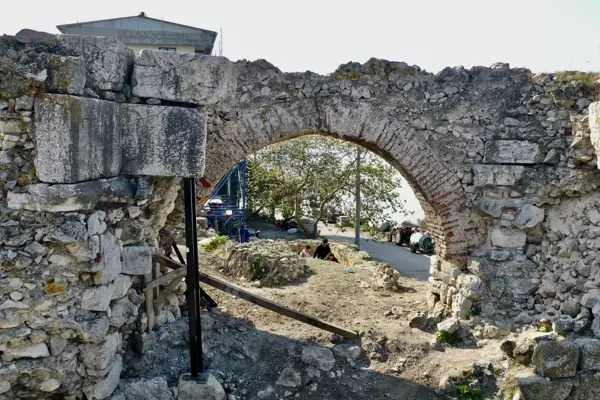
The excavation team has preserved 4.57 meters of the city walls’ original nine-meter height, with four of the seven towers still standing. The team’s initial intervention began after parts of the arched structure collapsed in December 2023. “We immediately informed the authorities and prioritized excavation and restoration,” Şahin explained. “After clearing around three truckloads of debris, we stabilized the structure using filling materials and metal supports.”
Known locally as Simitçi Castle, the name derives from a resemblance to a simit, the traditional Turkish sesame bread ring, and possibly from a time when the structure was repurposed as a local bakery. Şahin noted that such blending of historical and local identity is common in Gölyazı, where modern life intertwines seamlessly with remnants of antiquity.
Apollonia ad Rhyndacum: A Jewel by the Lake
Apollonia ad Rhyndacum, today known as Gölyazı, was one of the prominent cities of ancient Mysia, named after the god Apollo. Its position on a small peninsula surrounded by Lake Uluabat made it both a defensible and prosperous settlement. The city flourished through the Hellenistic, Roman, and Byzantine eras, serving as a strategic trade hub that connected inland Anatolia with the Marmara region.
Today, Gölyazı remains one of Türkiye’s most scenic heritage towns, attracting visitors with its cobblestone streets, lakeside cafés, and reflections of Byzantine architecture. Fishermen still anchor their boats under the shadow of ancient walls, and during spring, migrating storks nest atop the city’s ruins — a striking reminder of the site’s living continuity.
Bursa: The Silk Capital of Anatolia
The discovery of a silk workshop within Gölyazı’s ancient fortifications reinforces Bursa’s reputation as a historical center of silk production. Bursa’s connection to silk dates back to the 14th century, when it became a major stop on the Silk Road, linking the Far East with Europe. During the Ottoman period, the city’s famed Koza Han (Silk Cocoon Market) became a bustling hub for traders dealing in raw silk, textiles, and embroidered garments destined for Istanbul and beyond.
Even today, traditional silk weaving continues in certain villages of Bursa, preserving the meticulous hand-loom techniques that once defined Ottoman luxury. Local artisans still produce ipek kumaş (silk fabric) and Bursa scarves, merging centuries-old craftsmanship with contemporary design.
Şahin emphasized that the Gölyazı workshop represents an important piece of this cultural puzzle. “Finding evidence of silk production within an ancient fortress is rare. It shows that the industry’s influence extended far beyond urban centers like Bursa’s historic bazaar, reaching smaller rural settlements,” she said.
Restoration and Future Plans
Basic repair and conservation work at the site is scheduled for completion by November 28, after which a larger restoration phase will begin. Once stabilized, Simitçi Castle and its surrounding structures are expected to become part of a broader archaeological and cultural tourism route connecting Bursa’s historical silk workshops, Ottoman inns, and ancient settlements.
Nilüfer Municipality has expressed plans to open the area to visitors, highlighting both its archaeological significance and its contribution to local identity. The initiative aims to integrate the site into Bursa’s growing heritage tourism network, encouraging visitors to explore not only the famed Koza Han and Grand Mosque but also the serene beauty of Gölyazı and its timeless lake.
Preserving a Living Legacy
As conservation efforts continue, experts believe that the Apollonia excavation will deepen understanding of how ancient cities evolved over millennia—shifting from fortified settlements to centers of trade and craft. For Bursa, this rediscovery is more than an archaeological milestone; it is a revival of the city’s enduring story of artistry, resilience, and silk.
Cover Image Credit: Cetintas555 – Wikipedia
