
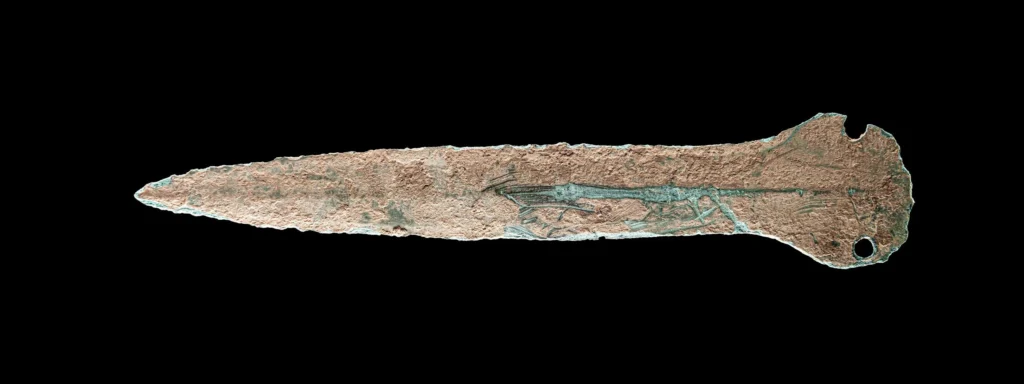
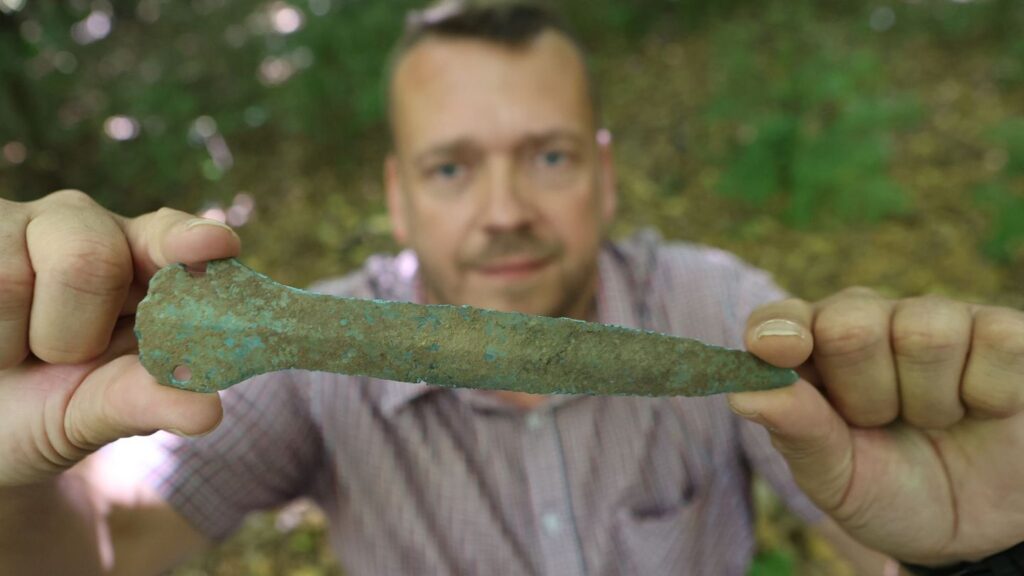
A simple family walk near the village of Gudersleben in Nordhausen County, in Thuringia, central Germany, has turned into a remarkable archaeological moment. A 3,500-year-old Bronze Age dagger, identified as a plate-tanged dagger, was discovered lying on the ground—likely exposed by heavy rains that had washed away the soil.
Experts say the find is not only exceptionally rare but also offers a direct link to the craftsmanship, rituals, and daily life of Europe’s Bronze Age societies.
According to Daniel Scherf, regional archaeologist with the Thuringian State Office for Monument Preservation and Archaeology in Weimar, such a find in this state of preservation is exceptionally rare. “Objects like this are not everyday discoveries. To see a Bronze Age dagger so well preserved is something truly special,” Scherf explained.
The dagger has since been transferred to the state’s restoration workshops in Weimar, where it is being carefully cleaned, conserved, and examined with both archaeological and scientific methods. Once the analysis is complete, the artifact will be displayed at the Local History Museum in Ellrich, offering the public a chance to view an object last held by human hands more than three millennia ago.
A Glimpse Into the Bronze Age
Plate-tanged daggers such as this one represent a distinctive type of weapon from the European Bronze Age (circa 2200–800 BCE). Unlike modern knives, these weapons featured a wide, flat tang designed to be riveted onto an organic handle made of wood, bone, or antler. The craftsmanship required not only skilled casting in bronze but also careful assembly to ensure durability in both combat and ceremonial use.
Archaeologists believe that such daggers were more than simple tools of war. In many cases, they symbolized status, power, or ritual significance within early European societies. Bronze was a valuable resource, requiring the smelting of copper and tin, and weapons forged from it were prestigious possessions. The Gudersleben find may once have belonged to a warrior, a leader, or perhaps been deposited intentionally as part of a burial or ritual offering.
The Landscape of Nordhausen and Gudersleben
The discovery site lies within a karst region of northern Thuringia, an area marked by dynamic soil movement, sinkholes, and underground streams. Such geological conditions often expose buried artifacts unexpectedly, particularly after periods of heavy rainfall. Local archaeologists suggest that this natural process likely brought the dagger back to the surface after lying hidden for thousands of years.
Gudersleben itself has a long settlement history, with archaeological traces pointing to prehistoric activity in the surrounding fields and hills. Finds like the bronze dagger reinforce the understanding that the area was part of a vibrant cultural landscape during the Bronze Age, with networks of trade, warfare, and ritual practice shaping daily life.
A Responsible Discovery
The dagger was discovered by Maik Böhner, a local resident, who immediately reported it to the authorities rather than attempting to retrieve it himself. Archaeologists praised his responsible action, noting that such cooperation is essential for preserving cultural heritage.
Unauthorized use of metal detectors is prohibited under German law, and responsible reporting ensures that artifacts like this are studied in their proper context.
“I am very pleased that everything was reported correctly,” Scherf emphasized, noting how such cooperation between citizens and heritage authorities is vital for preserving the region’s cultural history.
Preserving Heritage for the Future
Once conservation work in Weimar is complete, the dagger will be displayed in Ellrich’s Local History Museum. For archaeologists and visitors alike, it will serve as a tangible connection to Thuringia’s distant past, reminding us of the skill, symbolism, and stories of people who lived 3,500 years ago.
This extraordinary find not only enriches the archaeological record of northern Thuringia but also demonstrates how chance encounters can shed light on ancient civilizations. A simple family walk has revealed a weapon from the Bronze Age — a relic of power, craftsmanship, and cultural heritage now preserved for generations to come.
Cover Image Credit: MDR / Hauke Arnold, Thuringian State Office for Monument Preservation and Archaeology
