
10 November 2025 The Future is the Product of the Past

Rare Ancient Mosaics Seized in Türkiye: Crowned Sea Goddess and Mythical Creatures Uncovered in Smuggling Plot

In a decisive cultural heritage protection operation, gendarmerie officers in the Nurdağı district of Gaziantep province in southeastern Türkiye seized two rare ancient mosaics and detained three suspects—identified only as E.Ç., M.B., and M.B.—for attempting to sell historically significant artifacts obtained through illicit channels.

Acting on intelligence, officers intercepted a vehicle belonging to E.Ç., where the mosaics were discovered hidden inside. The artifacts, considered invaluable in terms of cultural and historical significance, were immediately handed over to the Gaziantep Museum Directorate for safekeeping. Authorities confirmed that the suspects remain in custody as the investigation continues.

Seized Roman-Era Mosaics Depicting Gods and Sea Creatures

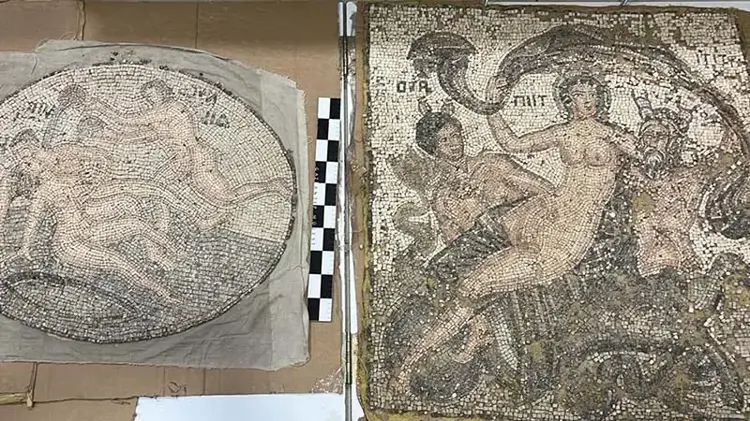
The seized mosaics evoke scenes from the Roman era, depicting gods and sea creatures, though a full analysis has yet to be conducted

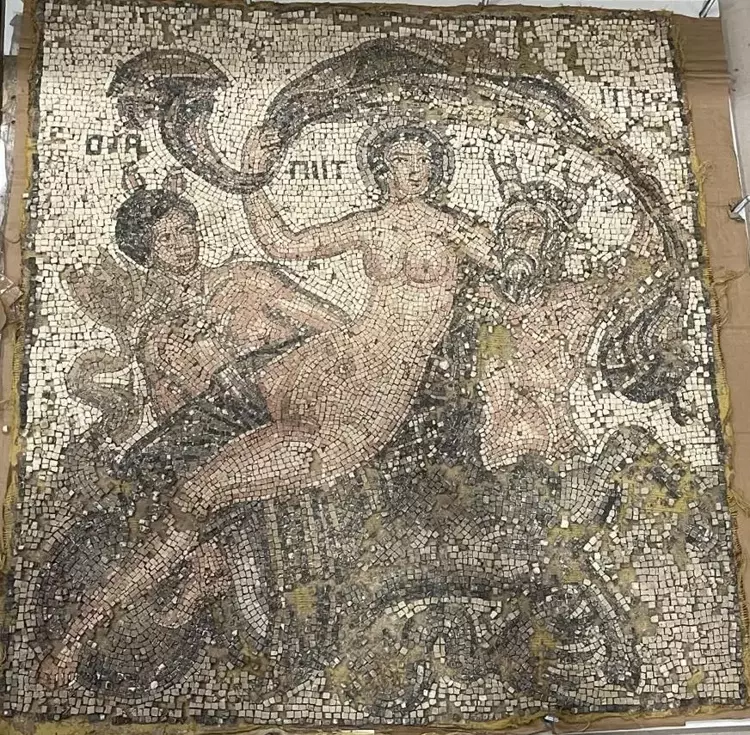
The mosaics feature intricate depictions of mythological sea figures. In the rectangular mosaic on the right, the central figure wears a crown or decorative headdress, suggesting she may represent a sea goddess such as Thetis or Tethys. Surrounding figures resemble Triton or Nereid-type attendants, commonly associated with marine divinities. Greek letter fragments above the scene may further indicate the identity of the goddess, similar to inscriptions observed in comparable mosaics.

The circular mosaic on the left depicts nude figures and sea creatures arranged in an oval composition, likely representing individual mythological or allegorical scenes, possibly featuring Nereids or Tritons as seen in Roman mosaics. Together, these mosaics illustrate a maritime mythological tableau, with the central female figure as a probable sea goddess accompanied by attendant sea entities.


📣 Our WhatsApp channel is now LIVE! Stay up-to-date with the latest news and updates, just click here to follow us on WhatsApp and never miss a thing!!


Seized ancient mosaics from Gaziantep depicting a crowned sea goddess—possibly Thetis or Tethys—surrounded by mythological sea figures such as Triton or Nereids. Credit: DHA

Gaziantep’s Cultural Treasure: The Gypsy Girl Mosaic

Gaziantep is home to the world-renowned Zeugma Mosaic Museum, one of the largest mosaic museums in existence. The museum houses thousands of square meters of ancient mosaics, most dating back to the Roman and Late Antique periods.

The museum’s most iconic piece, the “Gypsy Girl” mosaic, portrays a young woman with hauntingly expressive eyes, wearing a colorful shawl and holding what appears to be a tambourine. Crafted in the 2nd or 3rd century AD, this fragment—once part of a villa floor—captures the imagination and has been likened to the Mona Lisa for its enigmatic, traveling gaze. Her symbolism remains debated; she may represent a maenad, Gaia (the earth goddess), or even a veiled representation of Alexander the Great.

Interestingly, 12 fragments of the mosaic were smuggled to the United States in the 1960s and ended up at Bowling Green State University. In 2018, after concerted repatriation efforts, these pieces were returned and reunited with the original mosaic at Zeugma Museum. The museum—and especially the “Gypsy Girl”—miraculously survived the devastating 2023 Turkey–Syria earthquake unscathed and reopened to visitors shortly thereafter.
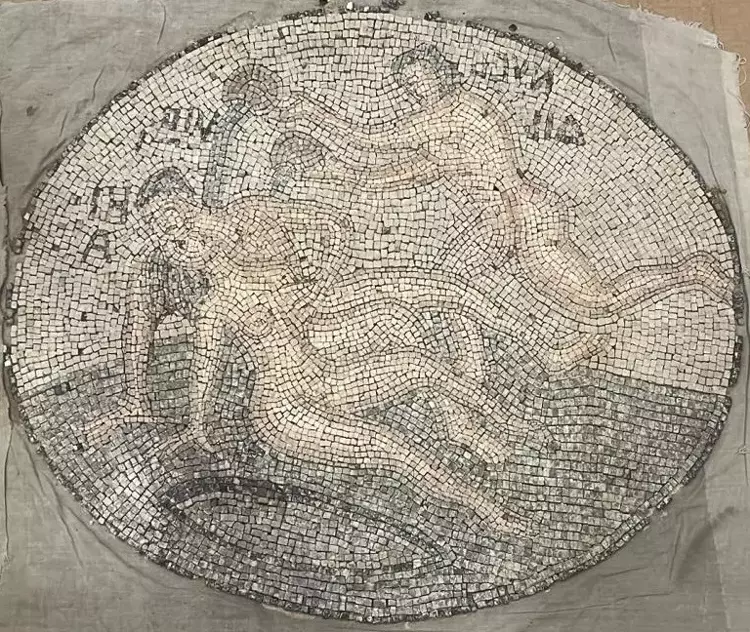
The circular mosaic depicts nude figures and sea creatures arranged in an oval composition, likely representing individual mythological or allegorical scenes, possibly featuring Nereids or Tritons as seen in Roman mosaics. Credit: DHA

Legal Consequences for Artifact Smuggling

Under Turkish law, the illegal excavation, possession, or trafficking of antiquities is a serious offense. The Law on the Protection of Cultural and Natural Assets (Law No. 2863) and related provisions in the Turkish Penal Code prescribe strict penalties.

Those found guilty of smuggling or selling cultural property can face several years of imprisonment and substantial fines, with harsher sentences applied when the artifacts are of great historical value. Additionally, confiscated items are permanently transferred to museums and state collections, ensuring their protection and public accessibility.

A Commitment to Heritage Protection

This recent seizure highlights Türkiye’s ongoing efforts to combat the illicit trade in cultural heritage. Authorities emphasize that every successful operation not only protects irreplaceable artifacts but also supports academic research, tourism, and the preservation of the country’s rich history.

Gaziantep’s Gypsy Girl mosaic stands as a reminder of what is at stake: a unique cultural legacy that must be safeguarded for future generations.

Cover Image Credit: DHA

Related Articles

Over 20 terracotta warriors have been discovered in the Terracotta Army pit in China

24 January 2022

24 January 2022

More than 20 Terracotta Warriors were unearthed from the Terracotta Army pit in Xi’an, northwest China’s Shaanxi province, according to...

Unlucky medieval woman underwent at least two skull surgeries in Longobard Italy

14 February 2023

14 February 2023

A detailed examination of the skull of a woman who lived at the medieval settlement of Castel Trosino in central...

Recent excavations reveal the complete water conservancy system of the nearly 5000-year-old Liangzhu Ruins

26 November 2024

26 November 2024

In recent excavations around the Liangzhu Ruins in east China’s Zhejiang Province, researchers have discovered about 20 ancient dams. Seven...

An extraordinary votive treasure was unearthed in the ancient Roman bath sanctuary of San Casciano Dei Bagni in Italy

7 August 2022

7 August 2022

In San Casciano Dei Bagni, a Tuscan hill town famous for its hot springs, 40 miles southeast of Siena, unique...

Rare Roman Articulated Terracotta Doll Unearthed at Torreparedones Archaeological Park

25 September 2025

25 September 2025

Archaeologists working at the Torreparedones Archaeological Park in Baena, Córdoba, Spain, have made a remarkable discovery: a rare Roman-era articulated...

Archaeologists found a noble woman buried beside her ‘husband’ 1,000 years ago with the top of her face hollowed out

4 November 2023

4 November 2023

Archaeologists unearthed the 1,000-year-old remains of a woman with her face and head hollowed out buried next to her husband...

Denmark King’s spice cabinet discovered on Gribshunden

13 February 2023

13 February 2023

The Gribshunden, a 15th-century Danish royal warship, was uncovered to have been loaded with botanical materials, including the first archaeological...

Rare Fresco of Fire-Worship Ritual Discovered in Ancient Sogdian Palace in Tajikistan

6 September 2025

6 September 2025

Archaeologists in Tajikistan have unearthed an exceptionally rare fresco depicting priests performing a fire-worship ritual at the palace of Sanjar-Shah,...

4,500-Year-Old Harappan Settlement Unearthed in Rajasthan’s Thar Desert

31 July 2025

31 July 2025

Archaeologists uncover the first-ever Harappan site in Rajasthan’s Thar Desert near the Pakistan border, expanding the known geographical reach of...

Medieval Masterpiece: Rare Jesus Christ Relief from Ani Ruins Unveiled After 130 Years

14 August 2025

14 August 2025

A significant archaeological artifact depicting Jesus Christ has been put on public display for the first time at the Kars...

Early Anatolian Genes: Genetic Links Between Girmeler Mound and 17,000-Year-Old Pınarbaşı Skeletons

16 April 2025

16 April 2025

Recent archaeological excavations at Girmeler Mound, located near the ancient Lycian city of Tlos in southwestern Türkiye, have not only...

For the first time in Turkish history, a gold belt buckle depicted the face of a Göktürk Khagan found

19 December 2023

19 December 2023

A social complex (Külliye) and new artifacts from the Western Gokturk period were discovered in Kazakhstan. Among these items, a...

A Roman statue of the sea god Triton discovered near A2, London Road

13 September 2023

13 September 2023

Archaeologists have uncovered a Roman Statue of Triton during excavations in preparation for a housing development in Kent, England. Archaeologists...

A unique find in the Middle Don: Scythian gods on a silver plate

19 November 2021

19 November 2021

Archaeologists of the Archaeological Institute of the Russian Academy of Sciences, during their excavations at the Devitsa V cemetery in...

Friendly Fire: Lost Battlefield from 1758 Found Near Fort Ligonier

16 July 2025

16 July 2025

A foggy evening in November 1758 nearly cost George Washington his life in a friendly fire skirmish between two groups...