

Archaeologists investigating a remarkably preserved 2,400-year-old Celtic structure in Aschaffenburg, Germany, now believe the massive timber-and-stone construction may have protected an important route from the Main River to an Iron Age settlement.
Workers unexpectedly encountered the ancient timbers in March 2026 during construction of a stormwater overflow basin near Aschaffenburg’s Willigis Bridge. Researchers from the Bavarian State Office for Monument Protection (Bayerisches Landesamt für Denkmalpflege, BLfD) later dated the oak beams to between 372 and 352 BC, placing the structure firmly within the Iron Age.
The discovery immediately stood out because of both its scale and preservation. According to the BLfD, no closely comparable structure of the same age, construction method and state of preservation is currently known elsewhere in Bavaria or Germany.
A Celtic Structure Beside the Main River
Archaeologists still cannot say with certainty what the riverside installation was built for, but months of excavation have produced a new working hypothesis.
“We do not yet know what the structure was used for,” Dr. Stefanie Berg, head of archaeological monument preservation at the BLfD, said in the agency’s announcement. Researchers suspect that it may have protected access from the Main River up toward the settlement.
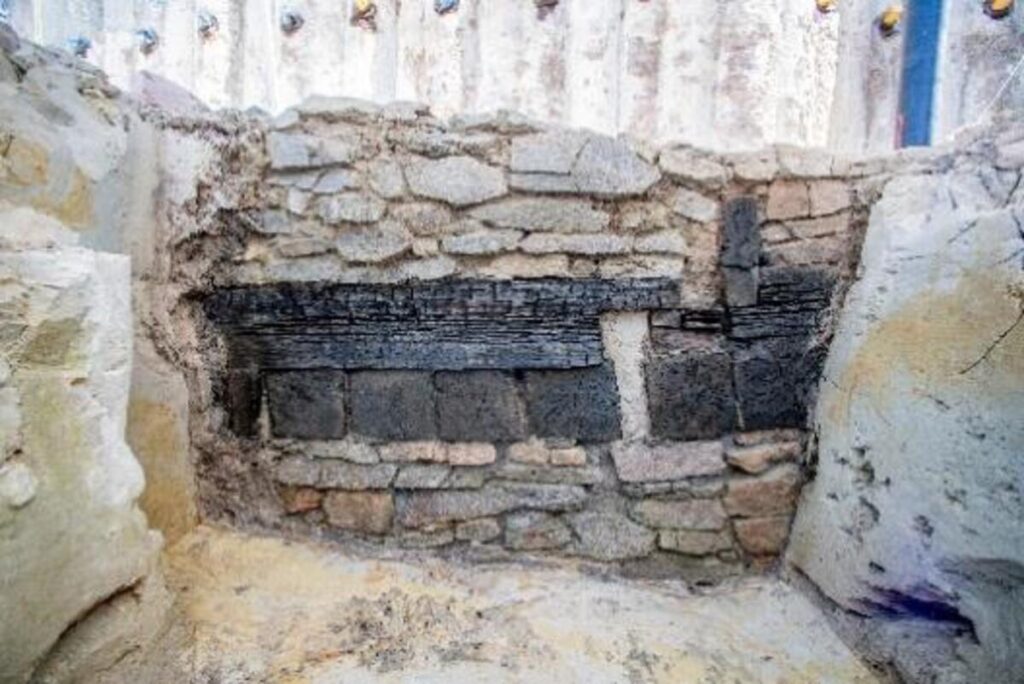
The arrangement beside the river adds another clue. Immediately in front of the large structure, which combined dry-stone masonry with an elaborate timber framework, archaeologists identified a wooden platform facing the Main.
Berg suggested that boats may have docked there and that people could have unloaded or transferred goods and other cargo at the site. The interpretation remains provisional, but it raises the possibility that the structure formed part of a controlled river access point rather than serving as an isolated riverside construction.
Oak Beams Weighing Up to 250 Kilograms
The engineering required to build the installation is becoming clearer as excavation progresses. The builders adapted the structure to wet and unstable ground, combining substantial timber components with dry-stone walls in a construction that required considerable planning and labor.
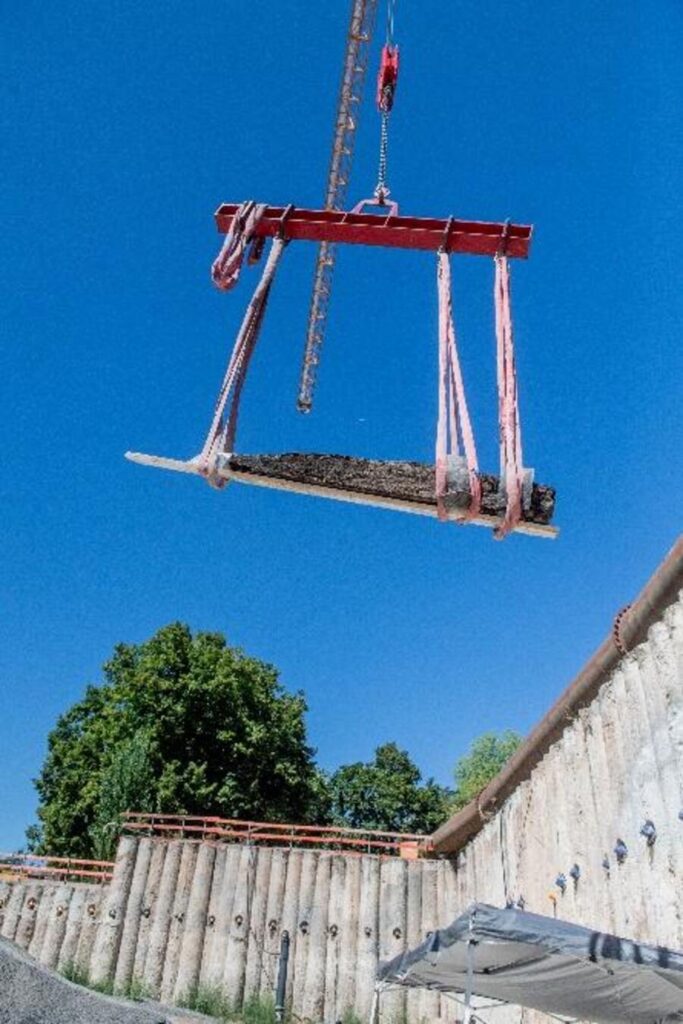
Some of the oak beams measure three to four meters long and weigh approximately 200 to 250 kilograms. Archaeologists carefully released each beam by hand before a crane lifted it from the excavation pit.
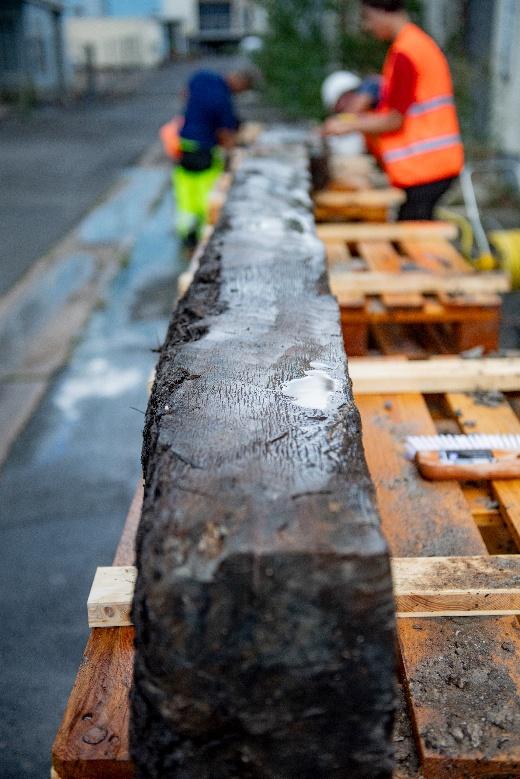
The first third of the approximately 2,400-year-old timbers has now been recovered. Conservators cleaned the waterlogged wood and prepared it for wet storage, while researchers plan to produce individual 3D laser scans of the beams.
Tool marks still visible on the wood are particularly valuable. Marks left by Iron Age axes and adzes allow specialists to examine how ancient craftspeople shaped and fitted the heavy timbers.
Timber Was Transported from the Spessart
The structure also reveals the logistical capacity of the community that built it.
According to Berg, the builders obtained the oak trees from the Spessart region, where workers felled and processed them before transporting the timber to Aschaffenburg. Stone used in the construction also travelled along the Main River. At the site, workers built the dry-stone walls and fitted the heavy wooden beams into the structure.
Such a project required far more than local carpentry skills. It demanded access to raw materials, organized transport, specialized labor and the ability to coordinate a substantial workforce.
The BLfD argues that this level of organization provides important evidence for the status of the Iron Age settlement. The construction would also have been clearly visible from the river, potentially making it both a functional installation and a conspicuous marker of the community above the Main.
Archaeologists Are Still Testing the Site
Several disciplines are now examining the structure and its surrounding deposits. Archaeologists and architectural researchers are studying its construction, while geoarchaeologists and archaeobotanists are analyzing soil layers and plant remains. Conservators are working on the recovered material, and researchers have also taken samples for further scientific dating.
Those analyses could help reconstruct the ancient riverbank environment and clarify how the installation related to the nearby settlement.
The excavation will continue alongside construction work at the stormwater facility, with archaeological investigations scheduled to conclude by the end of 2026. Part of the preserved timber and stonework is eventually expected to undergo conservation for display at Aschaffenburg’s Stiftsmuseum.
For now, the exact function of the Iron Age structure on the Main River remains unresolved. But the scale of its timberwork, the riverside platform and the resources required to build it increasingly point toward a carefully planned installation connected to a settlement important enough to control — and perhaps display — its access to the river.
