
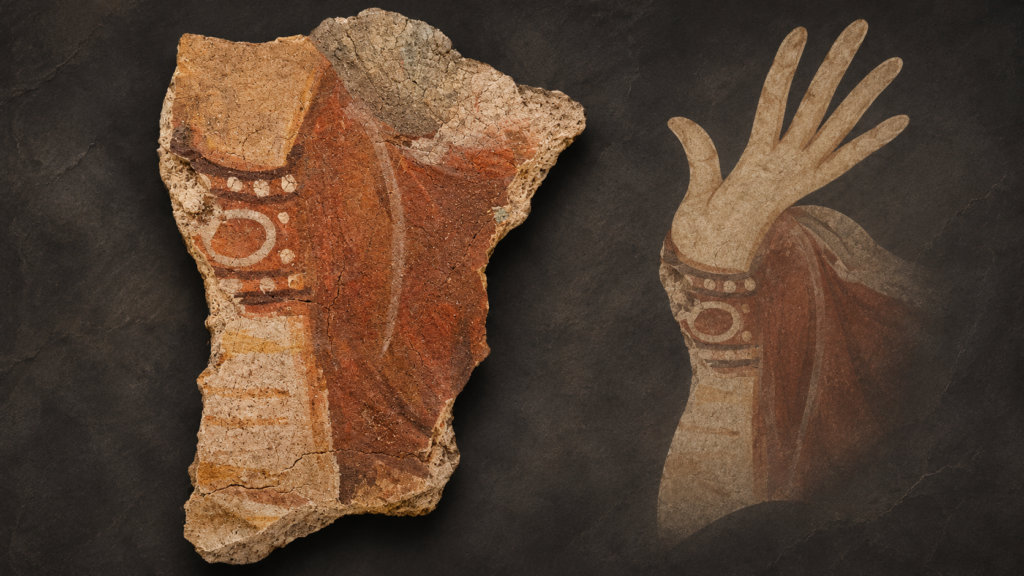
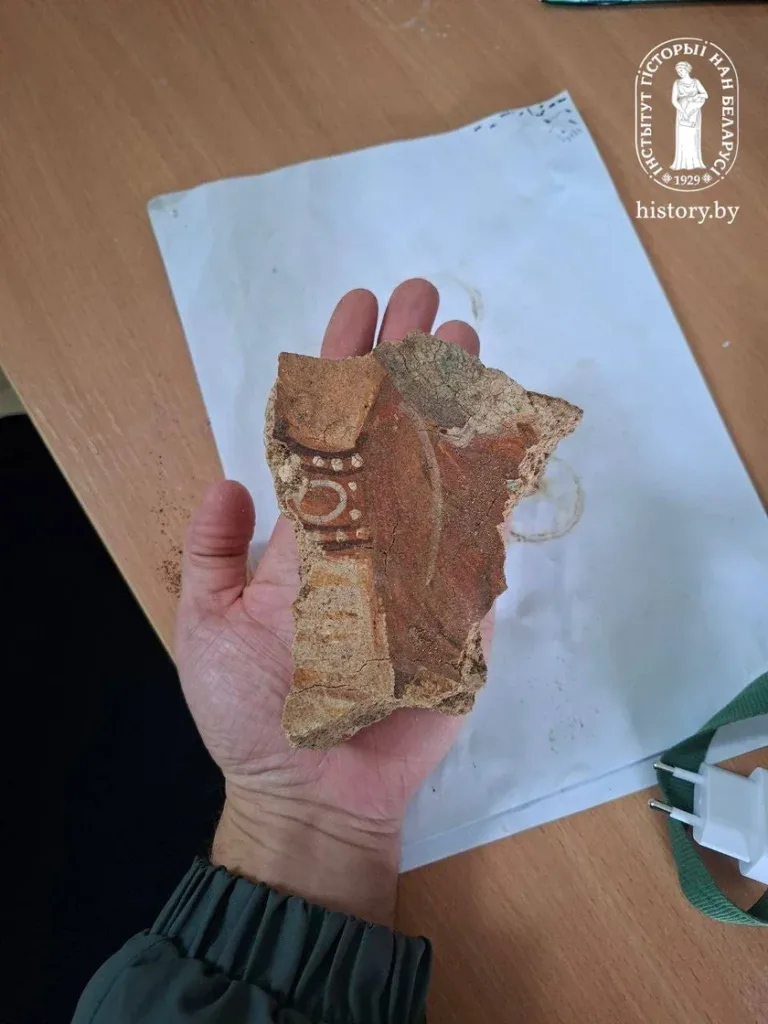
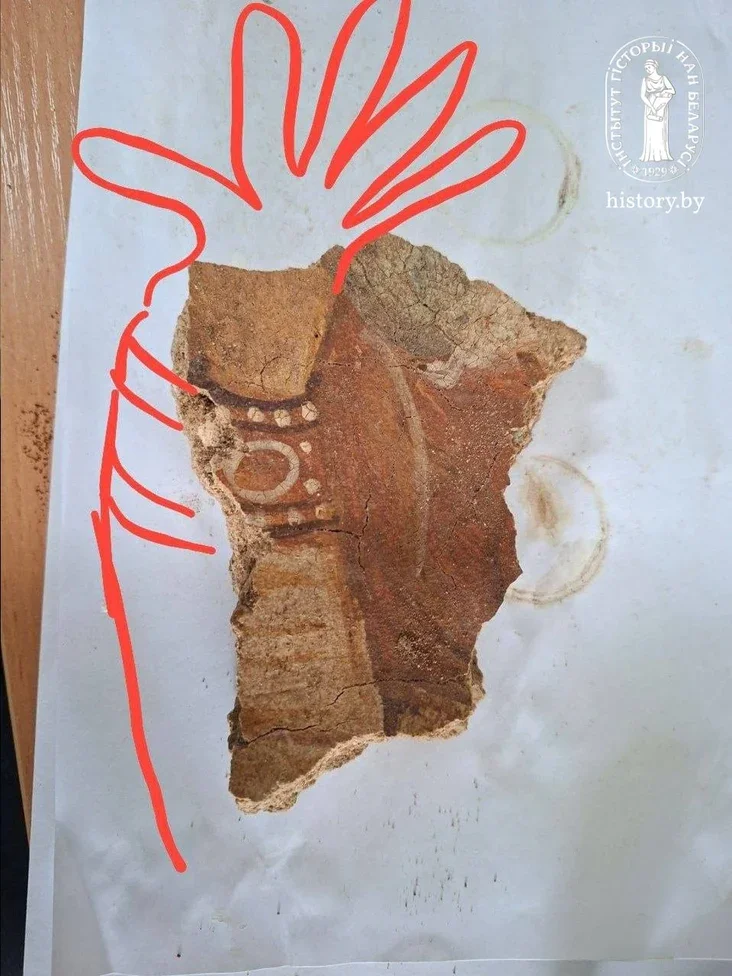
An archaeological excavation at Krevo Castle in western Belarus has uncovered a fragment of a medieval fresco depicting a human palm. This find is the first piece of wall painting in the castle’s research history to feature a depiction of the human body, revealing previously unknown characteristics of the paintings that once decorated the structure’s interiors. Rare traces of green pigment on the fresco also provide new insights into the color palette used by the artists.
According to a statement dated November 27 from the Institute of History of the National Academy of Sciences of Belarus, archaeologists discovered the fragment during work carried out in the castle’s Prince’s Tower. The research team, led by Oleg Dernovich, is examining the historical destruction layers of the castle alongside restoration experts.
Dimensions of the human figure can be determined
The majority of wall painting fragments found at Krevo Castle until now contained geometric decorations. This new discovery indicates that artists incorporated human figures alongside these geometric compositions. Researchers state that they will be able to calculate the dimensions of the human figure in the original composition based on the measurements of the depicted palm.
However, the current find is not sufficient to determine the identity of the figure or the subject of the painting. It is not yet known whether the depiction belongs to a religious scene or another type of composition.
The wall paintings of Krevo Castle have long been a subject of scientific research. According to an academic study by Aleh Dziarnovich and art historian Giedrė Mickūnaitė, excavations conducted in the Prince’s Tower in 1988 and 2012 unearthed approximately 4,000 wall painting fragments dating back to the second half of the 14th century. Researchers determined that these paintings were created using the al secco technique, applied onto dry plaster.
An artistic tradition stretching from Ancient Greece to Byzantium
Artists used pigments available in the region for the wall paintings of Krevo Castle. Red ochre, white, and black formed the characteristic color palette of the paintings. The newly discovered piece, however, contains traces of green pigment, which is rarely encountered in the castle’s known wall paintings.
One of the striking elements in the castle’s decoration is the meander motif, consisting of successive angular lines. This geometric decoration, originating in Ancient Greek art, persisted in Byzantine art. Researchers from the Institute of History state that the motif reached Krevo via the Byzantine artistic tradition.
These decorations are significant for understanding cultural interactions in medieval Eastern Europe. The fact that castles built for military purposes also served as living spaces for rulers and nobles meant that importance was placed on interior decoration alongside architectural defense elements.
A castle that shaped European history
Located today in the Grodno region of Belarus, Krevo Castle was one of the important political and military centers of the Grand Duchy of Lithuania in the 14th century. Built of stone and brick, the castle witnessed dynastic struggles and developments that changed the political geography of Europe throughout the Middle Ages.
One of the most significant events in the castle’s history took place on August 14, 1385. The Union of Krevo, prepared as a result of negotiations between Grand Duke Jogaila of Lithuania and Polish nobles, laid the foundation for Jogaila’s conversion to Christianity, his marriage to Queen Jadwiga of Poland, and his ascent to the Polish throne. This development marked the beginning of a political union between Poland and Lithuania that would last for centuries.
However, the castle was also affected by power struggles within the Lithuanian dynasty in later years. The forces of Prince Švitrigaila attacked the castle in 1433. The ruins currently being examined by archaeologists in the lower floor of the Prince’s Tower bear the marks of this attack.
The research team aims to reconstruct the original decoration by assembling the wall painting fragments found during the excavations. The newly discovered depiction of a human hand provides a significant contribution to this work and serves as a new starting point for understanding the artistic richness of the castle’s medieval interiors.
Institute of History of the National Academy of Sciences of Belarus
