
Two siblings buried hundreds of kilometers apart in ancient Spain have been linked through DNA analysis after roughly 1,600 years. Their remarkable story forms part of a major genetic study revealing how Roman rule transformed the population of the Iberian Peninsula more profoundly than the Germanic migrations that followed.
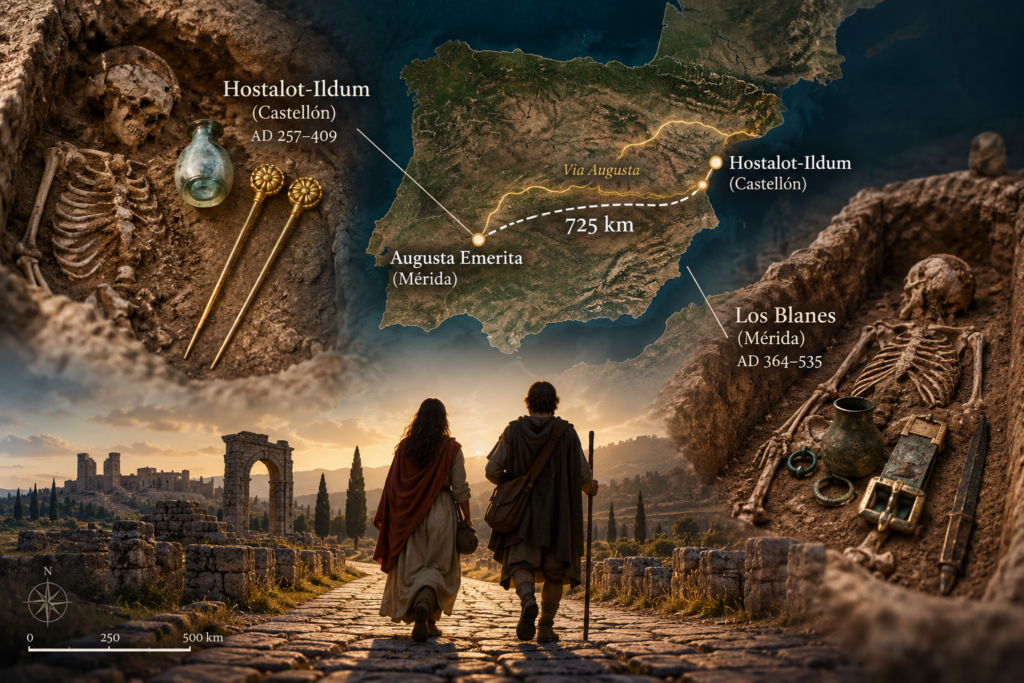
A woman died in late Roman Hispania and was buried beside the Via Augusta, one of the empire’s major roads. Her grave contained a glass vessel and two gold pins associated with traditions from the Danube and Black Sea regions. Hundreds of kilometers away, in the ancient city of Augusta Emerita, another burial held the remains of her brother.
For more than 1,600 years, their family connection remained hidden, preserved only in the remains they left behind. Buried hundreds of kilometers apart, the brother and sister might never have been linked again. But centuries after their deaths, ancient DNA finally revealed the bond that neither distance nor time had erased.
Their story is one of the most striking discoveries in a new study published in the journal Cell, which examines how migration shaped the Iberian Peninsula under Roman rule and during the centuries that followed.
Two Siblings Connected by Ancient DNA
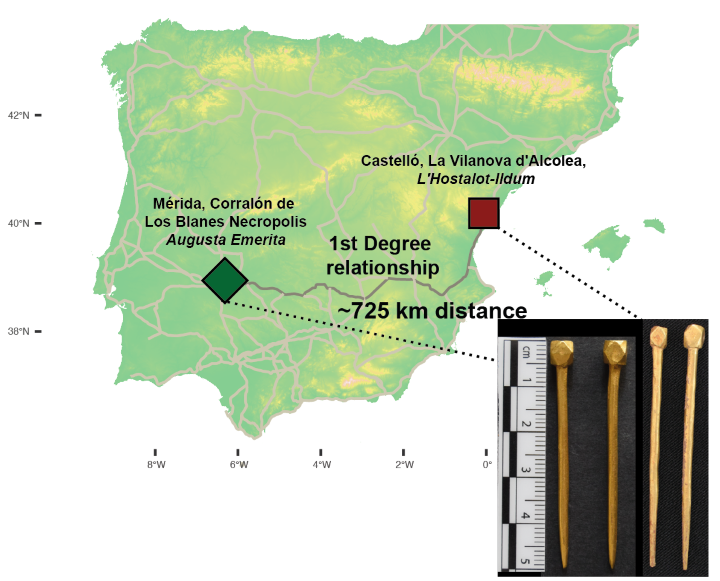
Researchers identified the brother at the Los Blanes cemetery in Augusta Emerita, modern-day Mérida in western Spain. His remains date to between AD 364 and 535. His sister was buried at Hostalot-Ildum, a roadside complex along the Via Augusta in northeastern Spain, where her burial dates to between AD 257 and 409.
Genetic analysis established their sibling relationship and revealed that both had ancestry closely associated with Central and Northern European populations. The researchers suggest they may have belonged to the first generation of migrants arriving in the Iberian Peninsula during a period of profound political change.
The woman’s burial provides an especially revealing archaeological context. Its gold pins, associated with Danubian-Pontic traditions, resemble objects recovered at Los Blanes, suggesting cultural connections between communities separated by considerable distances.
According to the study, the siblings represent the greatest geographical separation yet documented between first-degree relatives in the ancient DNA record.
Their relationship also raises questions that archaeology cannot yet answer. Did they travel together before taking different paths, or did they become separated during a wider movement of people into Hispania?
The researchers suggest that the woman may have died during a southward migration while her brother continued toward Augusta Emerita. However, their precise movements remain unknown, and the available evidence cannot establish whether they traveled together.
A Journey Across the Roman Empire
The Roman road network may have played a crucial role in the siblings’ movements across Hispania. Researchers estimate that traveling between their burial sites would have taken approximately 24 days on foot or 14 days on horseback. The woman’s burial near a roadside hospitality complex suggests that the infrastructure built under Roman rule continued to serve travelers even as imperial authority weakened.
This mobility was particularly important during the fifth century, when Suebi, Vandals, Alans, and Visigoths entered the Iberian Peninsula and established new centers of political power.
Yet the siblings’ story represents only one part of a much larger demographic picture. Their genetic connection helps illustrate the movement of individuals across Hispania, while the wider study reveals how different migration waves affected the peninsula’s population.
Roman Rule Transformed Iberia’s Genetic Landscape
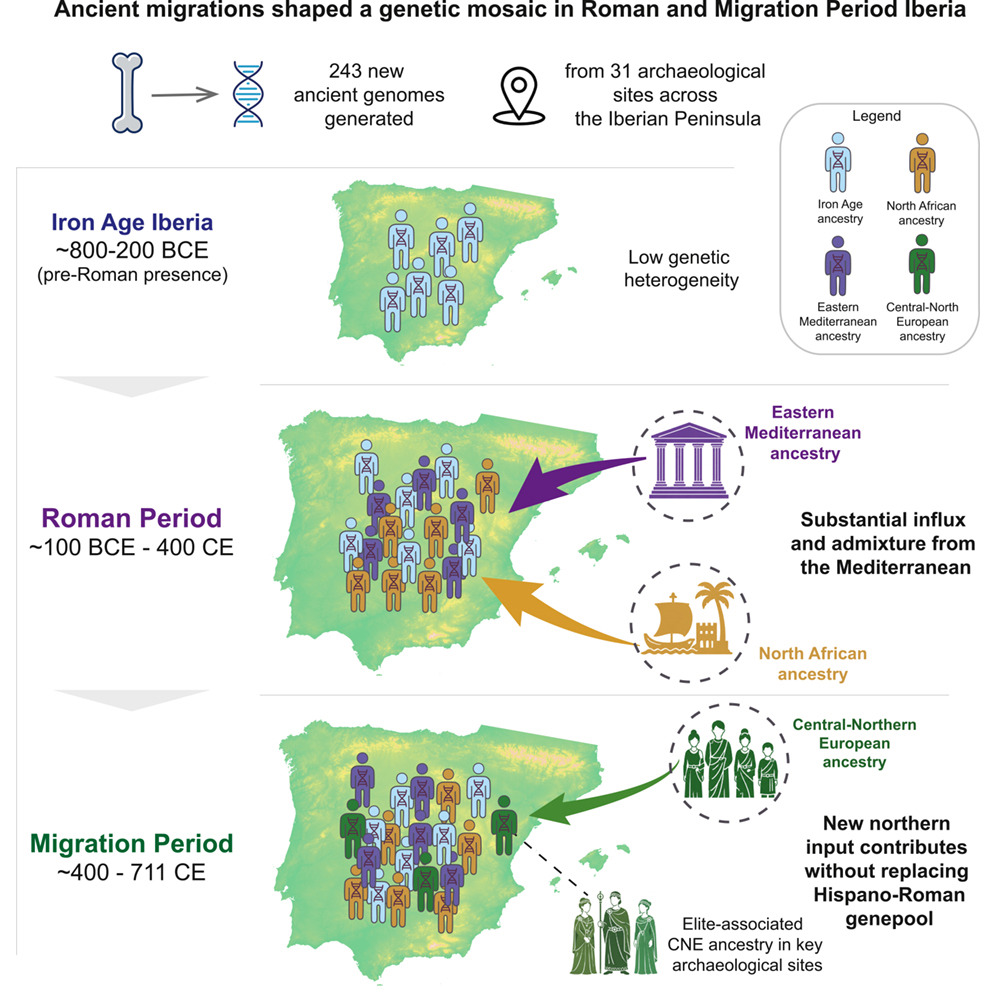
The international research team, led by Pablo Carrión and colleagues, generated genetic data from 243 ancient individuals recovered from 31 archaeological sites across the Iberian Peninsula. The researchers compared these results with previously published ancient genomes to investigate population changes between approximately AD 100 and 800.
Their findings reveal that Roman rule brought substantial genetic diversity to Hispania through migration from the Eastern Mediterranean and North Africa.
Among 66 Roman-period individuals examined in one ancestry analysis, 55 carried genetic ancestry associated with the Eastern Mediterranean. The researchers identified particularly strong connections with populations resembling those of Roman and Byzantine western Anatolia, including regions associated with ancient cities such as Ephesus, Pergamon, and Smyrna.
North African ancestry also became widespread, particularly in southern and central Iberia. In a group of 34 Roman-period individuals from southeastern sites, researchers identified this ancestry in 33, revealing extensive connections across the western Mediterranean.
These findings suggest that Roman Hispania was far more genetically diverse than its pre-Roman population. Trade, imperial administration, military activity, and the movement of people connected the peninsula with distant parts of the Mediterranean world.
One particularly revealing example comes from the early Christian cemetery at Cortijo Coracho, near Lucena. Researchers reconstructed a family network spanning four generations and identified ancestry associated with local Iberian, Eastern Mediterranean, and North African populations within the community.
The discovery provides evidence of the close demographic connections between North Africa and southern Hispania during the spread of early Christianity, although genetic evidence alone cannot establish how religious beliefs traveled.
Germanic Rulers Arrived, but the Population Remained
The study also challenges the assumption that the arrival of Germanic kingdoms necessarily produced large-scale population replacement.
Following the weakening of Roman authority, new political powers emerged across the Iberian Peninsula. The Suebi established a kingdom in the northwest, while the Visigoths eventually controlled much of the region.
Genetic evidence confirms that migrants carrying Central and Northern European-related ancestry reached Hispania. Researchers detected this ancestry in 53 of 164 individuals from the migration period, particularly at archaeological sites associated with Germanic material culture and higher-status burials.
However, the broader Hispano-Roman population remained largely continuous. Migrants and established communities lived alongside one another, and genetic evidence indicates that intermarriage gradually brought their ancestry together.
This pattern contrasts with developments in Britain after Roman rule, where previous genetic studies have documented much more extensive demographic changes.
The researchers therefore conclude that political control and population replacement did not necessarily go hand in hand. In Iberia, the genetic transformation associated with Roman imperial connections was more extensive than the changes accompanying the rise of Germanic kingdoms.
The authors nevertheless acknowledge important gaps in the archaeological record, particularly for the Iron Age, the Roman Republican period, and northern Iberia. These limitations mean that further ancient DNA research will be necessary to reconstruct the peninsula’s complete demographic history.
Institut de Biologia Evolutiva (IBE)
Carrión, P., Olalde, I., et al. (2026). Contrasting demographic impacts of Roman colonization and early medieval migrations in the Iberian Peninsula. Cell. https://doi.org/10.1016/j.cell.2026.09.052
