
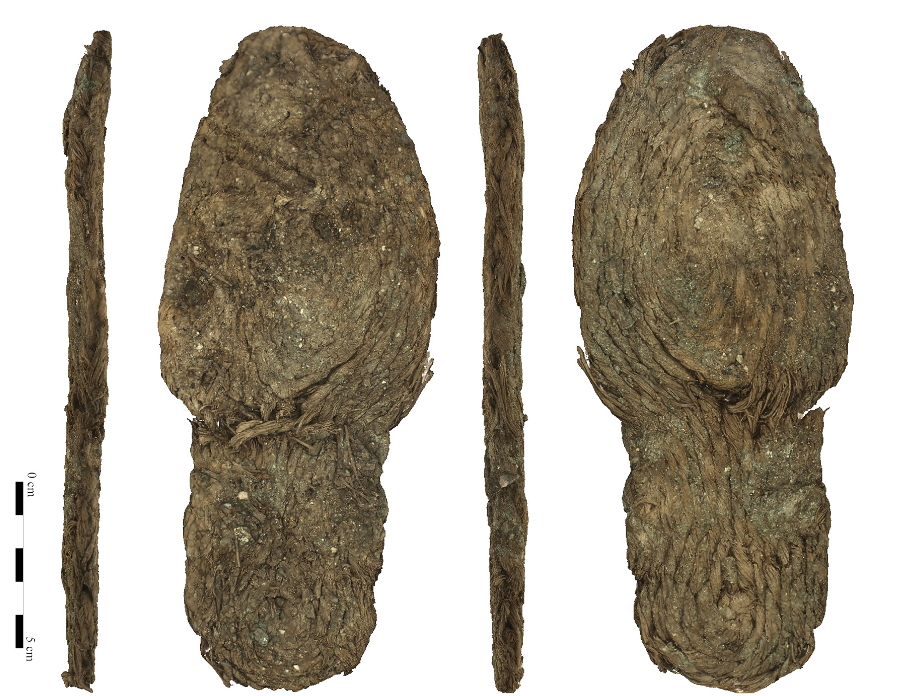
Archaeologists examining the ancient mining settlement of Urium in southwestern Spain have documented eight remarkably preserved sandal soles woven from esparto grass. Radiocarbon dating indicates that some of the footwear may have been made more than 2,300 years ago, before Rome gained control of the region.
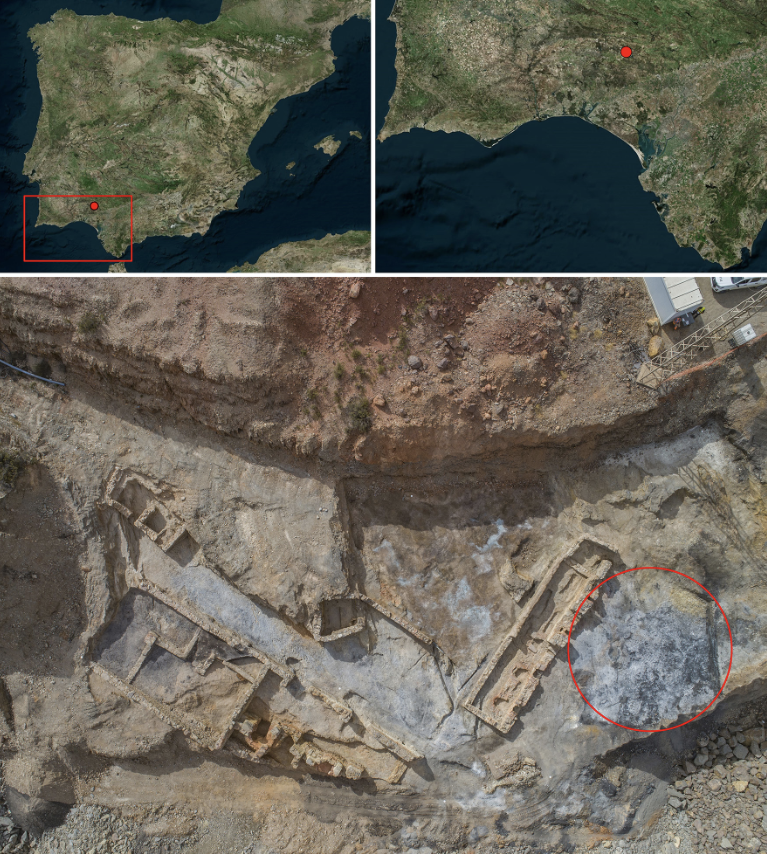
The finds come from the Nuevo Filón Norte 1 sector at Riotinto in Huelva, one of the Iberian Peninsula’s most important historic mining districts. Their analysis was published in the journal Pyrenae by Macarena Bustamante-Álvarez, Ana Pajuelo Pando, Alberto Dorado Alejos and María Auxiliadora Lobo Torres.
Sandals discarded beside an ancient metalworking workshop
Excavations at Nuevo Filón Norte 1 uncovered a metallurgical workshop dating to the middle of the first century AD. The complex contained ten furnaces, four open working areas and sixteen rooms whose precise functions remain uncertain.
The sandals were recovered from two ash deposits in separate courtyards. These areas had been used to discard material removed while cleaning the furnaces, together with broken or worn-out objects from everyday life.
The ash-rich sediment helped stabilize organic materials that would normally have decayed. In addition to the footwear, archaeologists found baskets and ropes made from similar plant fibres.
Although the soles survived in relatively good condition, they had already reached the end of their working lives when thrown away. Most had lost the cords that once secured them to the foot, while heavy wear had damaged the forefoot and distorted the structure of the woven soles.
Radiocarbon dates reach back to the Iron Age
Three sandals were selected for radiocarbon dating, producing unexpectedly different results.
One sample was dated to the early Roman period, most probably between AD 28 and 124. A second belonged to the late Iron Age, with a calibrated range of 360–205 BC, while the third was dated broadly between 175 and 56 BC.
Taken together, the results suggest repeated activity at Urium between approximately 382 BC and AD 201. However, the researchers caution that the two older sandals may have been moved from earlier deposits when soil was disturbed during later Roman construction or waste disposal. Only the Roman-period example appears contemporary with the formation of the furnace dump.
The dates nevertheless show that esparto footwear was being used around Riotinto long before the region became fully integrated into the Roman imperial economy.
Ancient footwear engineered for strength and flexibility
Microscopic examination identified the material as Stipa tenacissima, the tough grass commonly known as esparto. Its characteristic parallel fibre bundles, grooved surfaces and vascular channels allowed researchers to distinguish it from other textile plants such as flax and hemp.
Most of the grass appears to have been used raw rather than softened through prolonged soaking. Craftspeople first produced narrow, flat braids and then wound them repeatedly to form the outline and body of each sole. Additional cords were passed through the structure to hold the layers together.
The researchers identified both thick, highly regular cords and much finer strands. The strongest fibres were positioned in load-bearing sections of the footwear, while thinner and more flexible cords were used for bindings, joins and areas that needed to move with the foot.
Statistical analysis found that some cords were produced with an almost standardized degree of regularity. Others varied more considerably, reflecting the natural properties of the plant or their less demanding structural role. The combination was not accidental: it reveals deliberate planning and a detailed understanding of how esparto behaved under pressure.
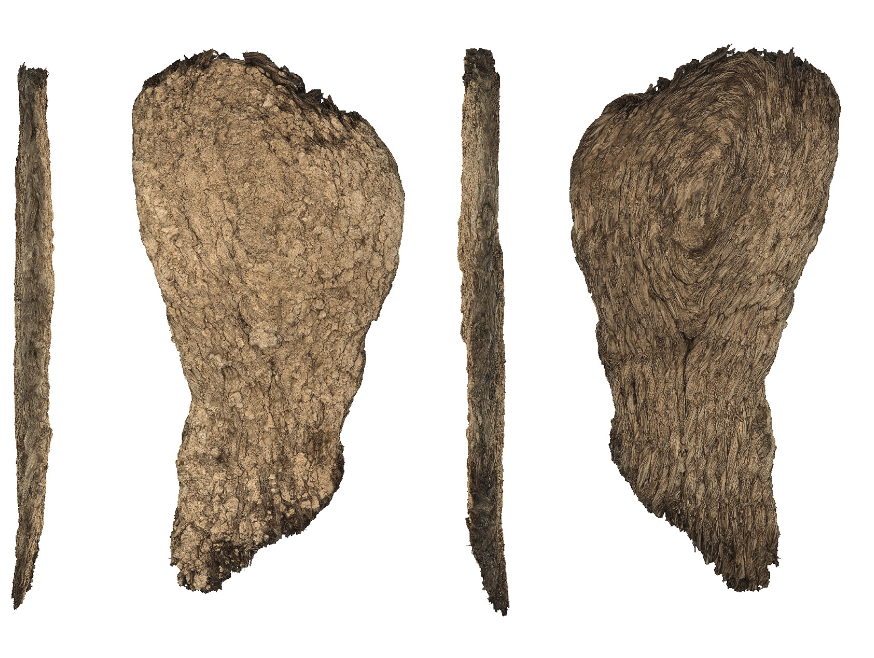
Because the ancient footwear is fragile, the team created three-dimensional digital models that could be examined without repeatedly handling the originals. High-resolution micro-CT imaging also revealed the internal arrangement of the braided fibres, compacted areas, mineral deposits and microscopic fractures hidden inside the soles.
Different sizes and possibly different workshops
The surviving sandals range from about 17 to 25 centimetres in length. Researchers divided them into small, medium and large groups. Four could be identified as left-foot sandals and two as right-foot examples, while the remaining pieces were too damaged to determine.
Archaeometric results also separated the footwear into two morphological groups corresponding to the two archaeological deposits. The differences might indicate production in separate workshops, the use of esparto collected from different areas or sandals manufactured during different periods.
Despite these variations, the underlying construction method remained notably consistent. Robust cords were repeatedly selected for vulnerable parts of the sole, while more flexible fibres were placed where movement was required. The authors describe the sandals as carefully planned products made by craftspeople with considerable technical skill.
Rare evidence of everyday life at Riotinto
Plant-fibre footwear rarely survives in the archaeological record. Comparable sandals have been found at ancient mining centres such as Aljustrel, Mazarrón and the Sierra de Almagrera, as well as in exceptionally preserved contexts in Egypt, Herculaneum and the Vesuvian region.
The Riotinto group is particularly important because eight examples were recovered from the same industrial setting. Their worn surfaces, missing straps and mud-covered undersides preserve direct evidence of objects used until they could no longer be repaired.
Rather than luxury goods or ceremonial objects, the sandals belonged to the practical equipment of people living and working around one of the ancient Mediterranean’s major mining landscapes. Their survival offers an unusually close look at the materials, technical choices, and daily routines behind metal production at Urium.
Bustamante-Álvarez, M., Pajuelo Pando, A., Dorado Alejos, A., & Lobo Torres, M. A. (2026). Nuevos ejemplares de calzado en esparto en contexto minero: Excavaciones del sector «Nuevo Filón Norte 1» en Urium (Riotinto, Huelva). Pyrenae, 57(2), 79–113. https://doi.org/10.1344/Pyrenae2026.vol57num2.4
